Penn South · Property and capacity
Through-Running at Penn. Keep the Blocks.
Before New York acquires the blocks south of Penn Station, the railroads should demonstrate why those properties are necessary to meet the region’s service goals.

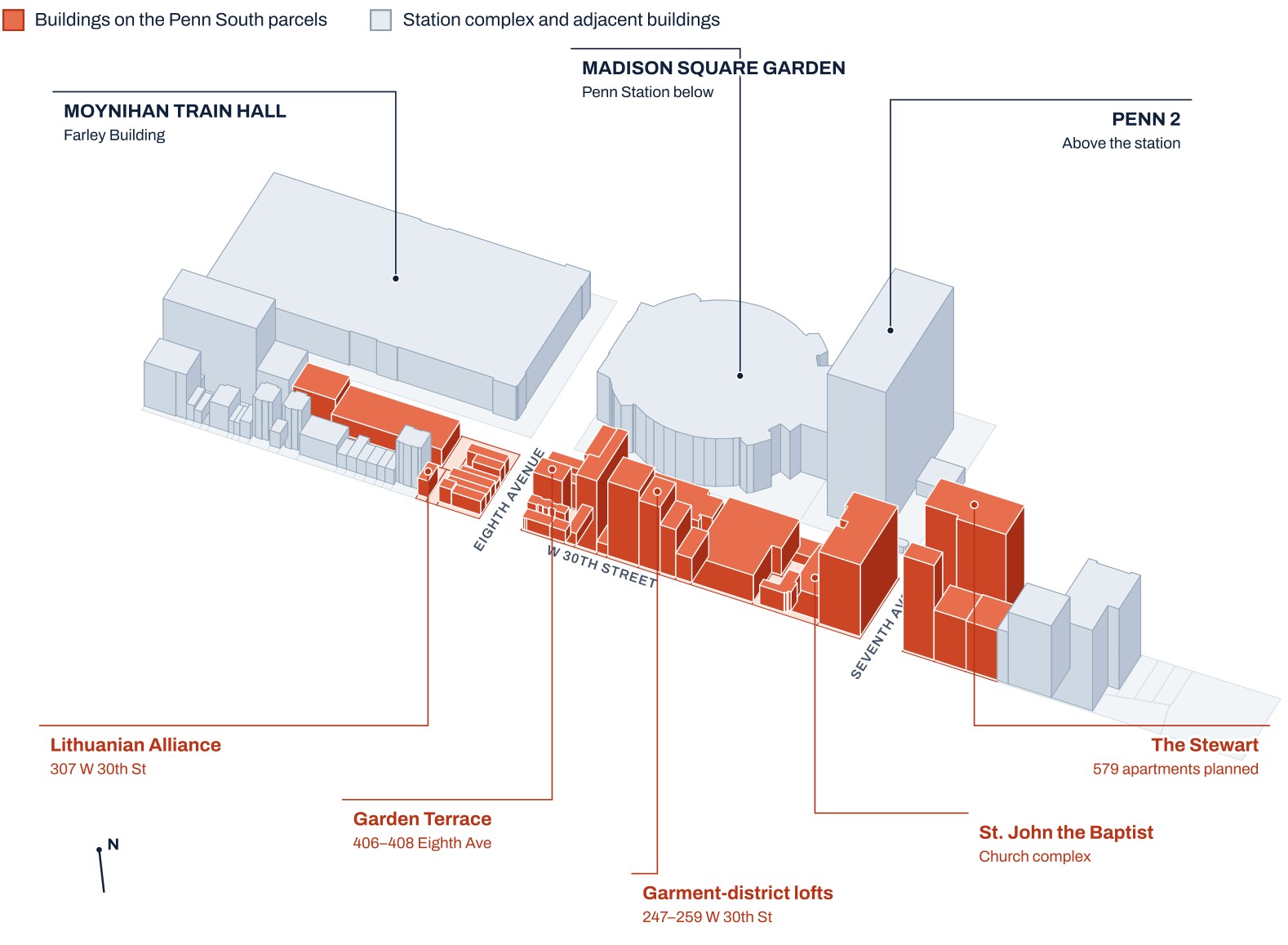
The decision connects two questions that belong together: how many trains Penn can reliably handle, and what the public would lose and pay to build additional tracks outside the station.
What the acquisition footprint contains
Empire State Development’s 2022 modified General Project Plan identifies Sites 1–3 for a possible southern expansion, covering all of Block 780 and portions of Blocks 754 and 806. This report maps 39 parcels within that footprint, grouping the Garden Terrace condominium property as one parcel. The sites contain homes, commercial buildings, a church complex and a planned supportive-housing conversion.
Source: Modified General Project Plan. Acquisition follows federal site selection; condemnation requires separate authorization.
The property inventory records approximately 2.1 million square feet of building floor area. The Stewart Hotel’s planned conversion would create 579 affordable and supportive apartments, with about half reserved for formerly homeless adults. The acquisition financing has closed, according to the Low Income Investment Fund’s project announcement.
Establish the need before acquiring the land
The railroads’ 2024 feasibility study assessed alternatives within Penn’s existing footprint against a minimum requirement of 48 peak-direction trans-Hudson trains per hour. Its evaluated through-running concepts failed the study’s criteria, and it assigned expansion alternatives to a separate, future analysis. A defined southern expansion still needs its own operating case.
Source: 2024 feasibility study executive summary.
FRA’s subsequent Phase I study identified a path to increased service within the existing station: platform and circulation improvements, shorter dwell times and limited through-running. Its modeled result reaches 32 peak-direction trans-Hudson trains per hour in the morning and 30 in the evening, with completed Gateway infrastructure. Phase II will examine further regional operating and infrastructure changes. A reliable 48-train alternative within the existing footprint still requires validation.
Sources: FRA Phase I report and Phase II scope. See also Penn Station’s next capacity gains.
The next decision should rest on published operating tests using common service, reliability and construction assumptions. Those tests should compare a defined expansion plan with alternatives inside Penn, including the infrastructure and operating agreements each would require. Acquisition appraisals, relocation and demolition costs belong in the same comparison.
Until necessity is established, the state should remove Sites 1–3 from its acquisition provisions and require fresh public justification for any future proposal.
Read the full report
The October 2026 report brings together the parcel map, building inventory, recorded property transactions, capacity comparisons and 41 source notes.