How Will We Straighten Out The Tri-State Transport Mess?
Source pages
Source page 1
Source page 2
Source page 3
Source page 4
Source page 5
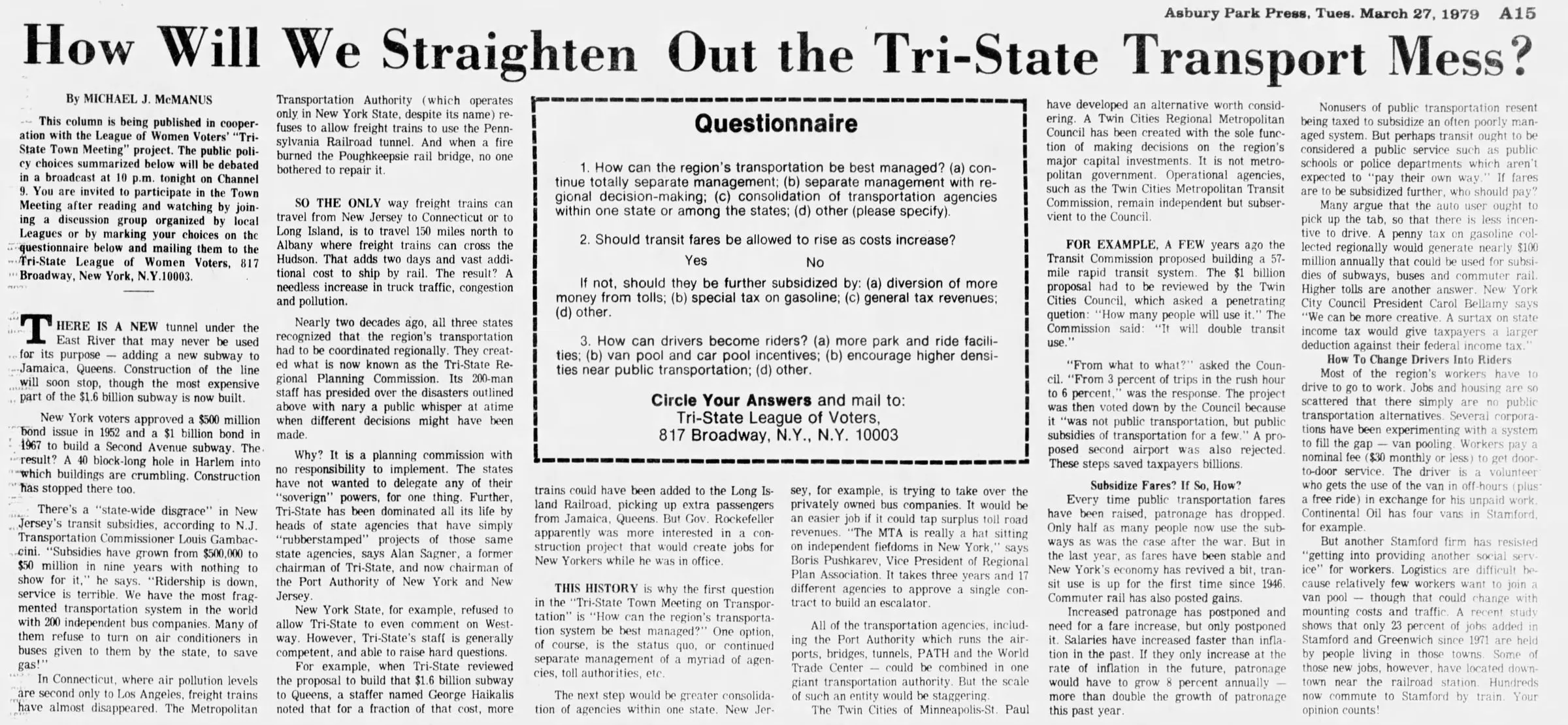
Transcription
Transcriptions may contain errors. Consult the source pages for the original wording and layout.
By MICHAEL J. McMANUS
This column is being published in cooperation with the League of Women Voters' "Tri-State Town Meeting" project. The public policy choices summarized below will be debated in a broadcast at 10 p.m. tonight on Channel 9. You are invited to participate in the Town Meeting after reading and watching by joining a discussion group organized by local Leagues or by marking your choices on the questionnaire below and mailing them to the Tri-State League of Women Voters, 817 Broadway, New York, N.Y. 10003.
THERE IS A NEW tunnel under the East River that may never be used for its purpose — adding a new subway to Jamaica, Queens. Construction of the line will soon stop, though the most expensive part of the $1.6 billion subway is now built.
New York voters approved a $500 million bond issue in 1952 and a $1 billion bond in 1967 to build a Second Avenue subway. The result? A 40 block-long hole in Harlem into which buildings are crumbling. Construction has stopped there too.
There’s a "state-wide disgrace" in New Jersey’s transit subsidies, according to N.J. Transportation Commissioner Louis Gambaccini. "Subsidies have grown from $500,000 to $50 million in nine years with nothing to show for it," he says. "Ridership is down, service is terrible. We have the most fragmented transportation system in the world with 200 independent bus companies. Many of them refuse to turn on air conditioners in buses given to them by the state, to save gas!"
In Connecticut, where air pollution levels are second only to Los Angeles, freight trains have almost disappeared. The Metropolitan Transportation Authority (which operates only in New York State, despite its name) refuses to allow freight trains to use the Pennsylvania Railroad tunnel. And when a fire burned the Poughkeepsie rail bridge, no one bothered to repair it.
SO THE ONLY way freight trains can travel from New Jersey to Connecticut or to Long Island, is to travel 150 miles north to Albany where freight trains can cross the Hudson. That adds two days and vast additional costs to ship by rail. The result? A needless increase in truck traffic, congestion and pollution.
Nearly two decades ago, all three states recognized that the region’s transportation had to be coordinated regionally. They created what is now known as the Tri-State Regional Planning Commission. Its 200-man staff has presided over the disasters outlined above with nary a public whisper at time when different decisions might have been made.
Why? It is a planning commission with no responsibility to implement. The states have not wanted to delegate any of their "sovereign" powers, for one thing. Further, Tri-State has been dominated all its life by heads of state agencies that have simply "rubberstamped" projects of those same state agencies, says Alan Sagner, a former chairman of Tri-State, and now chairman of the Port Authority of New York and New Jersey.
New York State, for example, refused to allow Tri-State to even comment on Westway. However, Tri-State’s staff is generally competent, and able to raise hard questions.
For example, when Tri-State reviewed the proposal to build that $1.6 billion subway in Queens, a staffer named George Haikalis noted that far more capacity for trains could have been added to the Long Island Railroad, picking up extra passengers from Jamaica, Queens. But Gov. Rockefeller apparently was more interested in a construction project that would create jobs for New Yorkers while he was in office.
THIS HISTORY is why the first question in the “Tri-State Town Meeting on Transportation” is “How can the region’s transportation system be best managed?” One option, of course, is the status quo, or continued separate management of a myriad of agencies, toll authorities, etc.
The next step would be greater consolidation of agencies within one state. New Jersey, for example, is trying to take over the privately owned bus companies. It would be an easier job if it could tap surplus toll road revenues. “The MTA is really a hat sitting on independent fiefdoms in New York,” says Boris Pushkarev, Vice President of Regional Plan Association. “It takes three years and 17 different agencies to approve a single contract to build an escalator.”
All of the transportation agencies, including the Port Authority which runs the airports, bridges, tunnels, PATH and the World Trade Center — could be combined in one giant transportation authority. But the scale of such an entity would be staggering.
The Twin Cities of Minneapolis-St. Paul have developed an alternative worth considering. A Twin Cities Regional Metropolitan Council has been created with the sole function of making decisions on the region’s major capital investments. It is not metropolitan government. Operational agencies, such as the Twin Cities Metropolitan Transit Commission, remain independent but subservient to the Council.
FOR EXAMPLE, A FEW years ago the Transit Commission proposed building a 57-mile rapid transit system. The $1 billion proposal had to be reviewed by the Twin Cities Council, which asked a penetrating question: “How many people will use it.” The Commission said: “It will double transit use.”
“From what to what?” asked the Council. “From 3 percent of trips in the rush hour to 6 percent,” was the response. The project was then voted down by the Council because it “was not public transportation, but public subsidies of transportation for a few.” A proposed second airport was also rejected. These steps saved taxpayers billions.
Subsidize Fares? If So, How?
Every time public transportation fares have been raised, patronage has dropped. Only half as many people now use the subways as was the case after the war. But in the last year, as fares have been stable and New York’s economy has revived a bit, transit use is up for the first time since 1946. Commuter rail has also posted gains.
Increased patronage has postponed and need for a fare increase, but only postponed it. Salaries have increased faster than inflation in the past. If they only increase at the rate of inflation in the future, patronage would have to grow 8 percent annually—more than double the growth of patronage this past year.
Nonusers of public transportation resent being taxed to subsidize an often poorly managed system. But perhaps transit ought to be considered a public service such as public schools or police departments which aren’t expected to “pay their own way.” If fares are to be subsidized further, who should pay?
Many argue that the auto user ought to pick up the tab, so that there is less incentive to drive. A penny tax on gasoline collected regionally would generate nearly $100 million annually that could be used for subsidies of subways, buses and commuter rail. Higher tolls are another answer. New York City Council President Carol Bellamy says “We can be more creative. A surtax on state income tax would give taxpayers a larger deduction against their federal income tax.”
How To Change Drivers Into Riders
Most of the region’s workers have to drive to go to work. Jobs and housing are so scattered that there simply are no public transportation alternatives. Several corporations have been experimenting with a system to fill the gap — van pooling. Workers pay a nominal fee ($30 monthly or less) to get door-to-door service. The driver is a volunteer who gets the use of the van in off-hours (plus a free ride) in exchange for his unpaid work. Continental Oil has four vans in Stamford, for example.
But another Stamford firm has resisted “getting into providing another social service” for workers. Logistics are difficult because relatively few workers want to join a van pool—though that could change with mounting costs and traffic. A recent study shows that only 23 percent of jobs added in Stamford and Greenwich since 1971 are held by people living in those towns. Some of those new jobs, however, have located downtown near the railroad station. Hundreds now commute to Stamford by train. Your opinion counts!
Questionnaire
1. How can the region’s transportation be best managed?
(a) continue totally separate management;
(b) separate management with regional decision-making;
(c) consolidation of transportation agencies within one state or among the states;
(d) other (please specify).
2. Should transit fares be allowed to rise as costs increase?
□ Yes
□ No
If not, should they be further subsidized by:
(a) diversion of more money from tolls;
(b) special tax on gasoline;
(c) general tax revenues;
(d) other.
3. How can drivers become riders?
(a) more park and ride facilities;
(b) van pool and car pool incentives;
(c) encourage higher densities near public transportation;
(d) other.