Port Authority is Best Agency for Mass Transit
Source page
Source page 1
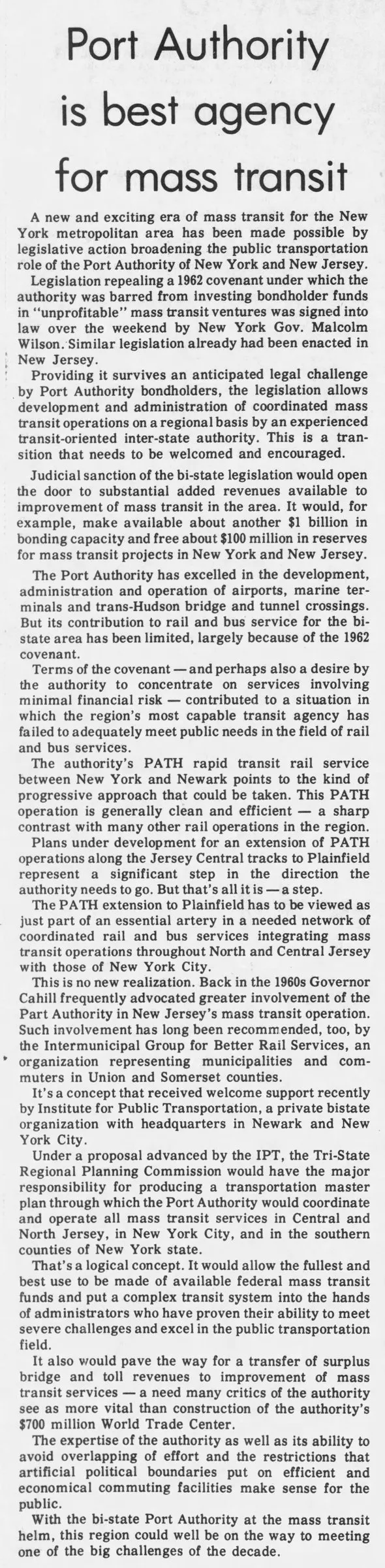
Transcription
Transcriptions may contain errors. Consult the source pages for the original wording and layout.
A new and exciting era of mass transit for the New York metropolitan area has been made possible by legislative action broadening the public transportation role of the Port Authority of New York and New Jersey.
Legislation repealing a 1962 covenant under which the authority was barred from investing bondholder funds in “unprofitable” mass transit ventures was signed into law over the weekend by New York Gov. Malcolm Wilson. Similar legislation already had been enacted in New Jersey.
Providing it survives an anticipated legal challenge by Port Authority bondholders, the legislation allows development and administration of coordinated mass transit operations on a regional basis by an experienced transit-oriented inter-state authority. This is a transition that needs to be welcomed and encouraged.
Judicial sanction of the bi-state legislation would open the door to substantial added revenues available to improvement of mass transit in the area. It would, for example, make available about another $1 billion in bonding capacity and free about $100 million in reserves for mass transit projects in New York and New Jersey.
The Port Authority has excelled in the development, administration and operation of airports, marine terminals and trans-Hudson bridge and tunnel crossings. But its contribution to rail and bus service for the bi-state area has been limited, largely because of the 1962 covenant.
Terms of the covenant — and perhaps also a desire by the authority to concentrate on services involving minimal financial risk — contributed to a situation in which the region’s most capable transit agency has failed to adequately meet public needs in the field of rail and bus services.
The authority’s PATH rapid transit rail service between New York and Newark points to the kind of progressive approach that could be taken. This PATH operation is generally clean and efficient — a sharp contrast with many other rail operations in the region.
Plans under development for an extension of PATH operations along the Jersey Central tracks to Plainfield represent a significant step in the direction the authority needs to go. But that’s all it is — a step.
The PATH extension to Plainfield has to be viewed as just part of an essential artery in a needed network of coordinated rail and bus services integrating mass transit operations throughout North and Central Jersey with those of New York City.
This is no new realization. Back in the 1960s Governor Cahill frequently advocated greater involvement of the Part Authority in New Jersey’s mass transit operation. Such involvement has long been recommended, too, by the Intermunicipal Group for Better Rail Services, an organization representing municipalities and commuters in Union and Somerset counties.
It’s a concept that received welcome support recently by Institute for Public Transportation, a private bistate organization with headquarters in Newark and New York City.
Under a proposal advanced by the IPT, the Tri-State Regional Planning Commission would have the main responsibility for producing a transportation master plan through which the Port Authority would coordinate and operate all mass transit services in Central and North Jersey, in New York City, and in the southern counties of New York state.
That’s a logical concept. It would allow the fullest and best use to be made of available federal mass transit funds and put a complex transit system into the hands of administrators who have proven their ability to meet severe challenges and excel in the public transportation field.
It also would pave the way for a transfer of surplus bridge and toll revenues to improvement of mass transit services — a need many critics of the authority see as more vital than construction of the authority’s $700 million World Trade Center.
The expertise of the authority as well as its ability to avoid overlapping of effort and the restrictions that artificial political boundaries put on efficient and economical commuting facilities make sense for the public.
With the bi-state Port Authority at the mass transit helm, this region could well be on the way to meeting one of the big challenges of the decade.