‘Revolutionary’ Plan to Debut Tuesday: Institute Puts P.A. at Tri-State Transit Helm
The Star-Ledger
Source pages
Source page 1
Source page 2
Source page 3

Transcription
Transcriptions may contain errors. Consult the source pages for the original wording and layout.
The Port Authority would become the chief mass transit operating agency in the New York-New Jersey-Connecticut metropolitan region under a proposal drafted by the Institute for Public Transportation.
A “revolutionary approach” to transportation planning and developments in the metropolitan area will be unveiled by the Institute at a meeting of the continuing Transportation Forum, scheduled for 9:30 a.m. Tuesday at the Automation House in Manhattan.
Under the IPT proposal, the Tri-State Regional Planning Commission would have the major responsibility for producing a detailed Transportation Master Plan based on a long-range land-use development program for the region.
The Port Authority of New York and New Jersey would be expanded to assume a new role as the “single service agency” coordinating regional transportation services.
In developing the master plan, Tri-State would work with subregional planning units, community groups and the transit operating agencies to encourage maximum participation.
The operating agencies, according to the proposal, would play a secondary role and would not have the final decision-making authority.
“This would end the present practice of transit authorities writing their own plans,” explained Dr. Robert N. Rickles, executive director of the Institute, a private, non-profit, bistate organization with headquarters in Newark and New York City.
Rickles described the plan as a “revolutionary approach” towards solving the metropolitan region’s awesome mass transit problems.
The Forum is sponsored by the Regional Plan Association; the Authority for Coordinating Transportation, headed by labor negotiator Theodore Kheel; the City Club of New York, the New York Citizens for Clean Air, and IPT, which is sponsored by the New York Community Trust, the J.M. Kaplan Fund and several other foundations.
For long-range planning purposes, the Metropolitan Region Plan would be divided into four subregional transit districts:
* Northern New Jersey
(Bergen, Passaic, Morris, Essex, Hudson, Union, Somerset, Middlesex and Monmouth counties.)
* New York City.
* Nassau and Suffolk counties.
* Westchester, Rockland and Fairfield counties.
A special transit district would be established in each subregion to serve as Tri-State Regional Planning Commission Coordinator.
Members of the transit districts would be appointed by the county, borough and city executives from planning boards, county transportation boards, civic and community groups.
These transit districts would have the mandatory authority to raise revenues for transit planning and operations in their district through whatever appropriate taxing means they decide, up to a limit established by the state legislatures. This financing approach is similar to that of school, water and other special districts throughout the county.
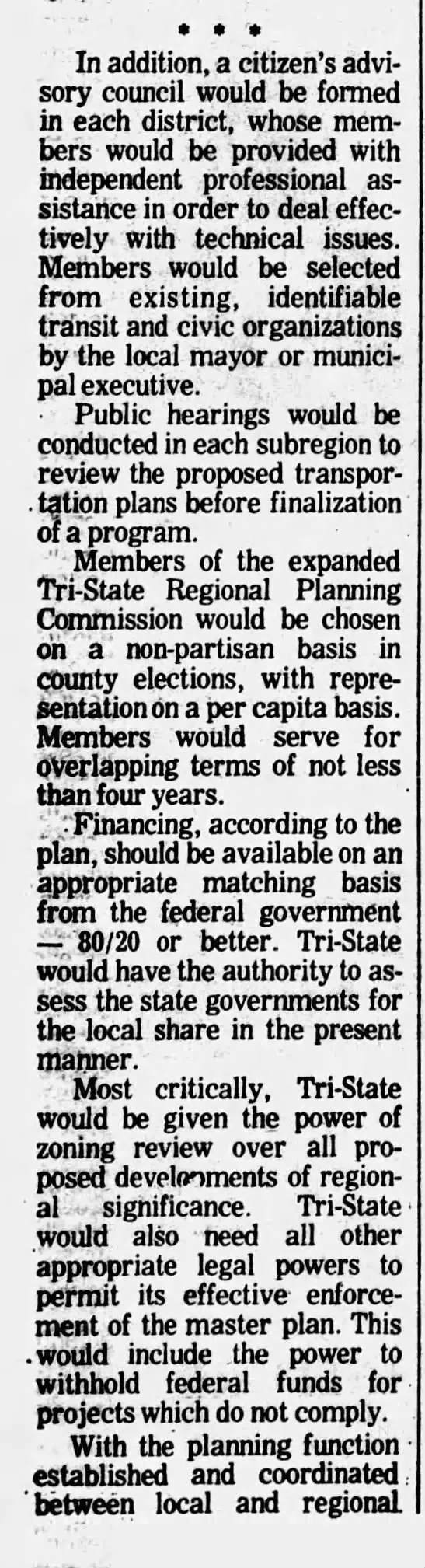
In addition, a citizen’s advisory council would be formed in each district, whose members would be provided with independent professional assistance in order to deal effectively with technical issues. Members would be selected from existing, identifiable transit and civic organizations by the local mayor or municipal executive.
Public hearings would be conducted in each subregion to review the proposed transportation plans before finalization of a program.
Members of the expanded Tri-State Regional Planning Commission would be chosen on a non-partisan basis in county elections, with representation on a per capita basis. Members would serve for overlapping terms of not less than four years.
Financing, according to the plan, should be available on an appropriate matching basis from the federal government—80/20 or better. Tri-State would have the authority to assess the state governments for the local share in the present manner.
Most critically, Tri-State would be given the power of zoning review over all proposed developments of regional significance. Tri-State would also need all other appropriate legal powers to permit its effective enforcement of the master plan. This would include the power to withhold federal funds for projects which do not comply.
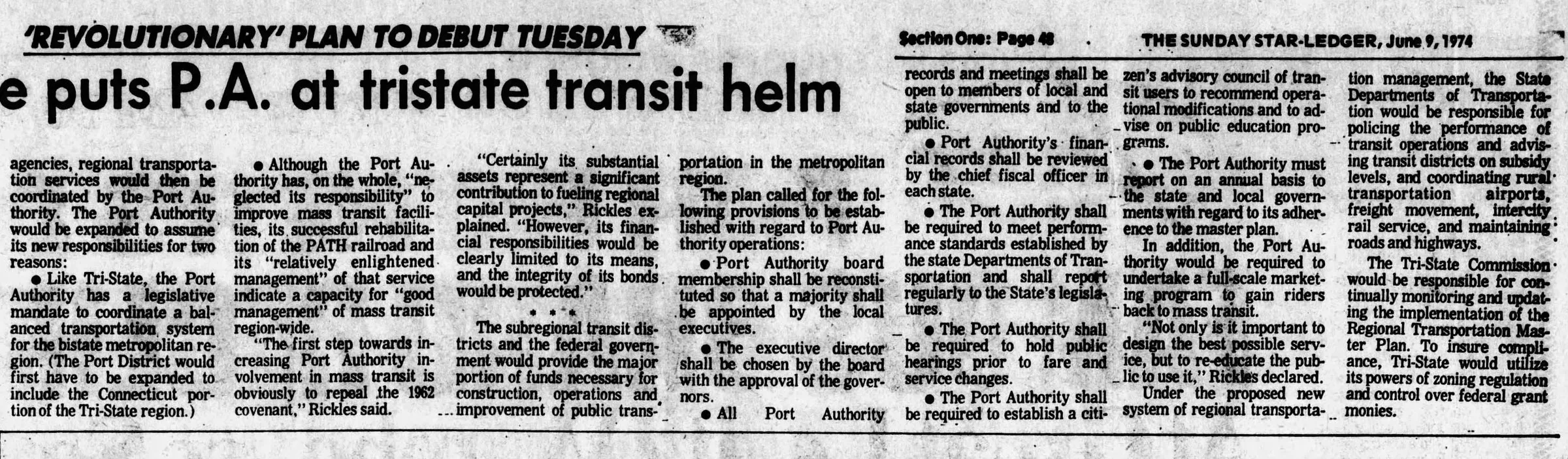
With the planning function established and coordinated between local and regional agencies, regional transportation services would then be coordinated by the Port Authority. The Port Authority would be expanded to assume its new responsibilities for two reasons:
* Like Tri-State, the Port Authority has a legislative mandate to coordinate a balanced transportation system for the bistate metropolitan region. (The Port District would first have to be expanded to include the Connecticut portion of the Tri-State region.)
* Although the Port Authority has, on the whole, “neglected its responsibility” to improve mass transit facilities, its successful rehabilitation of the PATH railroad and its “relatively enlightened management” of that service indicate a capacity for “good management” of mass transit region-wide.
“The first step towards increasing Port Authority involvement in mass transit is obviously to repeal the 1962 covenant,” Rickles said.
“Certainly its substantial assets represent a significant contribution to fueling regional capital projects,” Rickles explained. “However, its financial responsibilities would be clearly limited to its means, and the integrity of its bonds would be protected.”
The subregional transit districts and the federal government would provide the major portion of funds necessary for construction, operations and improvement of public transportation in the metropolitan region.
The plan called for the following provisions to be established with regard to Port Authority operations:
* Port Authority board membership shall be reconstituted so that a majority shall be appointed by the local executives.
* The executive director shall be chosen by the board with approval of the governors.
* All Port Authority records and meetings shall be open to members of local and state governments and to the public.
* Port Authority’s financial records shall be reviewed by the chief fiscal officer in each state.
* The Port Authority shall be required to meet performance standards established by the state Departments of Transportation and shall report regularly to the State’s legislatures.
* The Port Authority shall be required to hold public hearings prior to fare and service changes.
* The Port Authority shall be required to establish a citizen’s advisory council of transit users to recommend operational modifications and to advise on public education programs.
* The Port Authority must report on an annual basis to state and local governments with regard to its adherence to the master plan.
* In addition, the Port Authority would be required to undertake a full-scale marketing program to gain riders for mass transit.
“Not only is it important to design the best possible service, but we need to re-educate the public to use it,” Rickles declared.
Under the proposed new system of regional transportation management, the State Departments of Transportation would be responsible for policing the performance of transit operations and advising transit districts on subsidy levels, and coordinating rural transportation, airports, freight movement, intercity rail service, and maintaining roads and highways.
The Tri-State Commission would be responsible for continually monitoring and updating the implementation of the Regional Transportation Master Plan. To insure compliance, Tri-State would utilize its powers of zoning regulation and control over federal grant monies.
Other editions
- Revolutionary Plan to Debut Tuesday: Institute Puts P.A. at Tri-State Transit Helm · The Star-Ledger · June 9, 1974 · Page 48