Integrated Commuter Rail System Plotted
Source pages
Source page 1
Source page 2
Transcription
Transcriptions may contain errors. Consult the source pages for the original wording and layout.
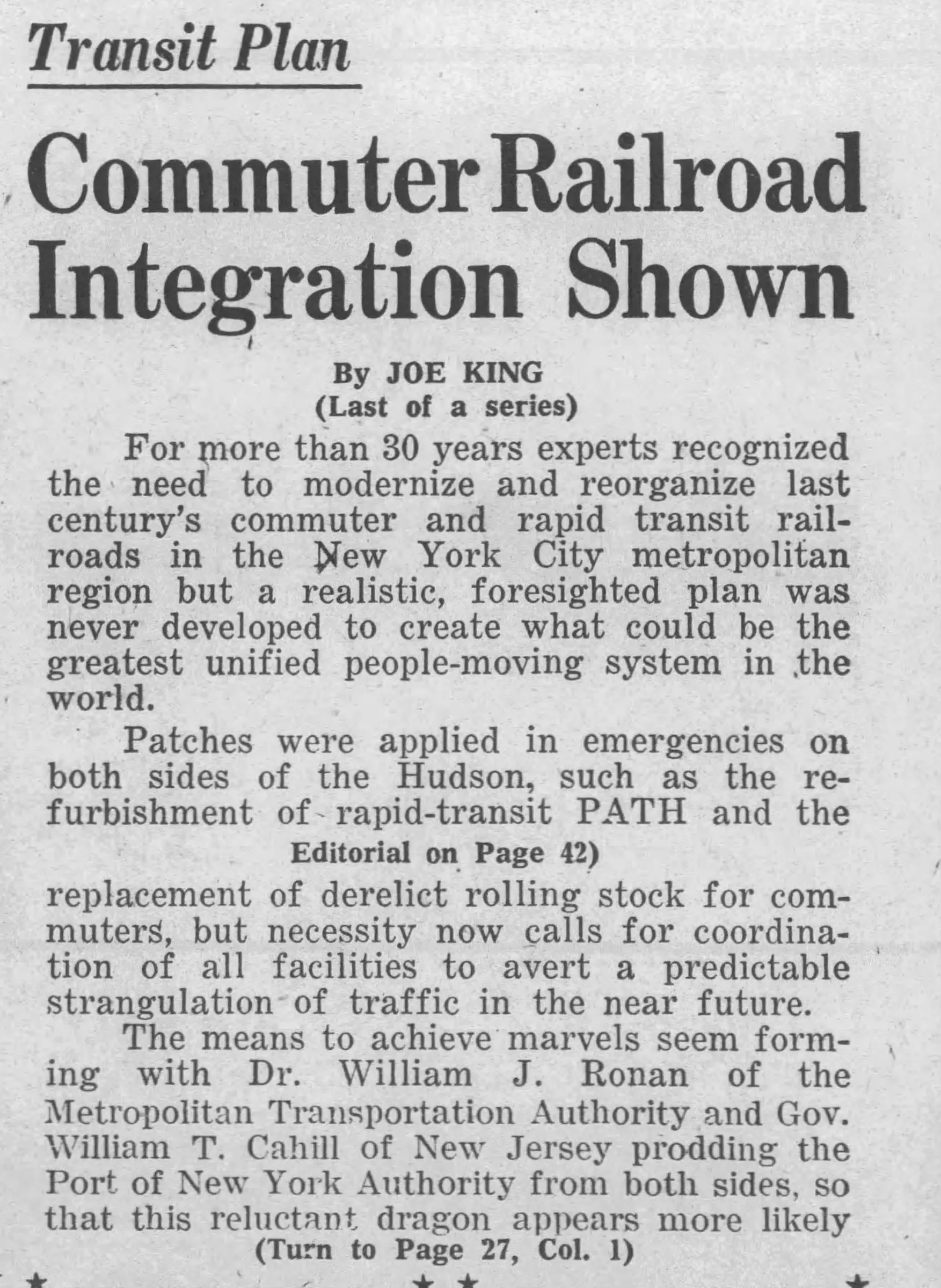
For more than 30 years experts recognized the need to modernize and reorganize last century's commuter and rapid transit railroads in the New York City metropolitan region but a realistic, foresighted plan was never developed to create what could be the greatest unified people-moving system in the world.
Patches were applied in emergencies on both sides of the Hudson, such as the refurbishment of rapid-transit PATH and the replacement of derelict rolling stock for commuters, but necessity now calls for coordination of all facilities to avert a predictable strangulation of traffic in the near future.
The means to achieve marvels seem forming with Dr. William J. Ronan of the Metropolitan Transportation Authority and Gov. William T. Cahill of New Jersey prodding the Port of New York Authority from both sides, so that this reluctant dragon appears more likely to throw its vast prestige and resources into a mighty mass transit triumvirate.
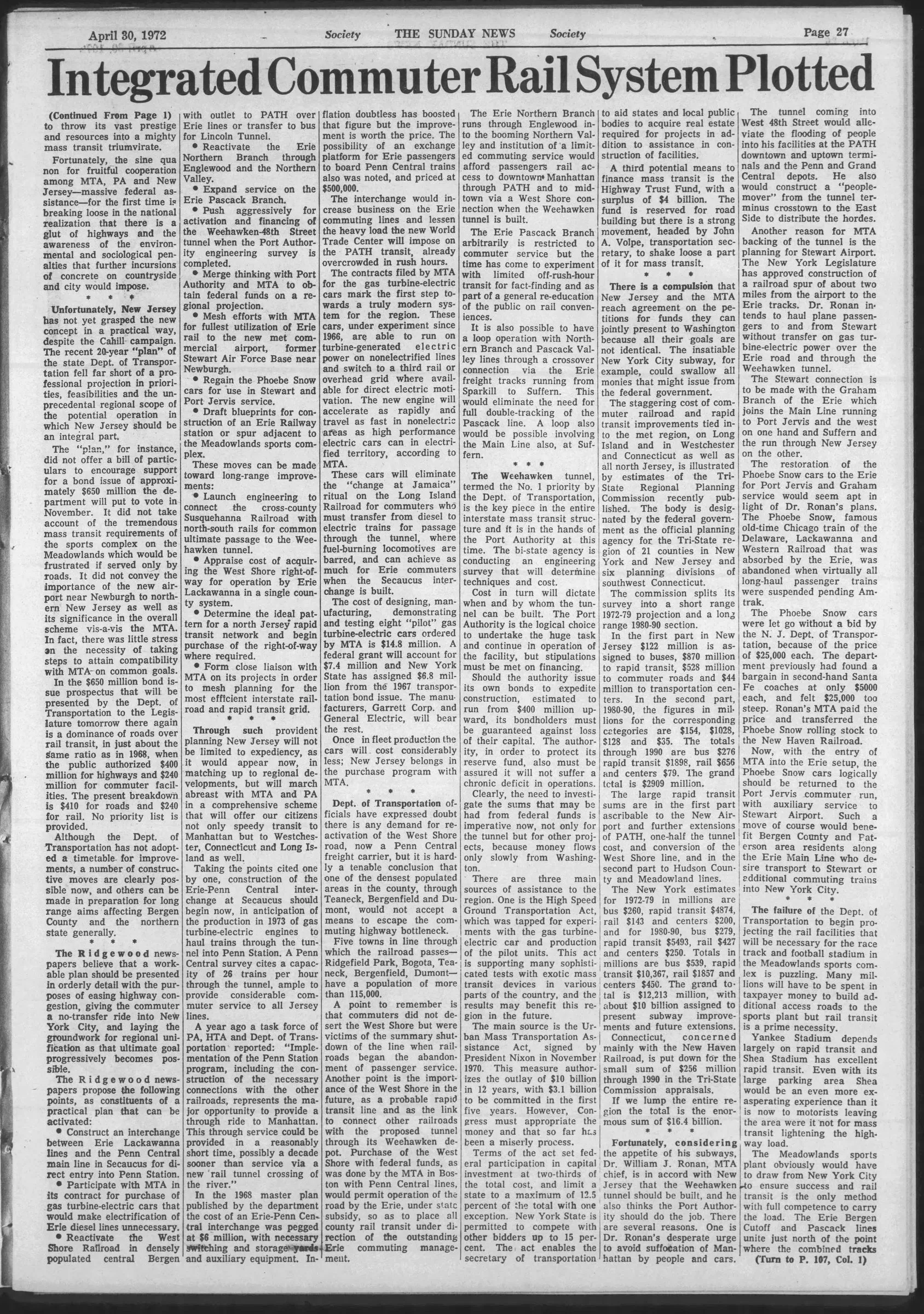
Fortunately, the sine qua non for fruitful cooperation among MTA, PA and New Jersey-massive federal assistance-for the first time is breaking loose in the national realization that there is a glut of highways and the awareness of the environmental and sociological penalties that further incursions of concrete on countryside and city would impose.
Unfortunately, New Jersey has not yet grasped the new concept in a practical way, despite the Cahill campaign. The recent 20-year "plan" of the state Dept. of Transportation fell far short of a professional projection in priorities, feasibilities and the unprecedental regional scope of the potential operation in which New Jersey should be an integral part.
The "plan," for instance, did not offer a bill of particulars to encourage support for a bond issue of approximately $650 million the department will put to vote in November. It did not take account of the tremendous mass transit requirements of the sports complex on the Meadowlands which would be frustrated if served only by roads. It did not convey the importance of the new airport near Newburgh to northern New Jersey as well as its significance in the overall scheme vis-a-vis the MTA. In fact, there was little stress on the necessity of taking steps to attain compatibility with MTA-on common goals.
In the $650 million bond issue prospectus that will be presented by the Dept. of Transportation to the Legislature tomorrow there again is a dominance of roads over rail transit, in just about the same ratio as in 1968, when the public authorized $400 million for highways and $240 million for commuter facilities. The present breakdown is $410 for roads and $240 for rail. No priority list is provided.
Although the Dept. of Transportation has not adopted a timetable for improvements, a number of constructive moves are clearly possible now, and others can be made in preparation for long range aims affecting Bergen County and the northern state generally.
The Ridgewood newspapers believe that a workable plan should be presented in orderly detail with the purposes of easing highway congestion, giving the commuter a no-transfer ride into New York City, and laying the groundwork for regional unifiction as that ultimate goal progressively becomes possible.
The Ridgewood newspapers propose the following points, as constituents of a practical plan that can be activated:
* Construct an interchange between Erie Lackawanna lines and the Penn Central main line in Secaucus for direct entry into Penn Station.
* Participate with MTA in its contract for purchase of gas turbine-electric cars that would make electrification of Erie diesel lines unnecessary.
* Reactivate the West Shore Railroad in densely populated central Bergen with outlet to PATH over Erie lines or transfer to bus for Lincoln Tunnel.
* Reactivate the Erie Northern Branch through Englewood and the Northern Valley.
* Expand service on the Erie Pascack Branch.
* Push aggressively for activation and financing of the Weehawken-48th Street tunnel when the Port Authority engineering survey is completed.
* Merge thinking with Port Authority and MTA to obtain federal funds on a regional projection.
* Mesh efforts with MTA for fullest utilization of Erie rail to the new met commercial airport, former Stewart Air Force Base near Newburgh.
* Regain the Phoebe Snow cars for use in Stewart and Port Jervis service.
* Draft blueprints for construction of an Erie Railway station or spur adjacent to the Meadowlands sports complex.
These moves can be made toward long-range improvements:
* Launch engineering to connect the cross-county Susquehanna Railroad with north-south rails for common ultimate passage to the Weehawken tunnel.
* Appraise cost of acquiring the West Shore right-of-way for operation by Erie Lackawanna in a single county system.
* Determine the ideal pattern for a north Jersey rapid transit network and begin purchase of the right-of-way where required.
* Form close liaison with MTA on its projects in order to mesh planning for the most efficient interstate railroad and rapid transit grid.
Through such provident planning New Jersey will not be limited to expediency, as it would appear now, in matching up to regional developments, but will march abreast with MTA and PA in a comprehensive scheme that will offer our citizens not only speedy transit to Manhattan but to Westchester, Connecticut and Long Island as well.
Taking the points cited one by one, construction of the Erie-Penn Central interchange at Secaucus should begin now, in anticipation of the production in 1973 of gas turbine-electric engines to haul trains through the tunnel into Penn Station. A Penn Central survey cites a capacity of 26 trains per hour through the tunnel, ample to provide considerable commuter service to all Jersey lines.
A year ago a task force of PA, HTA and Dept. of Transportation reported: "Implementation of the Penn Station program, including the construction of the necessary connections with the other railroads, represents the major opportunity to provide a through ride to Manhattan. This through service could be provided in a reasonably short time, possibly a decade sooner than service via a new "rail tunnel crossing of the river."
In the 1968 master plan published by the department the cost of an Erie-Penn Central interchange was pegged at $6 million, with necessary switching and storage yards and auxiliary equipment. Inflation doubtless has boosted that figure but the improvement is worth the price. The possibility of an exchange platform for Erie passengers to board Penn Central trains also was noted, and priced at $500,000.
The interchange would increase business on the Erie commuting lines and lessen the heavy load the new World Trade Center will impose on the PATH transit, already overcrowded in rush hours.
The contracts filed by MTA for the gas turbine-electric cars mark the first step towards a truly modern system for the region. These cars, under experiment since 1966, are able to run on turbine-generated electric power on nonelectrified lines and switch to a third rail or overhead grid where available for direct electric motivation. The new engine will accelerate as rapidly and travel as fast in nonelectric areas as high performance electric cars can in electrified territory, according to MTA.
These cars will eliminate the "change at Jamaica" ritual on the Long Island Railroad for commuters who must transfer from diesel to electric trains for passage through the tunnel, where fuel-burning locomotives are barred, and can achieve as much for Erie commuters when the Secaucus interchange is built.
The cost of designing, manufacturing, demonstrating and testing eight "pilot" gas turbine-electric cars ordered by MTA is $14.8 million. A federal grant will account for $7.4 million and New York State has assigned $6.8 million from the 1967 transportation bond issue. The manufacturers, Garrett Corp. and General Electric, will bear the rest.
Once in fleet production the cars will cost considerably less; New Jersey belongs in the purchase program with MTA.
Dept. of Transportation officials have expressed doubt there is any demand for reactivation of the West Shore road, now a Penn Central freight carrier, but it is hardly a tenable conclusion that one of the densest populated areas in the county, through Teaneck, Bergenfield and Dumont, would not accept a means to escape the commuting highway bottleneck.
Five towns in line through which the railroad passes–Ridgefield Park, Bogota, Teaneck, Bergenfield, Dumont–have a population of more than 115,000.
A point to remember is that commuters did not desert the West Shore but were victims of the summary shut-down of the line when railroads began the abandonment of passenger service.
Another point is the importance of the West Shore in the future, as a probable rapid transit line and as the link to connect other railroads with the proposed tunnel through its Weehawken depot.
Purchase of the West Shore with federal funds, as was done by the MTA in Boston with Penn Central lines, would permit operation of the road by the Erie, under state subsidy, so as to place all county rail transit under direction of the outstanding Erie commuting management.
The Erie Northern Branch runs through Englewood into the booming Northern Valley and institution of a limited commuting service would afford passengers rail access to downtown Manhattan through PATH and to midtown via a West Shore connection when the Weehawken tunnel is built.
The Erie Pascack Branch arbitrarily is restricted to commuter service but the time has come to experiment with limited off-rush-hour transit for fact-finding and as part of a general re-education of the public on rail conveniences.
It is also possible to have a loop operation with Northern Branch and Pascack Valley lines through a crossover connection via the Erie freight tracks running from Sparkill to Suffern. This would eliminate the need for full double-tracking of the Pascack line. A loop also would be possible involving the Main Line also, at Suffern.
The Weehawken tunnel termed the No. 1 priority by the Dept. of Transportation, is the key piece in the entire interstate mass transit structure and it is in the hands of the Port Authority at this time. The bi-state agency is conducting an engineering survey that will determine techniques and cost.
Cost in turn will dictate when and by whom the tunnel can be built. The Port Authority is the logical choice to undertake the huge task and continue in operation of the facility, but stipulations must be met on financing.
Should the authority issue its own bonds to expedite construction, estimated to run from $400 million upward, its bondholders must be guaranteed against loss of their capital. The authority, in order to protect its reserve fund, also must be assured it will not suffer a chronic deficit in operations.
Clearly, the need to investigate the sums that may be had from federal funds is imperative now, not only for the tunnel but for other projects, because money flows only slowly from Washington.
There are three main sources of assistance to the region. One is the High Speed Ground Transportation Act, which was tapped for experiments with the gas turbine-electric car and production of the pilot units. This act is supporting many sophisticated tests with exotic mass transit devices in various parts of the country, and the results may benefit this region in the future.
The main source is the Urban Mass Transportation Assistance Act, signed by President Nixon in November 1970. This measure authorizes the outlay of $10 billion in 12 years, with $3.1 billion to be committed in the first five years. However, Congress must appropriate the money and that so far has been a miserly process.
Terms of the act set federal participation in capital investment at two-thirds of the total cost, and limit a state to a maximum of 12.5 percent of the total with one exception. New York State is permitted to compete with other bidders up to 15 percent. The act enables the secretary of transportation to aid states and local public bodies to acquire real estate required for projects in addition to assistance in construction of facilities.
A third potential means to finance mass transit is the Highway Trust Fund, with a surplus of $4 billion. The fund is reserved for road building but there is a strong movement, headed by John A. Volpe, transportation secretary, to shake loose a part of it for mass transit.
There is a compulsion that New Jersey and the MTA reach agreement on the petitions for funds they can jointly present to Washington because all their goals are not identical. The insatiable New York City subway, for example, could swallow all monies that might issue from the federal government.
The staggering cost of commuter railroad and rapid transit improvements tied into the met region, on Long Island and in Westchester and Connecticut as well as all north Jersey, is illustrated by estimates of the Tri-State Regional Planning Commission recently published. The body is designated by the federal government as the official planning agency for the Tri-State region of 21 counties in New York and New Jersey and six planning divisions of southwest Connecticut.
The commission splits its survey into a short range 1972-79 projection and a long range 1980-90 section.
In the first part in New Jersey $122 million is assigned to buses, $870 million to rapid transit, $528 million to commuter roads and $44 million to transportation centers. In the second part, 1980-90, the figures in millions for the corresponding categories are $154, $1028, $128 and $35. The totals through 1990 are bus $276, rapid transit $1898, rail $656 and centers $79. The grand total is $2909 million.
The large rapid transit sums are in the first part ascribable to the New Airport and further extensions of PATH, one-half the tunnel cost, and conversion of the West Shore line, and in the second part to Hudson County and Meadowland lines.
The New York estimates for 1972-79 in millions are bus $260, rapid transit $4874, rail $143 and centers $200, and for 1980-90, bus $279, rapid transit $5493, rail $427 and centers $250. Totals in millions are bus $539, rapid transit $10,367, rail $1857 and centers $450. The grand total is $12,213 million, with about $10 billion assigned to present subway improvements and future extensions.
Connecticut, concerned mainly with the New Haven Railroad, is put down for the small sum of $256 million through 1990 in the Tri-State Commission appraisals.
If we lump the entire region the total is the enormous sum of $16.4 billion.
Fortunately, considering the appetite of his subways, Dr. William J. Ronan, MTA chief, is in accord with New Jersey that the Weehawken tunnel should be built, and he also thinks the Port Authority should do the job. There are several reasons. One is Dr. Ronan's desperate urge to avoid suffocation of Manhattan by people and cars.
The tunnel coming into West 48th Street would alleviate the flooding of people into his facilities at the PATH downtown and uptown terminals and the Penn and Grand Central depots. He also would construct a "people-mover" from the tunnel terminus crosstown to the East Side to distribute the hordes.
Another reason for MTA backing of the tunnel is the planning for Stewart Airport. The New York Legislature has approved construction of a railroad spur of about two miles from the airport to the Erie tracks. Dr. Ronan intends to haul plane passengers to and from Stewart without transfer on gas turbine-electric power over the Erie road and through the Weehawken tunnel.
The Stewart connection is to be made with the Graham Branch of the Erie which joins the Main Line running to Port Jervis and the west on one hand and Suffern and the run through New Jersey on the other.
The restoration of the Phoebe Snow cars to the Erie for Port Jervis and Graham service would seem apt in light of Dr. Ronan's plans. The Phoebe Snow, famous old-time Chicago train of the Delaware, Lackawanna and Western Railroad that was absorbed by the Erie, was abandoned when virtually all long-haul passenger trains were suspended pending Amtrak.
The Phoebe Snow cars were let go without a bid by the N. J. Dept. of Transportation, because of the price of $25,000 each. The department previously had found a bargain in second-hand Santa Fe coaches at only $5,000 each, and felt $25,000 too steep. Ronan's MTA paid the price and transferred the Phoebe Snow rolling stock to the New Haven Railroad.
Now, with the entry of MTA into the Erie setup, the Phoebe Snow cars logically should be returned to the Port Jervis commuter run, with auxiliary service to Stewart Airport. Such a move of course would benefit Bergen County and Paterson area residents along the Erie Main Line who desire transport to Stewart or additional commuting trains into New York City.
The failure of the Dept. of Transportation to begin projecting the rail facilities that will be necessary for the race track and football stadium in the Meadowlands sports complex is puzzling. Many millions will have to be spent in taxpayer money to build additional access roads to the sports plant but rail transit is a prime necessity.
Yankee Stadium depends largely on rapid transit and Shea Stadium has excellent rapid transit. Even with its large parking area Shea would be an even more exasperating experience than it is now to motorists leaving the area were it not for mass transit lightening the highway load.
The Meadowlands sports plant obviously would have to draw from New York City to ensure success and rail transit is the only method with full competence to carry the load. The Erie Bergen Cutoff and Pascack lines unite just north of the point where the combined tracks … [TURN TO PAGE 107, COLUMN 1]
Other editions
- Commuter Railroad Integration Shown · The Sunday News · April 30, 1972 · Page 1, 27
- Integrated Commuter Rail System Plotted · The Sunday News · April 30, 1972 · Page 27