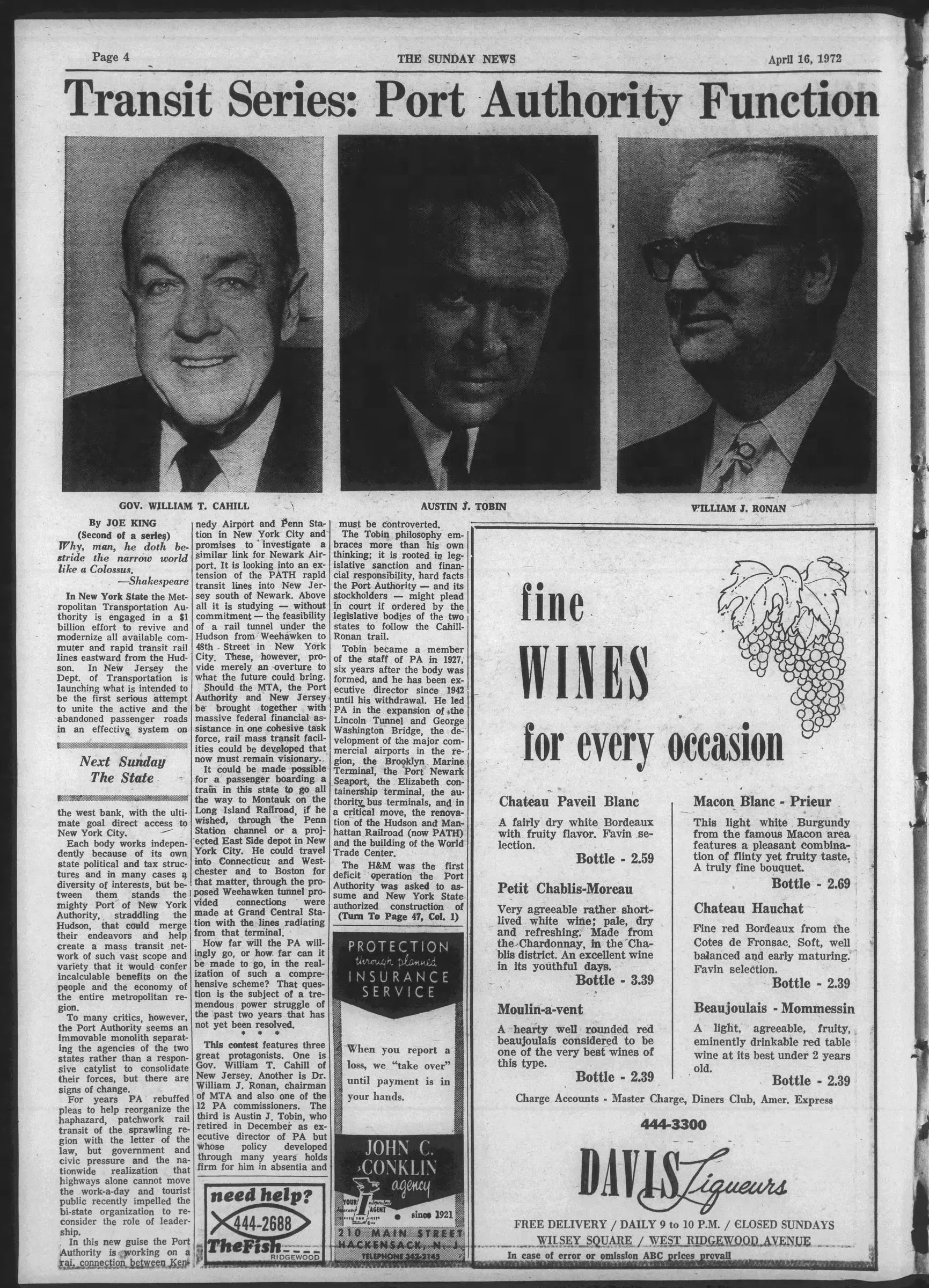
Transit Series: Port Authority Function
Source pages
Source page 1
Source page 2
Source page 3
Source page 4
Source page 5
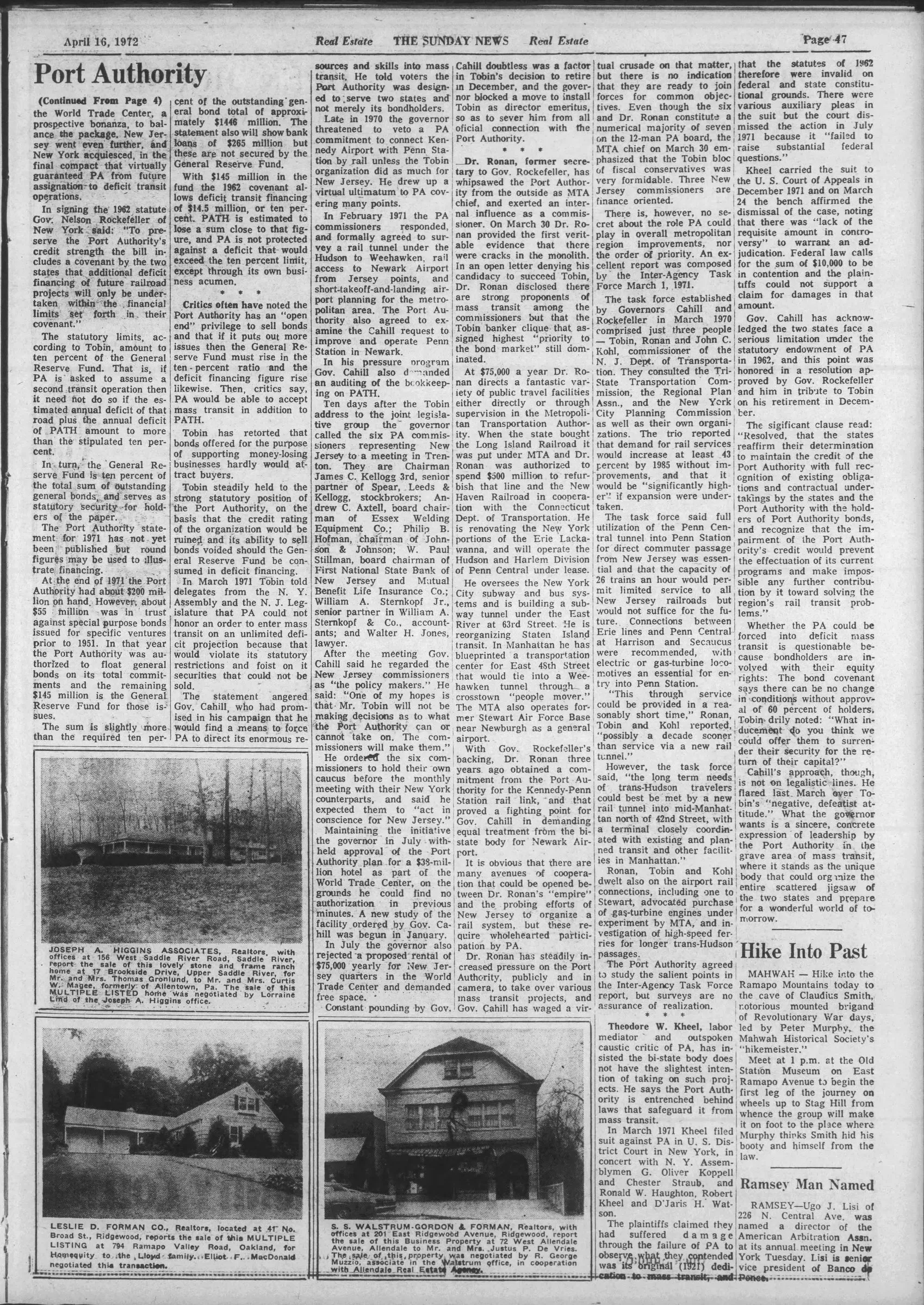
Source page 6
Transcription
Transcriptions may contain errors. Consult the source pages for the original wording and layout.
Why, man, he doth bestride the narrow world like a Colossus. – Shakespeare
In New York State the Metropolitan Transportation Authority is engaged in a $1 billion effort to revive and modernize all available commuter and rapid transit rail lines eastward from the Hudson. In New Jersey the Dept. of Transportation is launching what is intended to be the first serious attempt to unite the active and the abandoned passenger roads in an effective system on the west bank, with the ultimate goal direct access to New York City.
Each body works independently because of its own state political and tax structures and in many cases a diversity of interests, but between them stands the mighty Port of New York Authority, straddling the Hudson, that could merge their endeavors and help create a mass transit network of such vast scope and variety that it would confer incalculable benefits on the people and the economy of the entire metropolitan region.
To many critics, however, the Port Authority seems an immovable monolith separating the agencies of the two states rather than a responsive catylist to consolidate their forces, but there are signs of change.
For years PA rebuffed pleas to help reorganize the haphazard, patchwork rail transit of the sprawling region with the letter of the law, but government and civic pressure and the nationwide realization that highways alone cannot move the work-a-day and tourist public recently impelled the bi-state organization to reconsider the role of leadership.
In this new guise the Port Authority is working on a rail connection, between Kennedy Airport and Penn Station in New York City and promises to investigate a similar link for Newark Airport. It is looking into an extension of the PATH rapid transit lines into New Jersey south of Newark. Above all it is studying without commitment – the feasibility of a rail tunnel under the Hudson from Weehawken to 48th Street in New York City. These, however, provide merely an overture to what the future could bring.
Should the MTA, the Port Authority and New Jersey be brought together with massive federal financial assistance in one cohesive task force, rail mass transit facilities could be developed that now must remain visionary.
It could be made possible for a passenger boarding a train in this state to go all the way to Montauk on the Long Island Railroad, if he wished, through the Penn Station channel or a projected East Side depot in New York City. He could travel into Connecticut and Westchester and to Boston for that matter, through the proposed Weehawken tunnel provided connections were made at Grand Central Station with the lines radiating from that terminal.
How far will the PA willingly go, or how far can it be made to go, in the realization of such a comprehensive scheme? That question is the subject of a tremendous power struggle of the past two years that has not yet been resolved.
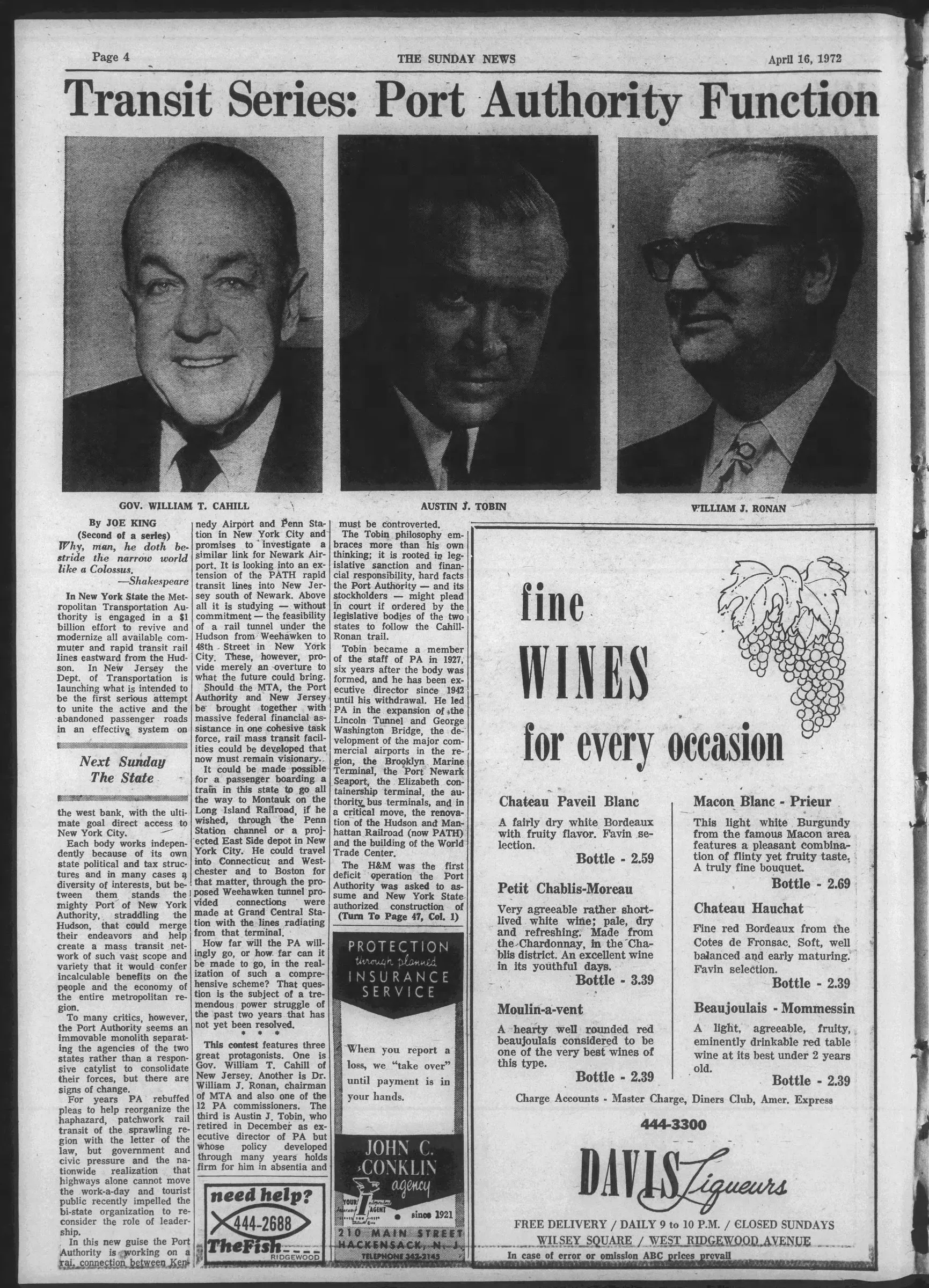
This contest features three great protagonists. One is Gov. William T. Cahill of New Jersey. Another is Dr. William J. Ronan, chairman of MTA and also one of the 12 Port Authority commissioners. The third is Austin J. Tobin, who retired in December as executive director of PA but whose policy developed through many years holds firm for him in absentia and must be controverted.
The Tobin philosophy embraces more than his own thinking; it is rooted in legislative sanction and financial responsibility, hard facts the Port Authority – and its stockholders – might plead in court if ordered by the legislative bodies of the two states to follow the Cahill-Ronan trail.
Tobin became a member of the staff of PA in 1927, six years after the body was formed, and he has been executive director since 1942 until his withdrawal. He led PA in the expansion of the Lincoln Tunnel and George Washington Bridge, the development of the major commercial airports in the region, the Brooklyn Marine Terminal, the Port Newark Seaport, the Elizabeth containership terminal, the authority bus terminals, and in a critical move, the renovation of the Hudson and Manhattan Railroad (now PATH) and the building of the World Trade Center.
The H&M was the first deficit operation the Port Authority was asked to assume and New York State authorized construction of the World Trade Center, a prospective bonanza, to balance the package. New Jersey went even further, and New York acquiesced, in the final compact that virtually guaranteed PA from future assignation to deficit transit operations.
In signing the 1962 statute Gov. Nelson Rockefeller of New York said:
"To preserve the Port Authority's credit strength the bill includes a covenant by the two states that additional deficit financing of future railroad projects will only be undertaken within the financial limits set forth in their covenant."
The statutory limits, according to Tobin, amount to ten percent of the General Reserve Fund. That is, if PA is asked to assume a second transit operation then it need not do so if the estimated annual deficit of that road plus the annual deficit of PATH amount to more than the stipulated ten percent.
In turn, the General Reserve Fund is ten percent of the total sum of outstanding general bonds, and serves as statutory security for holders of the paper.
The Port Authority statement for 1971 has not yet been published but round figures may be used to illustrate financing.
At the end of 1971 the Port Authority had about $200 million on hand, However, about $55 million was in trust against special purpose bonds issued for specific ventures prior to 1951. In that year the Port Authority was authorized to float general bonds on its total commitments and the remaining $145 million is the General Reserve Fund for those issues.
The sum is slightly more than the required ten percent of the outstanding general bond total of approximately $1446 million. The statement also will show bank loans of $265 million but these are not secured by the General Reserve Fund.
With $145 million in the fund the 1962 covenant allows deficit transit financing of $14.5 million, or ten percent. PATH is estimated to lose a sum close to that figure, and PA is not protected against a deficit that would exceed the ten percent limit, except through its own business acumen.
Critics often have noted the Port Authority has an “open end” privilege to sell bonds and that if it puts out more issues then the General Reserve Fund must rise in the ten-percent ratio and the deficit financing figure rise likewise. Then, critics say, PA would be able to accept mass transit in addition to PATH.
Tobin has retorted that bonds offered for the purpose of supporting money-losing businesses hardly would attract buyers.
Tobin steadily held to the strong statutory position of the Port Authority, on the basis that the credit rating of the organization would be ruined and its ability to sell bonds voided should the General Reserve Fund be consumed in deficit financing.
In March 1971 Tobin told delegates from the N.Y. Assembly and the N.J. Legislature that PA could not honor an order to enter mass transit on an unlimited deficit projection because that would violate its statutory restrictions and foist on it securities that could not be sold.
The statement angered Gov. Cahill who had promised in his campaign that he would find a means to force PA to direct its enormous resources and skills into mass transit, He told voters the Port Authority was designed to serve two states and not merely its bondholders.
Late in 1970 the governor threatened to veto a PA commitment to connect Kennedy Airport with Penn Station by rail unless the Tobin organization did as much for New Jersey. He drew up a virtual ultimatum to PA covering many points.
In February 1971 the PA commissioners responded, and formally agreed to survey a rail tunnel under the Hudson to Weehawken, rail access to Newark Airport from Jersey points, and short-takeoff-and-landing airport planning for the metropolitan area. The Port Authority also agreed to examine the Cahill request to improve and operate Penn Station in Newark.
In his pressure program Gov. Cahill also demanded an auditing of the bookkeeping on PATH.
Ten days after the Tobin address to the joint legislative group the governor called the six PA commissioners representing New Jersey to a meeting in Trenton. They are Chairman James C. Kellogg 3rd, senior partner of Spear, Leeds & Kellogg, stockbrokers; Andrew C. Axtell, board chairman of Essex Welding Equipment Co.; Philio B. Hofman, chairman of Johnson & Johnson; Paul Stillman, board chairman of First National State Bank of New Jersey and Mutual Benefit Life Insurance Co.; William A. Sternkopf Jr., senior partner in William A Sternkopf & Co., accountants; and Walter H. Jones, lawyer.
After the meeting, Gov. Cahill said he regarded the New Jersey commissioners as “the policy makers.” He said: “One of my hopes is that- Mr. Tobin will not be making decisions as to what the Port Authority can or cannot take on. The commissioners will make them.”
He ordered the six commissioners to hold their own caucus before the monthly meeting with their New York counterparts, and said he expected them to “act in conscience for New Jersey.”
Maintaining the initiative the governor in July withheld approval of the Port Authority plan for a $38-million hotel as part of the World Trade Center, on the grounds he could find no authorization in previous minutes. A new study of the facility ordered by Gov. Cahill was begun in January.
In July the governor also rejected a proposed rental of $75,000 yearly for New Jersey quarters in the World Trade Center and demanded free space.
Constant pounding by Gov Cahill doubtless was a factor in Tobin's decision to retire in December, and the governor blocked a move to install Tobin as director emeritus, so as to sever him from all oficial connection with the Port Authority.
Dr. Ronan, former secretary to Gov. Rockefeller, has whipsawed the Port Authority from the outside as MTA chief, and exerted an internal influence as a commissioner. On March 30 Dr. Ronan provided the first veritable evidence that there were cracks in the monolith.
In an open letter denying his candidacy to succeed Tobin, Dr. Ronan disclosed there are strong proponents of mass transit among the commissioners but that the Tobin banker clique that assigned highest "priority to the bond market" still dominated.
At $75,000 a year Dr. Ronan directs a fantastic variety of public travel facilities either directly or through supervision in the Metropolitan Transportation Authority. When the state bought the Long Island Rail Road it was put under MTA and Dr. Ronan was authorized to spend $500 million to refurbish that line and the New Haven Railroad in cooperation with the Connecticut Dept. of Transportation. He is renovating the New York portions of the Erie Lackawanna, and will operate the Hudson and Harlem Division of Penn Central under lease.
He oversees the New York City subway and bus systems and is building a subway tunnel under the East River at 63rd Street. He is reorganizing Staten Island transit. In Manhattan he has blueprinted a transportation center for East 48th Street that would tie into a Weehawken tunnel through a crosstown “people mover.” The MTA also operates former Stewart Air Force Base near Newburgh as a general airport.
With Gov. Rockefeller's backing, Dr. Ronan three years ago obtained a commitment from the Port Authority for the Kennedy-Penn Station rail link, "and that proved a fighting point for Gov. Cahill in demanding equal treatment from the bi-state body for Newark Airport.
It is obvious that there are many avenues of cooperation that could be opened between Dr. Ronan's "empire" and the probing efforts of New Jersey to organize a rail system, but these require wholehearted participation by PA.
Dr. Ronan has steadily increased pressure on the Port Authority, publicly and in camera, to take over various mass transit projects, and Gov. Cahill has waged a virtual crusade on that matter, but there is no indication that they are ready to join forces for common objectives. Even though the six and Dr. Ronan constitute a numerical majority of seven on the 12-man PA board, the MTA chief on March 30 emphasized that the Tobin bloc of fiscal conservatives was very formidable. Three New Jersey commissioners are finance oriented.
There is, however, no secret about the role PA could play in overall metropolitan region improvements, nor the order of priority. An excellent, report was composed by the Inter-Agency Task Force March 1, 1971.
The task force established by Governors Cahill and Rockefeller in March 1970 comprised just three people – Tobin, Ronan and John C. Kohl, commissioner of the N.J. Dept. of Transportation. They consulted the Tri-State Transportation Commission, the Regional Plan Association, and the New York City Planning Commission as well as their own organizations. The trio reported that demand for rail services would increase at least 43 percent by 1985 without improvements, and that it would be "significantly higher" if expansion were undertaken.
The task force said full utilization of the Penn Central tunnel into Penn Station for direct commuter passage from New Jersey was essential and that the capacity of 26 trains an hour would permit limited service to all New Jersey railroads but would not suffice for the future. Connections between Erie lines and Penn Central at Harrison and Secaucus were recommended with electric or gas-turbine locomotives an essential for entry into Penn Station.
"This through service could be provided in a reasonably short time, Ronan, Tobin and Kohl reported, "possibly a decade sconer than service via a new rail tunnei."
However, the task force said, "the long term needs of trans-Hudson travelers could best be met by a new rail tunnel into mid-Manhattan north of 42nd Street, with a terminal closely coordinated with existing and planned transit and other facilities in Manhattan."
Ronan, Tobin and Kohl dwelt also on the airport rail connections, including one to Stewart, advocated purchase of gas-turbine engines under experiment by MTA, and investigation of high-speed ferries for longer trans-Hudson passages.
The Port Authority agreed to study the salient points in the Inter-Agency Task Force report, but surveys are no assurance of realization.
Theodore W. Kheel, labor mediator and outspoken caustic critic of PA, has insisted the bi-state body does not have the slightest intention of taking on such projects. He says the Port Authority is entrenched behind laws that safeguard it from mass transit.
In March 1971 Kheel filed suit against PA in U. S. District Court in New York, in concert with N. Y. Assemblymen G. Oliver Koppell and Chester Straub, and Ronald W. Haughton, Robert Kheel and D'Jaris H. Watson.
The plaintiffs claimed they had suffered damage through the failure of PA to observe what they contended was its original (1921) dedication to mass transit, and that the statutes of 1962 therefore were invalid on federal and state constitutional grounds. There were various auxiliary pleas in the suit but the court dismissed the action in July 1971 because it "failed to raise substantial federal questions."
Kheel carried the suit to the U. S. Court of Appeals in December 1971 and on March 24 the bench affirmed the dismissal of the case, noting that there was "lack of the requisite amount in controversy" to warrant an adjudication. Federal law calls for the sum of $10,000 to be in contention and the plaintiffs could not support a claim for damages in that amount.
Gov. Cahill has acknowledged the two states face a serious limitation under the statutory endowment of PA in 1962, and this point was honored in a resolution approved by Gov. Rockefeller and him in tribute to Tobin on his retirement in December.
The sigificant clause read: "Resolved, that the states reaffirm their determination to maintain the credit of the Port Authority with full recognition of existing obligatons and contractual undertakings by the states and the Port Authority with the holders of Port Authority bonds, and recognize that the impairment of the Port Authority's credit would prevent the effectuation of its current programs and make impossible any further contribution by it toward solving the region's rail transit problems."
Whether the PA could be forced into deficit mass transit is questionable because bondholders are involved with their equity rights: The bond covenant says there can be no change in conditions without approval of 60 percent of holders. Tobin drily noted: What inducement do you think we could offer them to surrender their security for the return of their capital?"
Cahill's approach, though, is not on legalistic lines. He flared last March over Tobin's “negative, defeatist attitude.” What the governor wants is a sincere, concrete expression of leadership by the Port Authority in the grave area of mass transit, where it stands as the unique body that could organize the entire scattered jigsaw of the two states and prepare for a wonderful world of tomorrow.
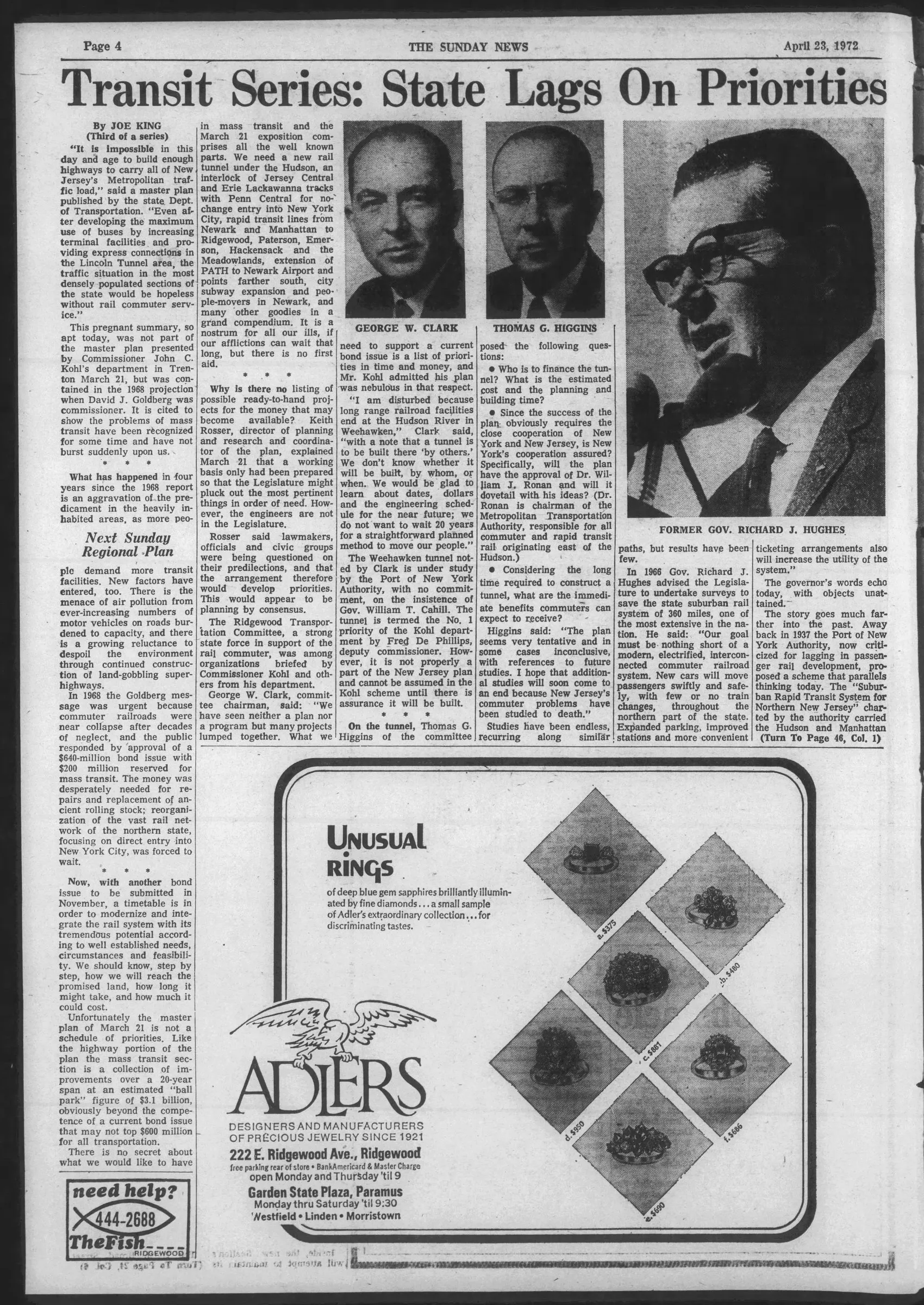
Transit Series: State Lags On Priorities
The Sunday News
April 23, 1972
"It is impossible in this day and age to build enough highways to carry all of New Jersey's Metropolitan traffic load." said a master plan published by the state Dept. of Transportation. "Even after developing the maximum use of buses by increasing terminal facilities and providing express connections in the Lincoln Tunnel area, the traffic situation in the most densely populated sections of the state would be hopeless without rail commuter service."
This pregnant summary, so apt today, was not part of the master plan presented by Commissioner John C. Kohl's department in Trenton March 21, but was contained in the 1968 projection when David J. Goldberg was commissioner. It is cited to show the problems of mass transit have been recognized for some time and have not burst suddenly upon us.
What has happened in four years since the 1968 report is an aggravation of the predicament in the heavily inhabited areas, as more people demand more transit facilities. New factors have entered, too. There is the menace of air pollution from ever-increasing numbers of motor vehicles on roads burdened to capacity, and there is a growing reluctance to despoil the environment through continued construction of land-gobbling super-highways.
In 1968 the Goldberg message was urgent because commuter railroads were near collapse after decades of neglect, and the public responded by approval of a $640-million bond issue with $200 million reserved for mass transit. The money was desperately needed for repairs and replacement of ancient rolling stock; reorganization of the vast rail network of the northern state, focusing on direct entry into New York City, was forced to wait.
Now, with another bond issue to be submitted in November, a timetable is in order to modernize and integrate the rail system with its tremendous potential according to well established needs, circumstances and feasibility. We should know, step by step, how we will reach the promised land, how long it might take, and how much it could cost.
Unfortunately the master plan of March 21 is not a schedule of priorities. Like the highway portion of the plan the mass transit section is a collection of improvements over a 20-year span at an estimated "ballpark" figure of $3.1 billion, obviously beyond the competence of a current bond issue that may not top $600 million for all transportation.
There is no secret about what we would like to have in mass transit and the March 21 exposition comprises all the well known parts. We need a new rail tunnel under the Hudson, an interlock of Jersey Central and Erie Lackawanna tracks with Penn Central for no-change entry into New York City, rapid transit lines from Newark and Manhattan to Ridgewood, Paterson, Emerson, Hackensack and the Meadowlands, extension of PATH to Newark Airport and points farther south, city subway expansion and people-movers in Newark, and many other goodies in a grand compendium. It is a nostrum for all our ills, if our afflictions can wait that long, but there is no first aid.
Why is there no listing of possible ready-to-hand projects for the money that may become available? Keith Rosser, director of planning and research and coordinator of the plan, explained March 21 that a working basis only had been prepared so that the Legislature might pluck out the most pertinent things in order of need. However, the engineers are not in the Legislature.
Rosser said lawmakers, officials and civic groups were being questioned on their predilections, and that the arrangement therefore would develop priorities. This would appear to be planning by consensus.
The Ridgewood Transportation Committee, a strong state force in support of the rail commuter, was among organizations briefed by Commissioner Kohl and others from his department.
George W. Clark, committee chairman, said: "We have seen neither a plan nor a program but many projects lumped together. What we need to support a current bond issue is a list of priorities in time and money, and Mr. Kohl admitted his plan was nebulous in that respect.
"I am disturbed because long range railroad facilities end at the Hudson River in Weehawken," Clark said, "with a note that a tunnel is to be built there 'by others.’ We don't know whether it will be built, by whom, or when. We would be glad to learn about dates, dollars and the engineering schedule for the near future; we do not want to wait 20 years for a straightforward planned method to move our people.”
The Weehawken tunnel noted by Clark is under study by the Port of New York Authority, with no commitment, on the insistence of Gov. William T. Cahill. The tunnel is termed the No. 1 priority of the Kohl department by Fred De Phillips, deputy commissioner. However, it is not properly a part of the New Jersey plan and cannot be assumed in the Kohl scheme until there is assurance it will be built.
On the tunnel, Thomas G. Higgins of the committee posed the following questions:
* Who is to finance the tunnel? What is the estimated cost and the planning and building time?
* Since the success of the plan: obviously requires the close cooperation of New York and New Jersey, is New York's cooperation assured? Specifically, will the plan have the approval of Dr. William J. Ronan and will it dovetail with his ideas? (Dr. Ronan is chairman of the Metropolitan Transportation Authority, responsible for all commuter and rapid transit rail originating east of the Hudson.)
* Considering the long time required to construct a tunnel, what are the immediate benefits commuters can expect to receive?
Higgins said: "The plan seems very tentative and in some cases inconclusive, with references to future studies. I hope that additional studies will soon come to an end because New Jersey's commuter problems have been studied to death." Studies have been endless, recurring along similar paths, but results have been few.
In 1966 Gov. Richard J. Hughes advised the Legislature to undertake surveys to save the state suburban rail system of 360 miles, one of the most extensive in the nation. He said: "Our goal must be nothing short of a modern, electrified, interconnected commuter railroad system. New cars will move passengers swiftly and safely; with few or no train changes, throughout the northern part of the state. Expanded parking, improved stations and more convenient ticketing arrangements also will increase the utility of the system."
The governor's words echo today, with objects unattained.
The story goes much farther into the past. Away back in 1937 the Port of New York Authority, now criticized for lagging in passenger rail development, proposed a scheme that parallels thinking today. The "Suburban Rapid Transit System for Northern New Jersey" charted by the authority carried the Hudson and Manhattan Railroad (now PATH) from 33rd Street in Manhattan to 51st Street where it crossed to Jersey through a new tunnel.
The H&M was to connect with the Erie tracks on the meadows and proceed thereon to Paterson, connecting there with the Susquehanna, the West Shore, and Northern, Pascack and Bergen Cutoff lines of the Erie. In addition, the Erie Main Line was to be electrified for direct passage to New York City through the new tunnel. Other first stage branches of the 1937 rapid transit system and secondary projections look much like the dreaming that has occurred to this day and finds present expression in the Dept. of Transportation's so-called "No. 1 goal" of the Weehawken tunnel.
To peer more deeply into the past, the state highway engineer in a 1924 report noted that "'railroads built in the previous century were not laid out with proper forethought for future traffic and their role as part of an overall transportation system." He said: "The increasing traffic demands placed upon these rail systems have made betterment and in many places complete reconstruction work, necessary in order that the burden and upon them could be carried at all."
Much of the "last century" that the engineer deplored still resides in our rail system. In light of the wealth of data available from the past, the failure of the Kohl department on March 21 to produce a hardnosed schedule with engineering references and professional awareness of needs compared to prospective funds seems puzzling. Perhaps it stems from the shifting nature of politics in which there seldom is continuity of purpose and planning.
The department, for instance, was recast and had to be "'retooled" at cost of time and a break in thinking when Gov. Cahill brought in Kohl. He was a professor of civil engineering for 20 years at the University of Michigan, where he directed a transportation institute, and he was acting director of the Office of Transportation in the federal Dept. of Housing and Urban Development when summoned to Trenton in May 1970.
A political bureau also bears pressures from many areas for improvements that must be weighed prudently, regardless of urgency. For example, the point was made March 21 that Cumberland County on Delaware Bay did not have a four-lane highway, a facility that would be imperative as the region grew. At the same time the growth crisis in the north has arrived, as any listener may learn from the rush hour jam-up reports on radio.
In an omnibus department such as state transportation there also are uneven forces backing roads vis-a-vis rail, aside from whatever philosophy the bureau itself may hold. The accent on highways has been a national perpossession and only now is Washington struggling to escape the stranglehold of the road lobbies, in the campaign to divert a portion of the Highway Trust Fund to mass transit.
The highway influence is strong in Trenton legislative halls, while mass transit support must derive from the general public, which organizes politically only in emergency. This aspect was reflected in 1968 in the original Goldberg bond issue proposal which was weighed 5-1 in favor of road building. The public mobilized to persuade the Legislature to whack that ratio near 2-1, at $440 million for roads, $200 million for railroads.
Cynically, as a politically responsible body, the Dept. of Transportation may be canny in its program of planning by questionnaire, because whatever priorities it ultimately advances may be laid to the public will as indicated by the poll that was conducted.
Because of the vast scope of operations and conflicting compulsions in the Kohl department, the best method to secure an independent approach to mass transit might be to strip the Commuter Operating Body from that bureau, as Sen. Garrett W. Hagedorn has suggested, and create a separate body.
Then there would be three similar bodies, with the Metropolitan Transportation Authority of New York and the bi-state Port of New York Authority, to focus on the grave mass transit problems of the region with only auxiliary concern for road building.
In a survey, "Mass Transportation in the New York Region," the First National City Bank discussed the character of authorities in transportation.
"One of the most perplexing difficulties confronting regional and state political administrators," the 1970 report said, "is the creation of transportation authorities whose structure embraces the proper balance between the degree of independence necessary for operating efficiency and an adequate responsiveness to changing public needs.
"An independent agency, for example, may elect to undertake only those projects which promise a profitable return, or at least are self-supporting," the bank said.
It cited the Port Authority in this class.
"On the other hand, to the extent an operating authority remains overly dependent on public fiscal support, it is subject to excessive political pressures," the survey said.
It cited the MTA in this category, because its operations even including subsidiary Triborough Authority tolls, "are unlikely to furnish any net surplus."
The report concluded: “if governments were dedicated to the creation of an independent transportation operating agency of maximum effectiveness they would create a structure as financially independent as feasible."
It could, the study noted, be given “surplus” facilities to balance money-losing mass transit, as in the case of the Port Authority. It could be sustained by a trust fund, as in the case of the federal Highway Trust Fund. It could be given freedom ("with responsibility safeguards") to invest federal mass transit funds and to set fares.
Sen. Hagedorn, in a 1971 bill to set up a separate Public Transportation Authority responsible directly to the governor, combined two suggestions by the First National City Bank. He stipulated that the state treasury be empowered annually to cover deficits of the authority by maintaining its debt service fund at a figure sufficient to pay amortization and interest due in each upcoming year, as a guarantee to bondholders. His bill transferred fare-setting from the Public Utilities Commission to the transit authority.
The Hagedorn bill failed to receive Cahill Administration backing because of a new philosophy in Trenton. Gov. Cahill believes in combining state services and duties in large combinations under one responsible head. The practice seems to have achieved order and efficiency in some areas.
One instance is the recent amalgamation of all state housing matters– planning, inspection, regulation, financing--in one compact body within the Dept. of Community Affairs. However, similar reasoning may not apply to the Dept. of Transportation where there is not necessarily a single goal, but more likely a conflict of interest between demands of road and rail.
Gov. Cahill, though, is firm, in these words: “We are geared to the development of a balanced transportation system and we are going to try to restructure the entire system that dates to 1920. That is why I brought John Kohl in, and I think he has an expert on mass transit in Nelson Slater. We think we have the expertise to reorganize our complete system and we are going to make sure none of the riding public is hurt."
In the crisis of 1965 when the railroad companies announced their intention to suspend virtually all commuter service, the public had to carry the ball. Civic and official groups petitioned legislators to act, and mounted effective propaganda campaigns.
The immediate result was a state subsidy to cover operating deficits of limited commuter service, which has been continued. Gov. Cahill recommended a grant of $15.9 million for all mass transit in the 1972-73 budget, an increase of $4.5 million over the previous budgetary figure. Actually $12.5 million will be spent 1971-72, with borrowing from other funds, the governor said.
The long-range effect of the 1966 call to arms was passage of the $200-million bond issue which replaced equipment which could not have continued rolling for long. A shining example of the value of this investment is the Erie Lackawanna Railway. Of the money authorized by the public $26 million was spent for 105 new cars and 23 new locomotives for the Erie. The result has been comfortable, courteous service with an on-time record unapproached by any other metropolitan region commuter line.
On this point Sen. Hagedorn says: "Rail patronage has been increasing steadily, with modern equipment, at the rate of 11 percent yearly. This indicates clearly the viability of our commuter rail network. On the other hand, the bond issue provided very little in the way of mass transportation improvements aside from replacement of obsolete equipment. There is no coordination whatsoever, especially in the vital matter of improved access to Manhattan."
On planning, Chairman Clark of the Ridgewood Transportation Committee says: "Our group began in January 1966 to talk about comprehensive planning. We askèd for a complete state plan of doing things, that could be implemented in a predetermined orderly manner.
"We can show accomplishments so far as we have been able to go," Clark says. "We kept the Erie running. We got the bond issue through with this area overwhelmingly in favor. We badgered the Dept. of Transportation when they tried to foist 3-2 seating on us and they agreed to 2-2.
"The elements of our original program that remain are direct access to New York.” he says, "and co-ordination of parking-bus-rail facilities."
There is divisiveness in Bergen County, howèver, with the Board of Chosen Freeholders pulling dead against the Clark commuter rail program. The freeholders, through Director Victor M. Williams, have petitioned Gov. Cahill to make a first priority of an east-west highway across the northern portion of the county with a new vehicular bridge or tunnel "'some place between the George Washington and Tappan Zee bridges."
The Weehawken rail tunnel and the vehicular crossing Williams advocates cannot both be built, but the Kohl department is subjected to the two pressures.
A comparison of rail and vehicular crossings is provided in the 1968 Goldberg plan. It said: "The existence of mass transit becomes even more essential when the daily tide of people is at its flood during peak commuter hours … The railroads alone carry 40,000 people into Manhattan … If these 40,000 had to be accommodated on highways, at least one additional vehicular tunnel or bridge would be required … The two existing tunnels and the George Washington Bridge carry a total of only 39,000 cars, trucks and buses into New York City during the three peak morning hours."
The statistics have not changed significantly since 1968 and it is common fact that bus traffic is at a satration point in rush hours with the congestion peak at Lincoln Tunnel lasting as long as three hours, from 7-10 a.m. weekdays.
The evidence seems clear that rail is the most efficient, swift and productive means of moving large numbers of commuters.
One of the strongest forces in shaping public opinion and exerting legislative influence has been Morris County, with a unifled campaign by free holders and civic groups and towns since 1961. Broadly, the Morris Board of Public Transportation has the same principles as the Ridgewood body, but with an added plea for strong action by the northern counties in a common purpose.
"The counties together," the board has said, "should be able to persuade the Legislature to make full use of 165 miles or more of railroad trackage already in place to relieve the pressure for more and more highways.
"This could well be a saving to the state," the board continued, "but the state deals in such broad aspects that it usually fails to see the more immediate conditions apparent at county levels. If counties do not work together on their mass transportation problems the state will ultimately work things out for us in a way we may not like."
There also is the possibility no improvement whatever may be made in the near future, because the proposed bond issue, however much needed, can be defeated if it is not supported by à reasonable, competent bill of particulars on its use.
Ridgewood's Higgins says: "It seems to me that unless the (Kohl) plan becomes much more specific as to immediate benefits, it stands little chance of getting voter approval in November and, incidentlly, time is running out fast when one considers the groundwork that is necessary to get voters in a positive mood."
Other editions
- Transit Series: State Lags On Priorities · The Sunday News · April 23, 1972 · Page 4
- Transit Series: Port Authority Function · The · April 16, 1972
Related events
- Port Authority proposes a new tunnel at 51st Street, then lets it drop
- Port Authority takes the Hudson tubes, with a covenant against further rail deficits
- New Jersey voters approve transportation bonds
- Two governors set up a three-man Inter-Agency Task Force
- Port Authority agrees to survey a new Hudson rail tunnel
- Tobin refuses open-ended transit deficits; Kheel sues
- Task force: use Penn Station’s tunnel now, build a new one for the long term
- New Jersey’s 20-year transportation plan arrives without priorities