Rapid Transit Costs Cut, Real Estate Board Told
Communities Must Pay Part Of Bill, But Towns Can Do It, Kervick Says
Source pages
Source page 1
Source page 2
Transcription
Transcriptions may contain errors. Consult the source pages for the original wording and layout.
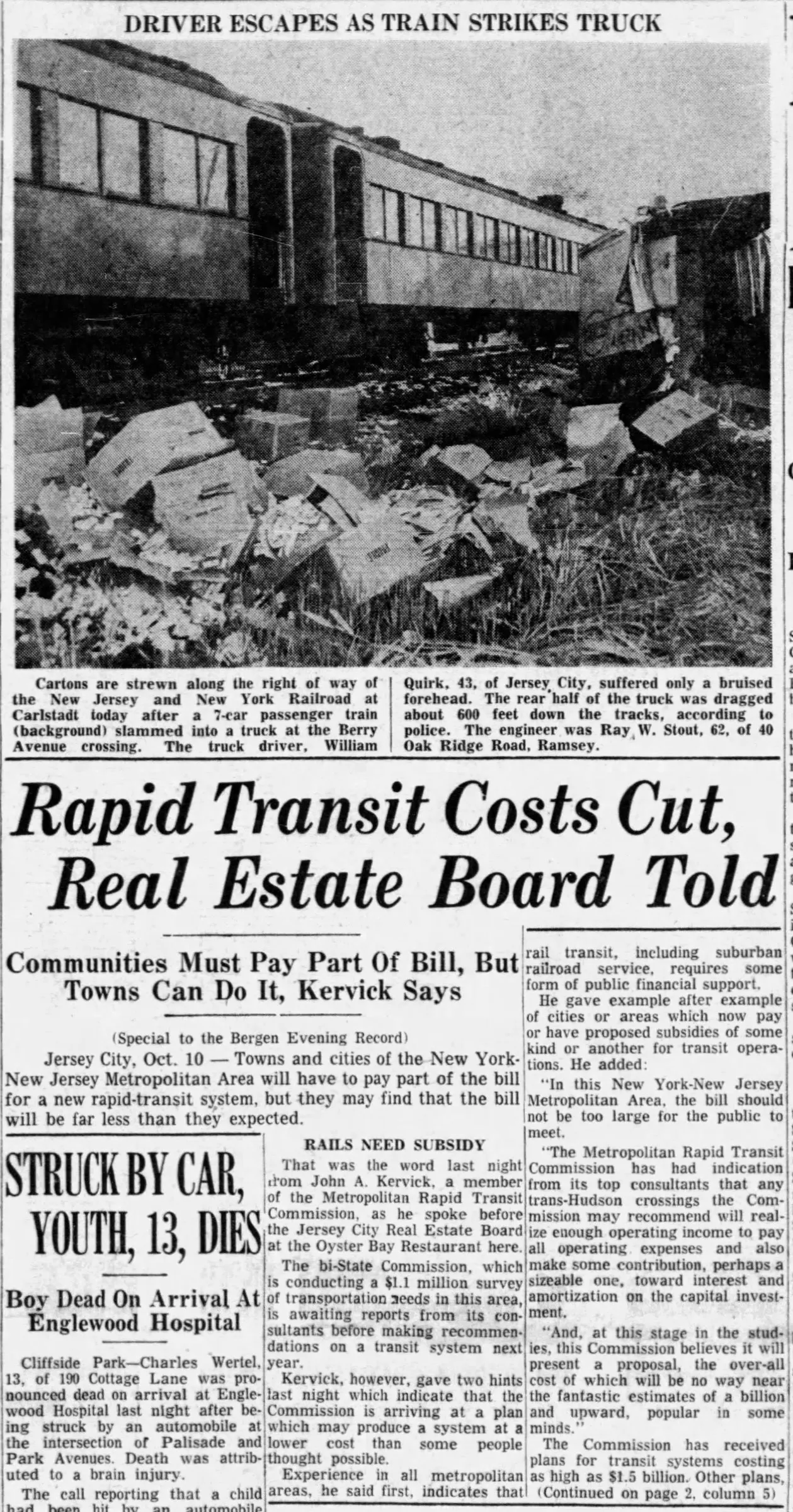
Jersey City, Oct. 10 – Towns and cities of the New York-New Jersey Metropolitan Area will have to pay part of the bill for a new rapid-transit system, but they may find that the bill will be far less than they expected.
Rails Need Subsidy
That was the word last night from John A. Kervick, a member of the Metropolitan Rapid Transit Commission, as he spoke before the Jersey City Real Estate Board at the Oyster Bay Restaurant here.
The bi-State Commission, which is conducting a $1.1 million survey of transportation needs in this area, is awaiting reports from its constituents before making recommendations on a transit system next year.
Kervick, however, gave two hints last night which indicate that the Commission is arriving at a plan which may produce a system at a lower cost than some people thought possible.
Experience in all metropolitan areas, he said first, indicates that rail transit, including suburban railroad service, requires some form of public financial support.
He gave example after example of cities or areas which now pay or have proposed subsidies of some kind or another for transit operations. He added:
“In this New York-New Jersey Metropolitan Area, the bill should not be too large for the public to meet.
“The Metropolitan Rapid Transit Commission has had indication from its top consultants that any trans-Hudson crossings the Commission may recommend will realize enough operating expenses and also make some contribution, perhaps a sizeable one, toward interest and amortization on the capital investment.
“And, at this stage in the studies, this Commission believes it will present a proposal, the overall cost of which will be no way near the fantastic estimates of a billion and upward, popular in some minds.”
The Commission has received plans for transit systems costing as high as $1.5 billion. Other plans, such as the one presented by Colonel Alfred Jenny of Dumont, are under $500,000. Among the plans now under study are an independent bi-State loop transit system and extensions of the New York City subways into New Jersey.
Charles H. Tuttle, Commission cochairman, also spoke yesterday. Addressing a meeting of the West Side Association of Commerce, he warned of progressive decay in transit facilities into New York City. Railroads, he said, are working on several fronts to discontinue commuter service. Only a strong interstate body, he added, can formulate a good transportation policy and keep it going.