All Rockin', No Rollin' In Commuter Explosion
Source pages
Source page 1
Source page 2
Transcription
Transcriptions may contain errors. Consult the source pages for the original wording and layout.
Commuter—one who spends his life
In riding to and from his wife;
A man who shaves and takes a train
And then rides back to shave again.
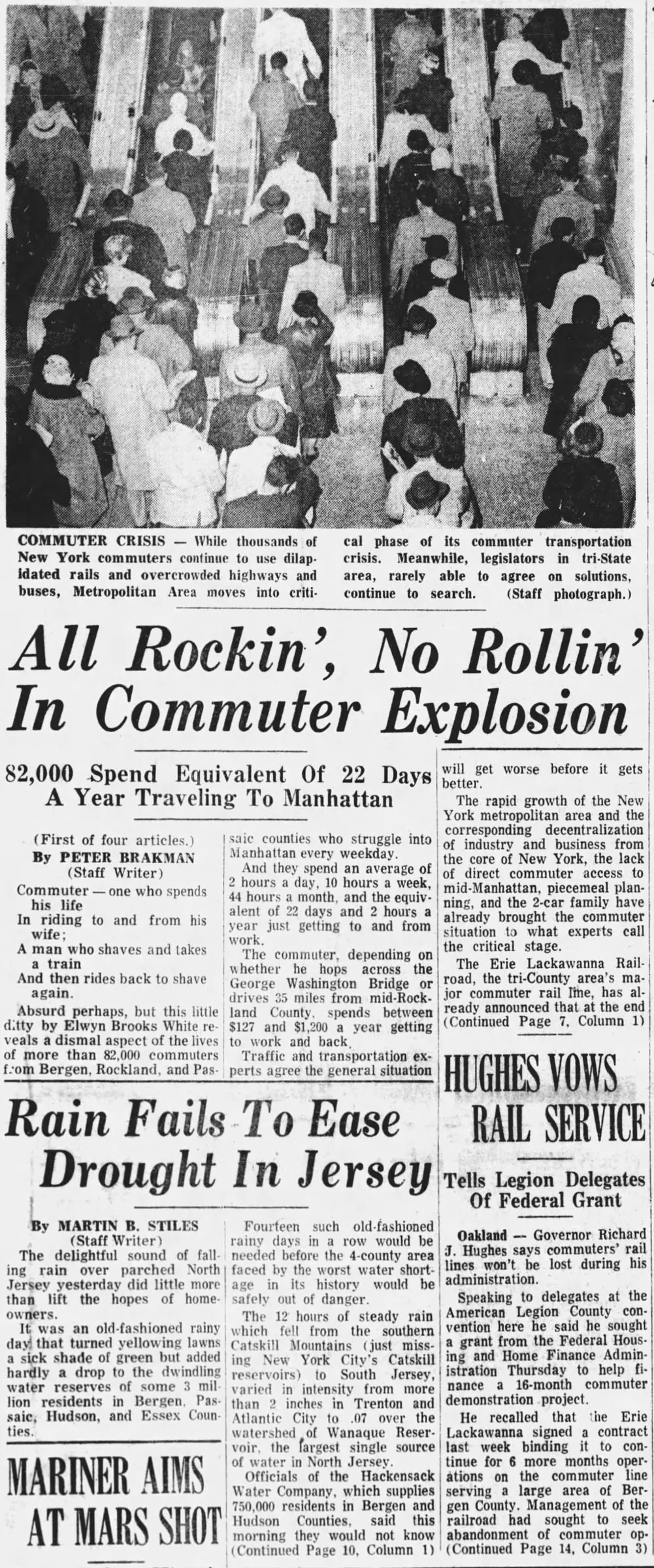
Absurd perhaps, but this little ditty by Elwyn Brooks White reveals a dismal aspect of the lives of more than 82,000 commuters from Bergen, Rockland, and Passaic counties who struggle into Manhattan every weekday.
And they spend an average of 2 hours a day, 10 hours a week, 44 hours a month, and the equivalent of 22 days and 2 hours a year just getting to and from work.
The commuter, depending on whether he hops across the George Washington Bridge or drives 35 miles from mid-Rockland County, spends between $127 and $1,200 a year getting to work and back.
Traffic and transportation experts agree the general situation will get worse before it gets better.
The rapid growth of the New York metropolitan area and the corresponding decentralization of industry and business from the core of New York, the lack of direct commuter access to mid-Manhattan, piecemeal plan- ning, and the 2-car family have already brought the commuter situation to what experts call the critical stage.
The Erie Lackawanna Railroad, the tri-County area's major commuter rail line, has al- ready announced that at the end (Continued from Page 1) of 1965, unless something is done to permanently relieve it of the financial burden of op- erating its commuter service, it will file applications to aban- don it.
The most acutely ill of the major North Jersey lines is the Jersey Central Railroad, which has been hovering on the brink of bankruptcy for years nurs- ing millions of dollars in def- icits incurred primarily by its commuter operations.
New Jersey Governor Richard J. Hughes recently took some pressure off the line by getting the Marine Midland Trust Com- pany of New York to defer for 2 years trying to collect an out- standing $1-million loan due next month.
The railroads are the key to the commuter crisis. They are able, when properly equipped, to carry more people in a given amount of space, and more cheaply, than buses and, cer- tainly, automobiles.
Railroads never shared the post-World War II prosperity that witnessed the construction of thousands of miles of new highways and multi-million-dol- lar airports, and the record highs in automobile production.
But, with the rapid develop- ment of suburban areas, the cost of highway construction has spiraled and, in time, could be- come entirely unrealistic.
It costs about $500,000 to build 1 mile of one lane of an ex- pressway in a relatively unde- veloped suburban area. In built-
up places the cost can be $6 million.
While some open spaces exist in Rockland County, they are virtually gone in central and east Bergen County and in Pas- saic County.
On an average weekday, 150,- 000 cars cross the Westchester- Bronx County line heading to- ward New York; about 35,000 Erie Lackawanna commuters pile into the Port Authority Trans Hudson (P. A. T. H.) trains and Erie ferries for trips over and under the Hudson River into lower and mid-Manhattan; an- other 22,500 take the Pennsyl- vania Railroad to Penn Station at 33rd Street; about 12,500 Jer- sey Central customers scramble onto ferries for lower Manhat- tan or P. A. T. H. trains.
The vast majority of Rockland's 17,000 commuters go to work by car: less than 1,500 use the County's three Erie Lackawanna lines; and fewer than 400 travel by bus.
A demonstration project was set up in 1963 by the Tri-State Transportation Committee to provide a mid-Rockland County bus feeder service for connection with the New York Central Railroad in Tarrytown, but it could not attract enough customers, and was abandoned in June.
One drawback to rapid im- provement of mass transportation facilities and services is that Americans are devotees of the car; they prefer the freedom of the road - if chronic bumper-to-bumper rush-hour traffic can be called that - to the discipline and scheduling of mass transportation.
Transferring from a bus to a subway or train or from a train to a subway makes the average commuter nervous; he is willing to pay three times as much to go by car, even if it takes him longer.
All the major plans ad- vanced so far by the New Jer- sey Highway Department and the New York Office of Trans- portation call for the minimiz- ing of transfers and more direct access to as many parts of Manhattan as possible.
The scope of the problem is extensive; much more than try- ing to lop off 5 or 10 minutes from the commuting time be- tween Doodletown and the Ful- ton Street fish market; it has tremendous impact on the gen- eral economic health and future of the entire metropolitan area.
Alleviating the commuter crisis is just one phase of a com- prehensive program of planning and action that must be accomplished in the forseeable fu- ture in order to keep the greater metropolitan area from bog- ging down in a mass of clogged highways, bankrupt railroads, and economic stagnation.
And so far, none of New York's major mass transit systems or New Jersey's commu- ter railroads have been able to put their commuter operations on a paying basis.
Without the $150 million a year New York turns over to its Transit Authority, its subways would come to grinding halts. The railroads, whose commuter service deficits run from pink to scarlet red, have their own unique tales of woe.
The New Jersey and New York Railroad is in receiver- ship, the West Shore Railroad is out of the passenger business, the New Haven is bankrupt, the Erie Lackawanna, which oper- ates its commuter service at an annual loss of more than $8 million, wants out of it, the Jersey Central says it can't last much longer, and the Susque- hanna is ready to quit.
Until 1960, when New Jersey began its railroad subsidy pro- gram to prevent the threatened disintegration of New Jersey's essential commuter service, little had been done to halt the impending railroad crisis.
In a Statewide referendum in 1959, New Jersey residents turned down a proposal to divert surplus revenues from the New Jersey Turnpike Authority for railroad assistance.
During the general decline of the railroads in the 1950s, the Port of New York Authority built bus terminals and ex- panded, improved, and supported bus service and air facilities while the railroad picture be- came redder and redder.
Even though subsidies have been initiated and increased, tax-abatement legislation pas- sed, and programs adopted to assist the railroads in purchasing new equipment, rail offi- cials are not enthusiastic over the prospects of improving commuter service. They either want out or someone to foot the bill.
The newest of the 507 commuter cars used by the Erie Lackawanna were built during President Franklin D. Roosevelt's first term. None is newer than 30 years old and 100 of them are more than 40 years old. The railroad says it is unwilling to invest any more money in a service that has no prospect of paying its way.
The New Jersey State Highway Department's division of railroad transportation and New York State's Office of Transportation have come up with a number of workable solutions to the commuting crisis.
Money is needed to implement them. Where it will come from remains problematical.
"The commuter situation," a New Jersey railroad planning expert said recently, "has been studied to death. All it needs is money."
Other editions
- All Rockin’, No Rollin’ In Commuter Explosion · The Record · July 12, 1965 · Page 7, 1