Narrowing Down The Transit Question
Source page
Source page 1
Transcription
Transcriptions may contain errors. Consult the source pages for the original wording and layout.
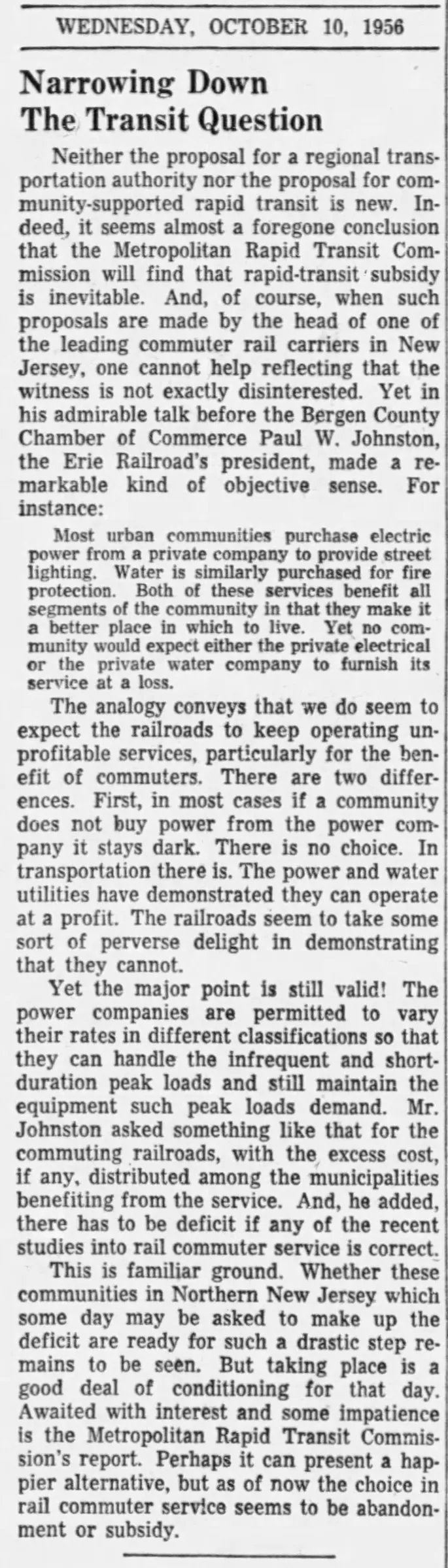
Neither the proposal for a regional transportation authority nor the proposal for community-supported rapid transit is new. Indeed, it seems almost a foregone conclusion that the Metropolitan Rapid Transit Commission will find that rapid-transit subsidy is inevitable. And, of course, when such proposals are made by the head of one of the leading commuter rail carriers in New Jersey, one cannot help reflecting that the witness is not exactly disinterested. Yet in his admirable talk before the Bergen County Chamber of Commerce Paul W. Johnston, the Erie Railroad’s president, made a remarkable kind of objective sense. For instance:
“Most urban communities purchase electric power from a private company to provide street lighting. Water is similarly purchased for fire protection. Both of these services benefit all segments of the community in that they make a better place in which to live. Yet no community would expect either the private electrical or the private water company to furnish its services at a loss.”
The analogy conveys that we do seem to expect the railroads to keep operating unprofitable services, particularly for the benefit of commuters. There are two differences. First, in most cases if a community does not buy power from the power company it stays dark. There is no choice. In transportation there is. The power and water utilities have demonstrated they can operate at a profit. The railroads seem to take some sort of perverse delight in demonstrating that they cannot.
Yet the major point is still valid! The power companies are permitted to vary their rates in different classifications so that they can handle the infrequent and short-duration peak loads and still maintain the equipment such peak loads demand. Mr. Johnston asked something like that for the commuting railroads, with the excess cost, if any, distributed among the municipalities benefiting from the service. And, he added, there has to be deficit if any of the recent studies into rail commuter service is correct.
This is familiar ground. Whether these communities in Northern New Jersey which same day may be asked to make up the deficit are ready for such a drastic step remains to be seen. But taking place is a good deal of conditioning for that day. Awaited with interest and some impatience is the Metropolitan Rapid Transit Commission’s report. Perhaps it can present a happier alternative, but as of now the choice in rail commuter service seems to be abandonment or subsidy.
Other editions
- Narrowing Down The Transit Question · Bergen Evening Record (The Record) · October 10, 1956