Friction Keeps Transit Wheels Screeching
Source pages
Source page 1
Source page 2
Transcription
Transcriptions may contain errors. Consult the source pages for the original wording and layout.
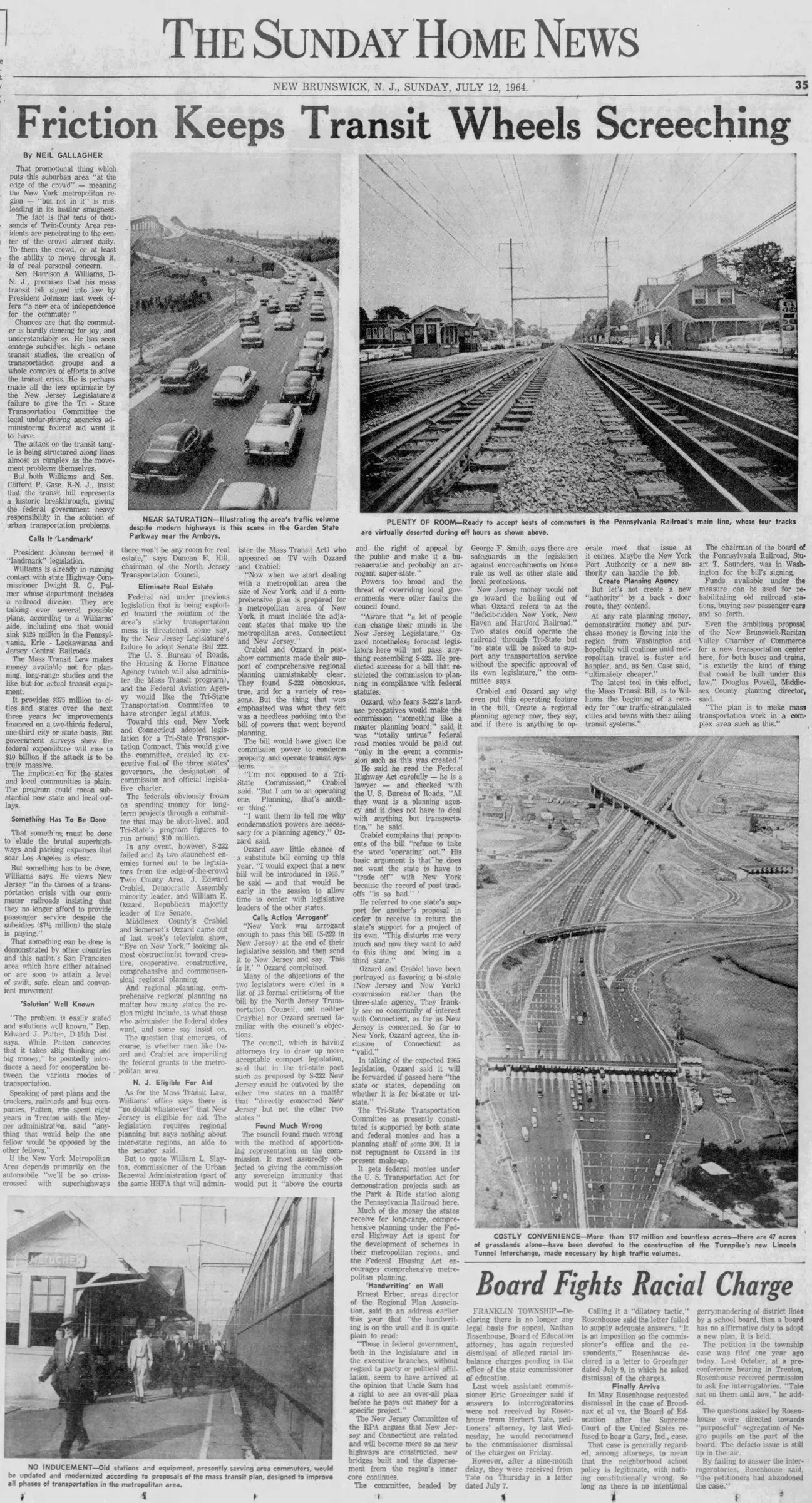
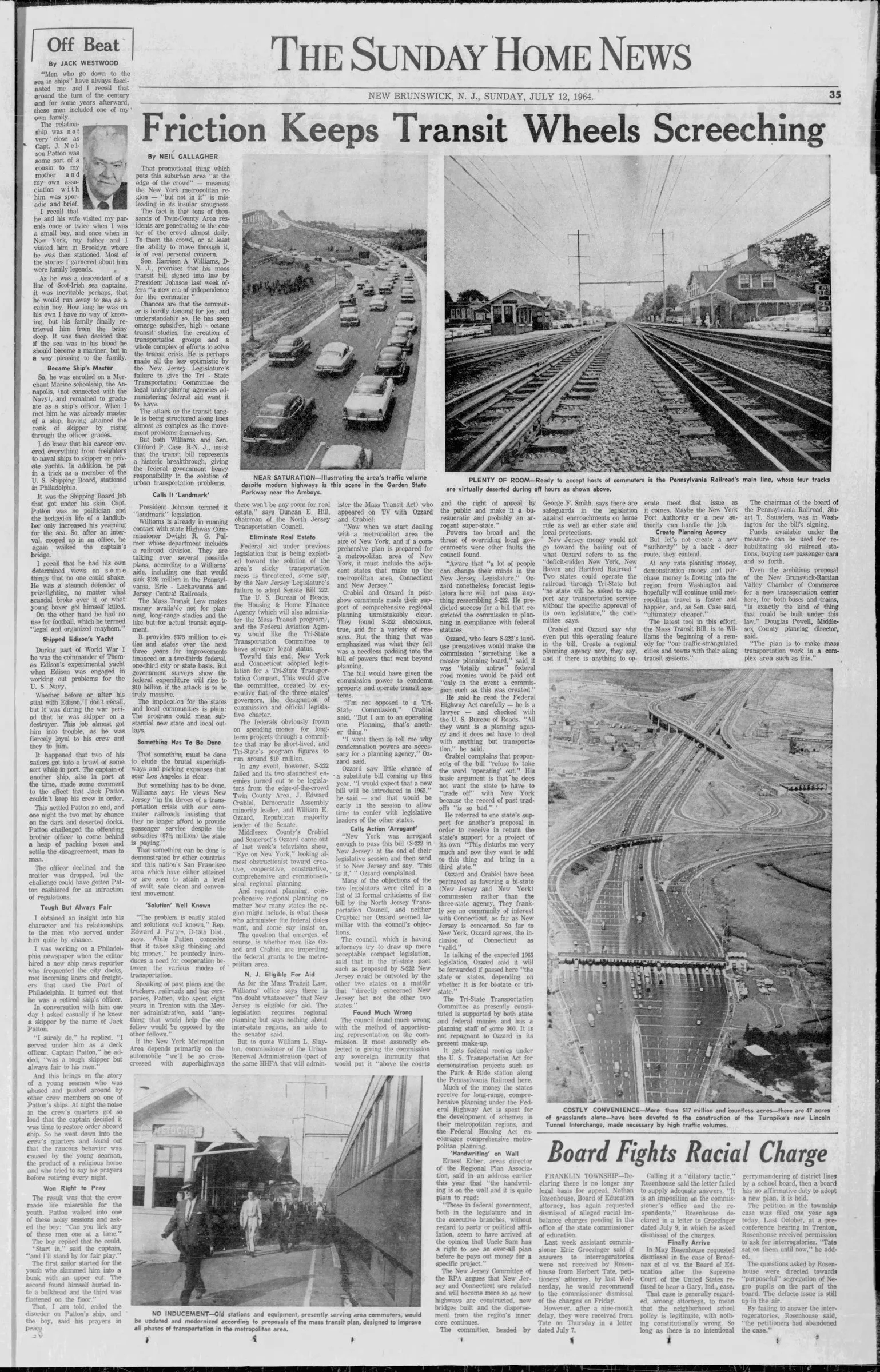
That promotional thing which puts this suburban area “at the edge of the crowd” – meaning the New York metropolitan region – “but not in it” is misleading in its insular smugness.
The fact is that tens of thousands of Twin-County Area residents are penetrating to the center of the crowd almost daily. To them the crowd, or at least the ability to move through it, is of real personal concern.
Sen. Harrison A. Williams, D., N.J., promises that his mass transit bill signed into law by President Johnson last week offers “a new era of independence for the commuter.”
Chances are that the commuter is hardly dancing for joy, and understandably so. He has seen emerge subsidies, high - octane transit studies, the creation of transportation groups and a whole complex of efforts to solve the transit crisis. He is perhaps made all the less optimistic by the New Jersey Legislature's failure to give the Tri - State Transportation Committee the legal under-pinning agencies administering federal aid want it to have.
The attack on the transit tangle is being structured along lines almost as complex as the movement problems themselves.
But both Williams and Sen. Clifford P. Case, R-N.J., insist that the transit bill represents a historic breakthrough, giving the federal government heavy responsibility in the solution of urban transportation problems.
Calls It ‘Landmark’
President Johnson termed it “landmark” legislation.
Williams is already in running contact with state Highway Commissioner Dwight R. G. Palmer whose department includes a railroad division. They are talking over several possible plans, according to a Williams’ aide, including one that would sink $126 million in the Pennsylvania, Erie - Lackawanna and Jersey Central Railroads.
The Mass Transit Law makes money available not for planning long-range studies and the like but for actual transit equipment.
It provides $375 million to cities and states over the next three years for improvements financed on a two-thirds federal, one-third city or state basis, but government surveys show the federal expenditure will rise to $50 billion if the attack is to be truly massive.
The implication for the states and local communities is plain: The program could mean substantial new state and local outlays.
Something Has To Be Done
That something must be done to elude the brutal superhighways and parking expenses that Los Angeles is clear.
But something has to be done in Williams’ view. He views New Jersey in the throes of a transportation crisis with our commuter railroads insisting that they no longer afford to provide the service despite the subsidies ($74 million) the state is paying.
That something can be done is demonstrated by other countries and this nation's San Francisco area which have either attained or are soon to attain a level of swift, safe, clean and convenient movement.
‘Solution’ Well Known
“The problem is easily stated and solutions well known,” Rep. Edward J. Patten, D-15th Dist., says, while Patten concedes that it takes “big thinking and big money,” he pointedly introduces a need for cooperation between the various modes of transportation.
Speaking of past plans and the truckers, railroads and bus companies, Patten, who spent eight years in Trenton with the Hughes administration, said “anything that would help the one fellow would be opposed by the others.”
If the New York Metropolitan Area depends primarily on the automobile “we’ll be so crossed with superhighways there won’t be any room for real estate,” says Duncan E. Hill, chairman of the North Jersey Transportation Council.
Eliminate Real Estate
Federal aid under previous legislation that is being exploited toward the solution of the area's sticky transportation mess is threatened, some say, by the New Jersey Legislature's failure to adopt Senate Bill 222.
The U.S. Bureau of Roads, the Housing & Home Finance Agency (which will also administer the Mass Transit program), and the Federal Aviation Agency would like the Tri-State Transportation Committee to have stronger legal status.
Toward this end, New York and Connecticut adopted legislation for a Tri-State Transportation Compact. This would give the committee, created by executive fiat, of the three states' governors, the designation of commission and official legislative charter.
The federal’s obviously frown on spending money for long-term projects through a committee that may be short-lived, and Tri-State’s program figures to run around $10 million.
In any event, however, S.222 failed and its two staunchest members turned out to be legislators from the edge-of-the-crowd Twin County Area. J. Edward Crabiel, Democratic Assembly minority leader, and William E. Ozzard, Republican majority leader of the Senate.
Middlesex County's Crabiel and Somerset's Ozzard came out on last week’s television show, “Eye on New York,” looking almost obstructionist toward creative, cooperative, constructive, comprehensive and commonsensical regional planning.
And regional planning, comprehensive regional planning no matter how many states the region might include, is what those who administer the federal aid want, and some say insist on. The question that emerges, of course, is whether men like Oz-zard and Crabiel are imperiling the federal grants to the metropolitan area.
N. J. Eligible For Aid
Under the Mass Transit Law, Williams’ office says there is “no doubt whatsoever” that New Jersey is eligible for aid. The legislation requires regional planning but says nothing about inter-state regions, an aide to the senator said.
But to quote William L. Slayton, commissioner of the Urban Renewal Administration (part of the same HHFA that will administer the Mass Transit Act) who appeared on TV with Ozzard and Crabiel:
“Now when we start dealing with a metropolitan area the size of New York, and if a comprehensive plan is prepared for a metropolitan area and New York, it must include the adjacent states that make up the metropolitan area, Connecticut and New Jersey.”
Crabiel and Ozzard in post-show comments made their support of comprehensive regional planning unmistakably clear. They found S.222 obnoxious, and for a variety of reasons. But the thing that was emphasized was that they felt it a needless mingling and mixing bill of powers that went beyond the powers of need.
The bill would have given the commission power to condemn property and operate transit systems.
“I’m not opposed to a Tri-State Commission,” Crabiel said. “But I am opposed to an operating one. Planning, that’s another thing.”
“I want them to tell me why condemnation powers are necessary for a planning agency,” Ozzard said.
Ozzard saw little chance of a substitute bill coming up this year. “I would expect that a new bill will be introduced in 1965,” he said – and would be ready early in the session to allow time to confer with legislative leaders of the other states.
Calls Act ‘Arrogant’
New York was arrogant enough to pass this bill (S.222 in New Jersey) at the end of their legislative session and then send it to New Jersey and say, ‘this is it,’” Ozzard complained.
Many of the objections of the two legislators were cited in a list of 13 formal criticisms of the bill by the North Jersey Transportation Council, and neither Crabiel nor Ozzard seemed familiar with the council's objections.
The council, which has a library of attorneys try to draw up more comprehensive compact legislation, said: that in the tri-state pact, such as proposed by S.222 New Jersey could be outvoted by the other two states on a matter “of utterly concerned New Jersey but not the other two states.”
Found Much Wrong
The council found much wrong with the method of appointing representation on the commission. It most assuredly objected to giving the commission any sovereign immunity that could result from broad power applications and the right of appeal by the public and make it a bureaucratic and probably an arrogant super-state.”
Powers too broad and the threat of overriding local governments were other faults the council found.
“Aware that ‘a lot of people can change their minds in the New Jersey Legislature,” Ozzard nonetheless forecast legislators here will not pass anything resembling S.222. He predicted success for a bill that restricted the commission to planning in compliance with federal statutes.
Ozzard, who fears S.222’s land-use prerogatives would make the commission “something like a master planning board,” said it was “totally untrue” federal road monies would be paid out “only in the event a commission such as this was created.”
He said he read the Federal Highway Act carefully – he is a lawyer – and checked with the U. S. Bureau of Roads. “All they want is a planning agency and it does not have to deal with anything but transportation,” he said.
Crabiel complains that proponents of the bill “refuse to take the word ‘operating’ out.” His basic argument is that he does not want the state to have to “trade off” with New York because the record of past trade-offs “is so bad.”
He referred to one state’s support for another’s proposal in order to receive in return the state’s support for a project of its own. “This disturbs me very much and now they want to add to this thing and bring in a third state.”
Ozzard and Crabiel have been portrayed as favoring a bi-state (New Jersey and New York) commission rather than the three-state agency. They frankly see no community of interest with Connecticut, as far as New Jersey is concerned. So far to New York, Ozzard agrees, the inclusion of Connecticut as “valid.”
In talking of the expected 1965 legislation, Ozzard said it will be forwarded if passed here “the state or states, depending on whether it is for bi-state or tri-state.”
The Tri-State Transportation Committee as presently constituted is supported by both state and federal monies and has a planning staff of some 300. It is not repugnant to Ozzard in its present make-up.
It gets federal monies under the U. S. Transportation Act for demonstration projects such as the Park & Ride station along the Pennsylvania Railroad here.
Much of the money the states receive for long-range, comprehensive planning under the Federal Highway Act is spent for the development of schemes in their metropolitan regions, and the Federal Housing Act encourages comprehensive metropolitan planning.
‘Handwriting’ on Wall
Ernest Erber, areas director of the Regional Plan Association, said in an address earlier this year that “the handwriting is on the wall and it is quite plain to read:
“Those in federal government, both in the legislature and in the executive branches, without regard to party or political affiliation, seem to have arrived at the opinion that Uncle Sam has a right to see an over-all plan before he pays out money for a specific project.”
The New Jersey Committee of the RPA argues that New Jersey and Connecticut are related and will become more so as new highways are constructed, new bridges built and the dispersement from the region’s inner core continues.
The committee, headed by George F. Smith, says there are safeguards in the legislation against encroachments on home rule as well as other state and local protections.
New Jersey money would not go toward the bailing out of what Ozzard refers to as the “deficit-ridden New York, New Haven and Hartford Railroad.” Two states could operate the railroad through Tri-State but “no state will be asked to support any transportation service without the specific approval of its own legislature,” the committee says.
Crabiel and Ozzard say why even put this operating feature in the bill. Create a regional planning agency now, they say, and if there is anything to operate meet that issue as it comes. Maybe the New York Port Authority or a new authority can handle the job.
Create Planning Agency
But let’s not create a new “authority” by a back-door route, they contend.
At any rate planning money, demonstration money and purchase money is flowing into the region from Washington and hopefully will continue until metropolitan travel is faster and happier, and, as Sen. Case said, “ultimately cheaper.”
The latest tool in this effort, the Mass Transit Bill, is to Williams the beginning of a remedy for “our traffic-strangulated cities and towns with their ailing transit systems.”
The chairman of the board of the Pennsylvania Railroad, Stuart T. Saunders, was in Washington for the bill's signing. Funds available under the measure can be used for rehabilitating old railroad stations, buying new passenger cars and so forth.
Even the ambitious proposal of the New Brunswick-Raritan Valley Chamber of Commerce for a new transportation center here, for both buses and trains, is “exactly the kind of thing that could be built under this law,” Douglas Powell, Middlesex County planning director, said.
“The plan is to make mass transportation work in a complex area such as this.”
Other editions
- Friction Keeps Transit Wheels Screeching · The Central New Jersey Home News · July 12, 1964 · Page 35
- Friction Keeps Transit Wheels Screeching · The Central New Jersey Home News · July 12, 1964