Tri-State Transpo Unit Fights For Standing: Has No Teeth
Source pages
Source page 1

Source page 2
Source page 3
Transcription
Transcriptions may contain errors. Consult the source pages for the original wording and layout.
By BOB DUBILL
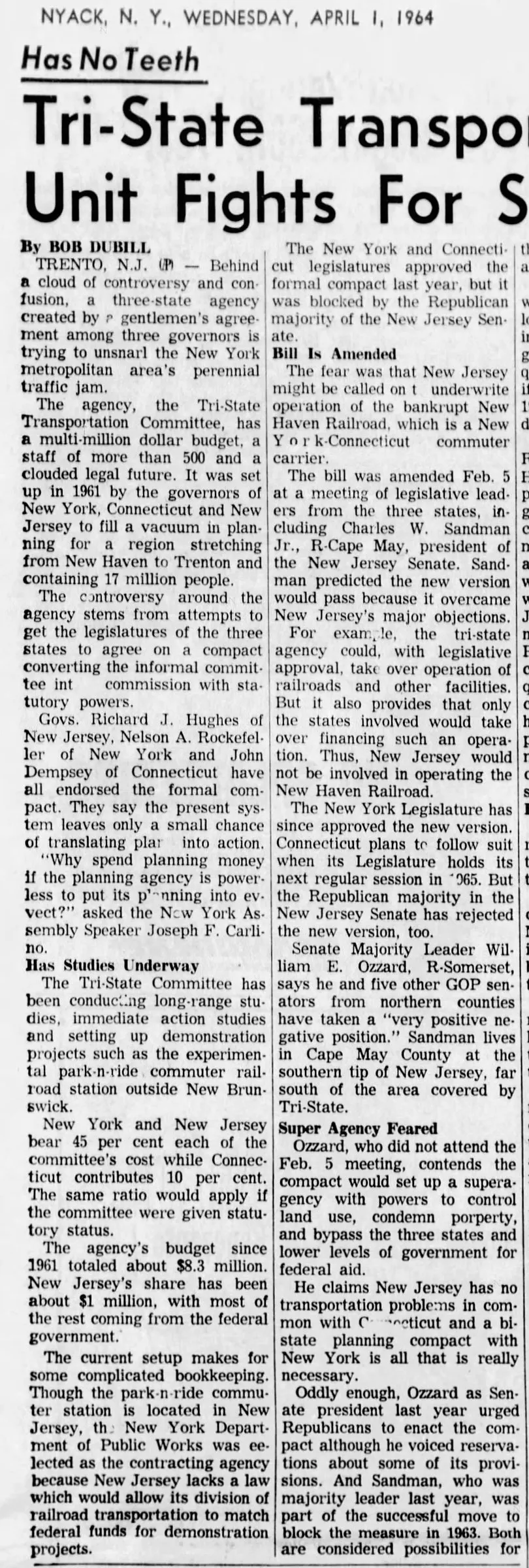
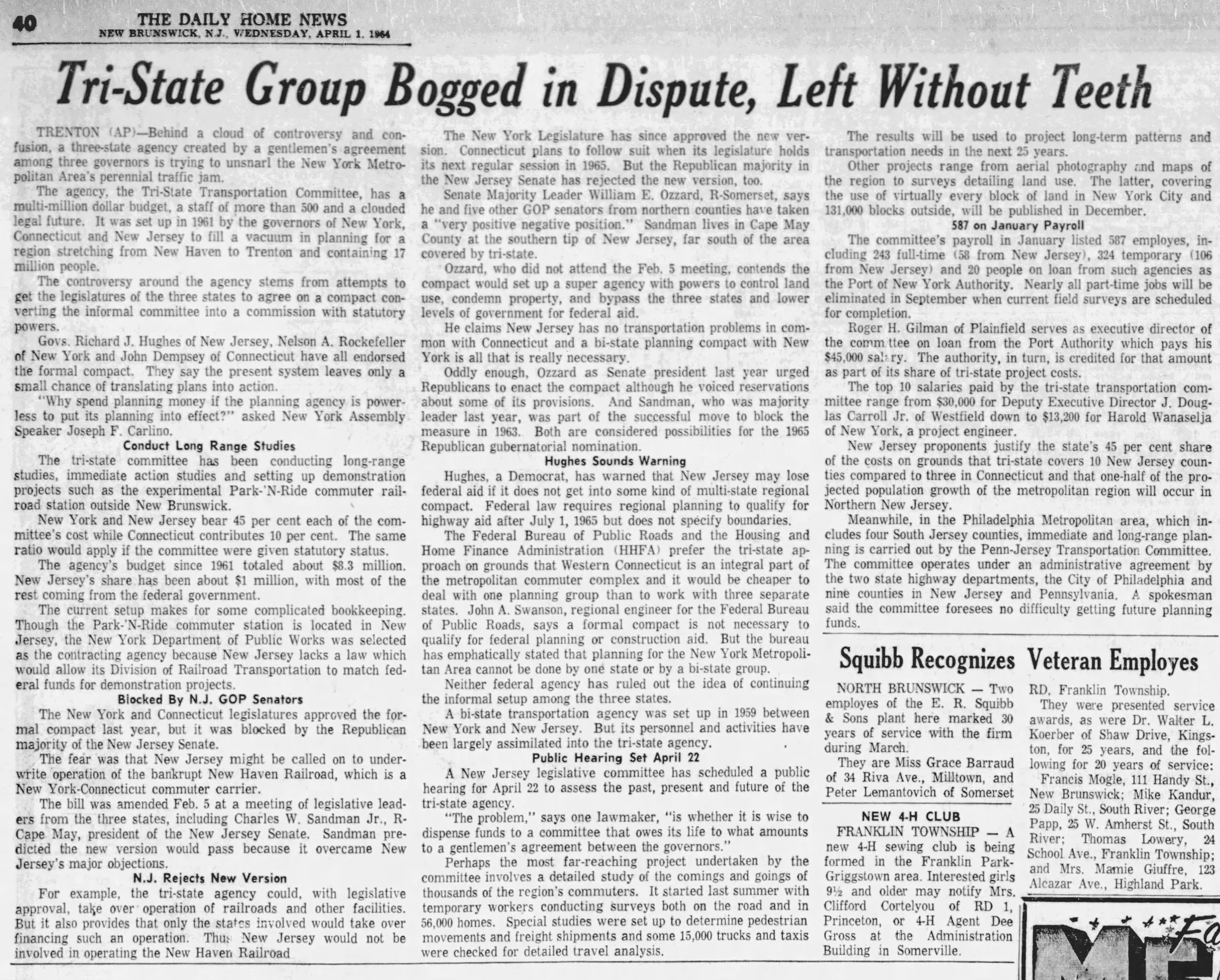
TRENTON, N.J. (AP) — Behind a cloud of controversy and confusion, a three-state agency created by a gentlemen’s agreement among three governors is trying to unsnarl the New York metropolitan area’s perennial traffic jam.
The agency, the Tri-State Transportation Committee, has a multi-million dollar budget, a staff of more than 500 and a clouded legal future. It was set up in 1961 by the governors of New York, Connecticut and New Jersey to fill a vacuum in planning for a region stretching from New Haven to Trenton and containing 17 million people.
The controversy around the agency stems from attempts to get the legislatures of the three states to agree on a compact converting the informal committee into a commission with statutory powers.
Govs. Richard J. Hughes of New Jersey, Nelson A. Rockefeller of New York and John Dempsey of Connecticut have all endorsed the formal compact. They say the present system leaves only a small chance of translating plans into action.
"Why spend planning money if the planning agency is powerless to put its planning into effect?" asked the New York Assembly Speaker Joseph F. Carlino.
Has Studies Underway
The Tri-State Committee has been conducting long-range studies, immediate action studies and setting up demonstration projects such as the experimental park-n-ride commuter railroad station outside New Brunswick.
New York and New Jersey bear 45 per cent each of the committee’s cost while Connecticut contributes 10 per cent. The same ratio would apply if the committee were given statutory status.
The agency’s budget since 1961 totaled about $8.3 million. New Jersey’s share has been about $1 million, with most of the rest coming from the federal government.
The current setup makes for some complicated bookkeeping. Though the park-n-ride commuter station is located in New Jersey, the New York Department of Public Works was selected as the contracting agency because New Jersey lacks a law which would allow its division of railroad transportation to match federal funds for demonstration projects.
The New York and Connecticut legislatures approved the formal compact last year, but it was blocked by the Republican majority of the New Jersey Senate.
Bill Is Amended
The fear was that New Jersey might be called on to underwrite the operation of the bankrupt New Haven Railroad, which is a New York-Connecticut commuter carrier.
The bill was amended Feb. 5 at a meeting of legislative leaders from the three states, including Charles W. Sandman Jr., R-Cape May, president of the New Jersey Senate. Sandman predicted the new version would pass because it overcame New Jersey’s major objections.
For example, the tri-state agency could, with legislative approval, take over operation of railroads and other facilities. But it also provides that only the states involved would take over financing such an operation. Thus, New Jersey would not be involved in operating the New Haven Railroad.
The New York Legislature has since approved the new version. Connecticut plans to follow suit when its Legislature holds its next regular session in 1965. But the Republican majority in the New Jersey Senate has rejected the new version, too.
Senate Majority Leader William E. Ozzard, R-Somerset, says he and five other GOP senators from northern counties have taken a "very positive negative position." Sandman lives in Cape May County at the southern tip of New Jersey, far south of the area covered by Tri-State.
Super Agency Feared
Ozzard, who did not attend the Feb. 5 meeting, contends the compact would set up a super-agency with powers to control land use, condemn property, and bypass the three states and lower levels of government for federal aid.
He claims New Jersey has no transportation problems in common with Connecticut and a bi-state planning compact with New York is all that is really necessary.
Oddly enough, Ozzard as Senate president last year urged Republicans to enact the compact although he voiced reservations about some of its provisions. And Sandman, who was majority leader last year, was part of the successful move to block the measure in 1963. Both are considered possibilities for the 1965 Republican gubernatorial nomination.
Hugh, a Democrat, has warned that New Jersey may lose federal aid if it does not get into some kind of multi-state regional compact. Federal law requires regional planning to qualify for highway aid after July 1, 1965, but does not specify boundaries.
The Federal Bureau of Public Roads and the Housing and Home Finance Administration prefer the tri-state approach on grounds that western Connecticut is an integral part of the metropolitan commuter complex and it would be cheaper to deal with one planning group than to work with three separate states. John A. Swanson, regional engineer for the Federal Bureau of Public Roads, says a formal compact is not necessary to qualify for federal planning or construction aid. But the bureau has emphatically stated that planning for the New York metropolitan area cannot be done by one state or by a bi-state group.
Public Hearing Set
Neither federal agency has ruled out the idea of continuing the informal setup among the three states.
A bi-state transportation agency was set up in 1959 between New York and New Jersey. But its personnel and activities have been largely assimilated into the tri-state agency.
A New Jersey legislative committee has scheduled a public hearing for April 22 to assess the past, present and future of the tri-state agency.
"The problem," says one lawmaker, "is whether it is wise to dispense funds to a committee that owes its life to what amounts to a gentlemen's agreement between the governors."
Perhaps the most far-reaching project undertaken by the committee involves a detailed study of the comings and goings of thousands of the region's commuters. It started last summer with temporary workers conducting surveys both on the road and in 56,000 homes. Special studies were set up to determine pedestrian movements and photograph shipments and costs of goods. Over 300 trucks and taxis were checked for detailed travel analysis.
The results will be used to project long-term patterns and transportation needs in the next 25 years.
Other projects range from aerial photography and maps of the region to surveys detailing land use. The latter, covering the use of virtually every block of land in New York City and 131,000 blocks outside, will be published in December.
587 On Payroll
The committee's payroll in January listed 587 employees, including 243 full-time (58 from New Jersey), 324 temporary (106 from New Jersey) and 20 people on loan from such agencies as the Port of New York Authority. Nearly all part-time jobs will be eliminated in September when current field surveys are scheduled for completion.
Roger H. Gilman of Plainfield serves as executive director of the committee on loan from the port authority which pays his $45,000 salary. The authority, in turn, is credited for that amount as part of its share of the committee's project costs.
The top 10 salaries paid by the Tri-State Transportation Committee range from $30,000 for Deputy Executive Director J. Douglas Carroll Jr. of Westfield down to $13,200 for Harold Wanaselja of New York, a project engineer.
New Jersey proponents justify the state's 45 per cent share of the costs on grounds that tri-state covers 10 New Jersey counties compared to 3 in Connecticut and that over half of the projected population growth of the metropolitan region will occur in Northern New Jersey.
Meanwhile, in the Philadelphia metropolitan area, which includes four South Jersey counties, immediate and long-range planning is carried out by the Penn-Jersey Transportation Committee. The committee operates under an administrative agreement by the two state highway departments, the city of Philadelphia and nine counties in New Jersey and Pennsylvania. A spokesman said the committee foresees no difficulty in getting future planning funds.
Other editions
- Tri-State Group Bogged in Dispute, Left Without Teeth · The Central New Jersey Home News · April 1, 1964 · Page 40