Port Authority Wants To Steer Clear Of Deficit-Ridden Railroads
Rapid-Transit Would Cost Authority, Curb Self-Supporting Projects
Source page
Source page 1
Transcription
Transcriptions may contain errors. Consult the source pages for the original wording and layout.
The iron wheels of a dying railroad locomotive cry out, “Rapid Transit, Rapid Transit, Rapid Transit,” as the old iron horse races down hill in America’s public transportation history.
NO. 1 PROBLEM
Charging past the train on its iron rails are the rubber-shoed horseless carriages on their asphalt and concrete carpets. While overhead the silver-winged jets are paving tomorrow's roads.
But today, commuters, legislators, and planners are asking for a railroad renaissance. Public transportation is the No. 1 problem of the Metropolitan Area. Rapid transit could be the answer.
They look to the Port of New York Authority as the master designer to stem the rapid-transit crisis. The P. A. says, "No thanks."
"You're subsidizing automobiles and airplanes and foresaking the railroads," a P. A. critic charges, pointing a finger at Port Authority monuments such as the second deck of the George Washington Bridge, the third Lincoln Tunnel tube, and New York International Airport.
The Authority's rebuttal is that it is legally impossible to assume transit deficits. "We are self-supporting, you know, and must remain so. It would be death for us to take over the deficit-ridden railroads," the organization maintains.
The P. A. states flatly that to aid the railroads with deficits running as high as $150 million a year -- even with State or federal subsidy -- would curb activities in other transportation areas.
BUILD RESERVE FUND
Besides, the Port Authority claims, it has no money for such a venture. But the agency's 1960 budget has added to its critics' demands that it enter the commuter railroad field.
This year's budget shows the Port Authority will retire $30 million more of its debt than is legally required and will add $7 million to its reserve fund which has already exceeded the required 10 per cent of a $574-million bonded debt.
So far, the P. A. has been successful in keeping the railroad crisis from dipping into its pockets, although it has paid for studies on suburban transit and is buying $20 million of railroad equipment to rent to New York railways.
"Technically the Port Authority has the statutory authority -- as distinguished from the statutory responsibility -- to undertake railroad operation," the P. A. admitted in a report 2 years ago to a New Jersey Assembly committee studying transportation.
The P. A. received a vote of confidence on its stand in April from the Division of Railroad Transportation of the New Jersey State Highway Department. In a report to Governor Robert B. Meyner, the division reported:
"The Port of New York Authority should not, in our opinion, be handed New Jersey's rail transportation problem... The foregoing fully recognizes the importance of maintaining the Port of New York Authority's commitments and credit requirements."
What has happened to the railroads? Competition from bus lines and private automobiles has cut deeply into railroad commuting. The disorganized railroads have failed to recover, despite complaints about competition, taxes, fare increases, and curtailment of services.
The weary railroad traveller is abandoning the commuter special, taking his chances in his own car or in a bus. On an average weekday about 150,000 bus riders use the Port Authority's terminal in mid-Manhattan.
Only 40,000 commuters use metropolitan railroads today. An Erie Railroad Company survey in 1953 showed 22,833 daily passenger trips on the Bergen County, Newark, and Greenwood Lake branches. A similar check last year revealed a 33 per cent drop in the last 6 years -- to 15,389 daily passengers.
BIG DECREASE
A Jersey Central report showed a 3,000 decrease in daily passengers last year, compared to the preceding year. The Hudson & Manhattan Railroad Co. dropped from 114 million passengers in 1927 to about 30 million in 1957. And the West Shore Railroad abandoned its passenger service completely.
As a contrast, the P. A. announced last year a $20-million expansion of the mid-Manhattan Port Authority bus terminal and its connecting ramps -- following a demand for more bus service.
The agency proudly reports that since the terminal opened 10 years ago, annual bus traffic has increased 25 per cent.
The Port Authority does not buy the theory that the automobile is competing with the railroads and that a rapid transit system would cut down the exorbitant highway construction costs. It is also against the theory of integration of rail and highway programs by a super authority.
"This point of view and reasoning has the appeal of simplification and the advantage of untested theory," the P. A. told the committee investigating transportation in the Metropolitan Area.
The P. A. says it's unreasonable to assume the railroads could ever recapture a significant portion of week-end or holiday automobile traffic because the public prefers to give up the comforts of the family car.
BUS EVERY 5 SECONDS
A Port Authority survey of origin and destination of passenger vehicles crossing the Hudson River on weekdays shows 52 per cent of the automobiles have neither origin or destination in Manhattan.
"As a matter of fact," the Port Authority reported, "approximately 90 per cent of the New Jersey commuters come into the City today by mass transit -- either rail or bus." The P. A. concluded there is only negligible competition between automobiles and rail or bus commuting.
The P. A. seems not to have differentiated between automobiles and buses which are carried on the same rubber fibers over the same roads as joint competitors to the railroads.
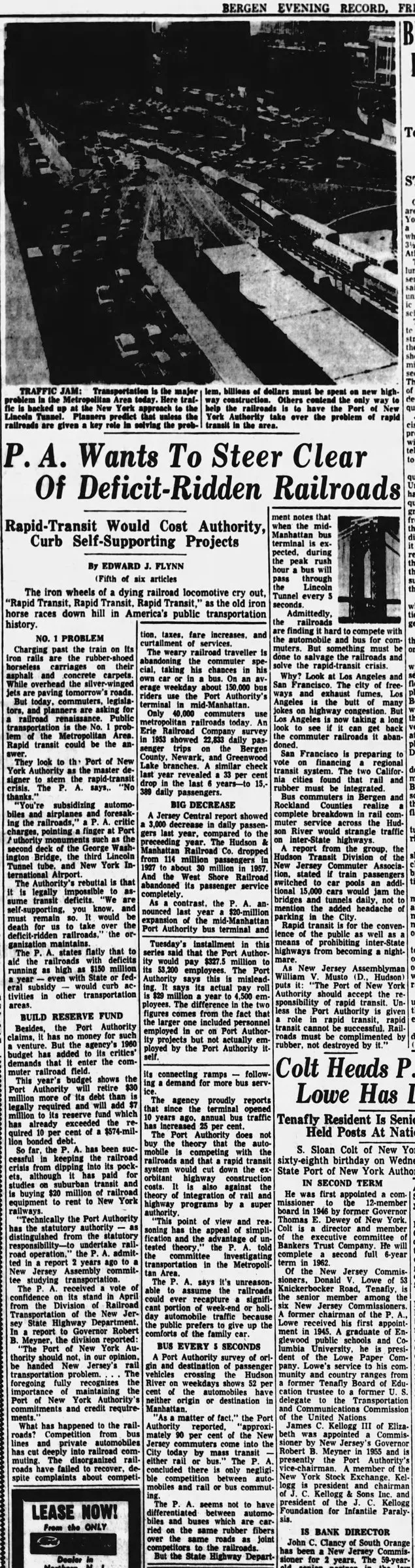
But the State Highway Department notes that when the mid-Manhattan bus terminal is expected, during the peak rush hour a bus will pass through the Lincoln Tunnel every 5 seconds.
Admittedly, the railroads are finding it hard to compete with the automobile and bus for commuters. But something must be done to salvage the railroads and solve the rapid-transit crisis.
Why? Look at Los Angeles and San Francisco. The city of freeways and exhaust fumes, Los Angeles is the butt of many jokes on highway congestion. But Los Angeles is now taking a long look to see if it can get back the commuter railroads it abandoned.
San Francisco is preparing to vote on financing a regional transit system. The two California cities found that rail and rubber must be integrated.
Bus commuters in Bergen and Rockland Counties realize a complete breakdown in rail commuter service across the Hudson River would strangle traffic on inter-State highways.
A report from the group, the Hudson Transit Division of the New Jersey Commuter Association, stated if train passengers switched to car pools an additional 15,000 cars would jam the bridges and tunnels daily, not to mention the added headache of parking in the City.
Rapid transit is for the convenience of the public as well as a means of prohibiting inter-State highways from becoming a nightmare.
As New Jersey Assemblyman William V. Musto (D., Hudson) puts it: "The Port Authority should accept the responsibility of rapid transit. Unless the Port Authority is given a role in rapid transit, rapid transit cannot be successful. Railroads must be complimented by rubber, not destroyed by it."