The Commuter Problem: Politics Again Is Biggest Bar To Solution of Transit Crisis
Source pages
Source page 1
Source page 2
Transcription
Transcriptions may contain errors. Consult the source pages for the original wording and layout.
By James S. Brown
State rail service has withered on the vine during two generations of political chicanery and gassy oratory and once again political wrangling appears the biggest stumbling block in efforts to solve the transit crisis.
The latest plan calls for use of New Jersey Turnpike surplus funds to subsidize rail transportation and preserve passenger service throughout the state. But how the Legislature will receive the idea at its special session July 27 no one can guess.
The turnpike plan comes from the state’s Division of Rail Transportation, one of two agencies facing a problem which has been a political hot potato for 40 years.
The proposal would make available immediately between 30 and 40 million dollars in turnpike reserve funds and probably would produce annual sums beginning at 11 million in 1960 and reaching 43 million in 1988.
Voters’ OK Needed
The program would require approval first by the Legislature, then by the state’s voters in November, and finally by two-thirds of the turnpike bond holders. In return for relinquishing the revenue, which ordinarily would be used to retire the 430 million in turnpike bonds ahead of schedule, the bondholders would get new bonds backed by the state’s credit.
“The application of these surplus funds to the solution of New Jersey’s transportation problem is entirely proper for without doubt the turnpike has contributed materially to the decline in railroad passenger and freight traffic,” said Highway Commissioner Dwight R. G. Palmer.
It is proposed that the surplus funds be used to help the railroads pay their 18-million-dollar annual tax bill on New Jersey facilities, and to provide loans for modernization. It also would give the state money for other programs to assist passenger service.
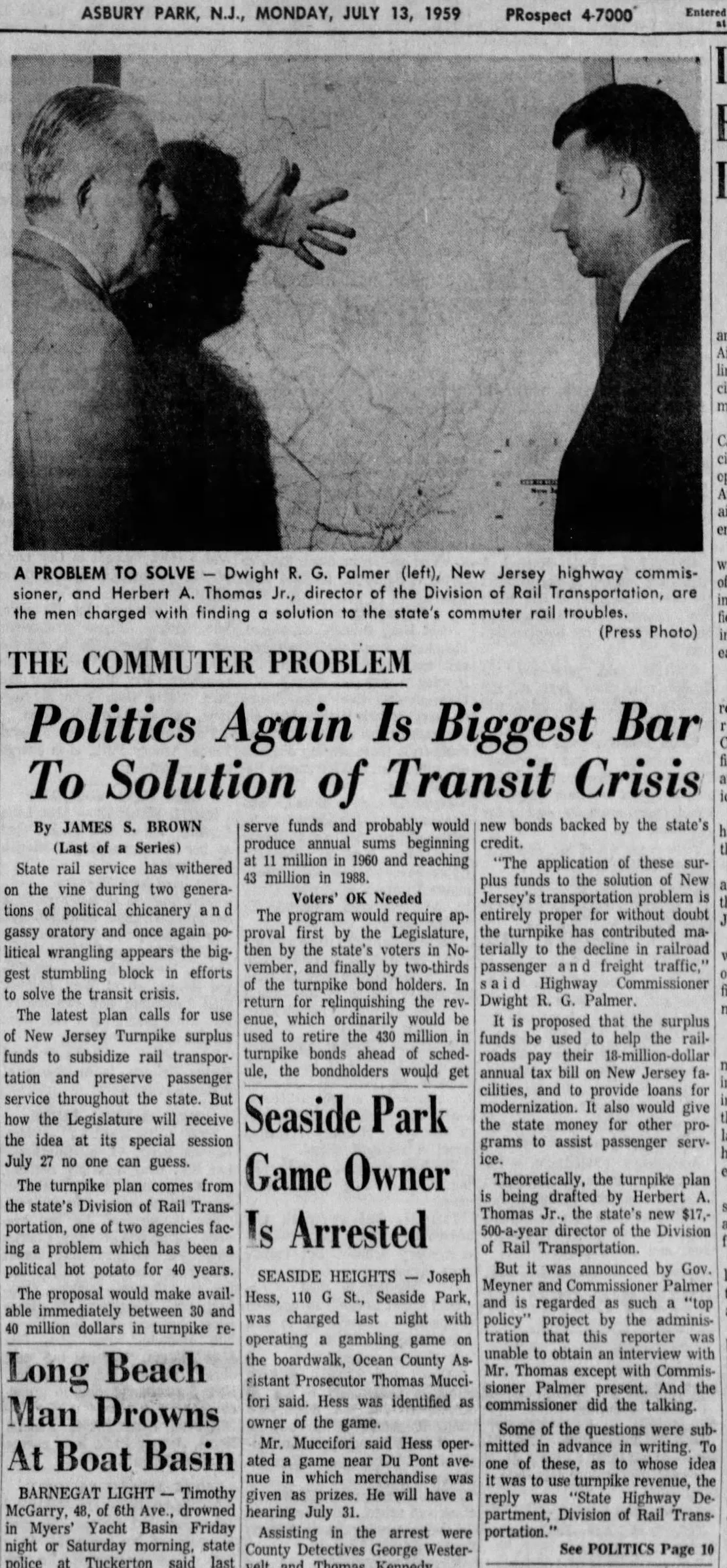
Theoretically, the turnpike plan is being drafted by Herbert A. Thomas Jr., the state’s new $17,500-a-year director of the Division of Rail Transportation.
But it was announced by Gov. Meyner and Commissioner Palmer and is regarded as such a “top policy” project by the administration that this reporter was unable to obtain an interview with Mr. Thomas except with Commissioner Palmer present. And the commissioner did the talking.
Some of the questions were submitted in advance in writing. To one of these, as to whose idea it was to use turnpike revenue, the reply was “State Highway Department, Division of Rail Transportation.”
Mr. Palmer said the plan contemplates consolidation of facilities in the North Jersey area, such as the Central Railroad using the Pennsylvania right of way into New York and shuttling passengers downtown on the Hudson & Manhattan. It could also mean elimination of Central or Lackawanna Ferry service, both deficit operations, but the plan “does not yet pinpoint which would be of greatest value to retain,” the commissioner said.
More specific information, including the future of Shore commuter service, won’t be revealed until the Legislature meets July 27, said Mr. Palmer.
Earl T. Moore, president of the Central, revealed that one of the plans is for Shore service by only one railroad. “I would guess it would be the Pennsylvania.”
Mr. Moore said “The approach at Trenton seems to be along much more practical lines than has been made in the past.” He emphasized that it is a plan to save the commuters, not the railroads.
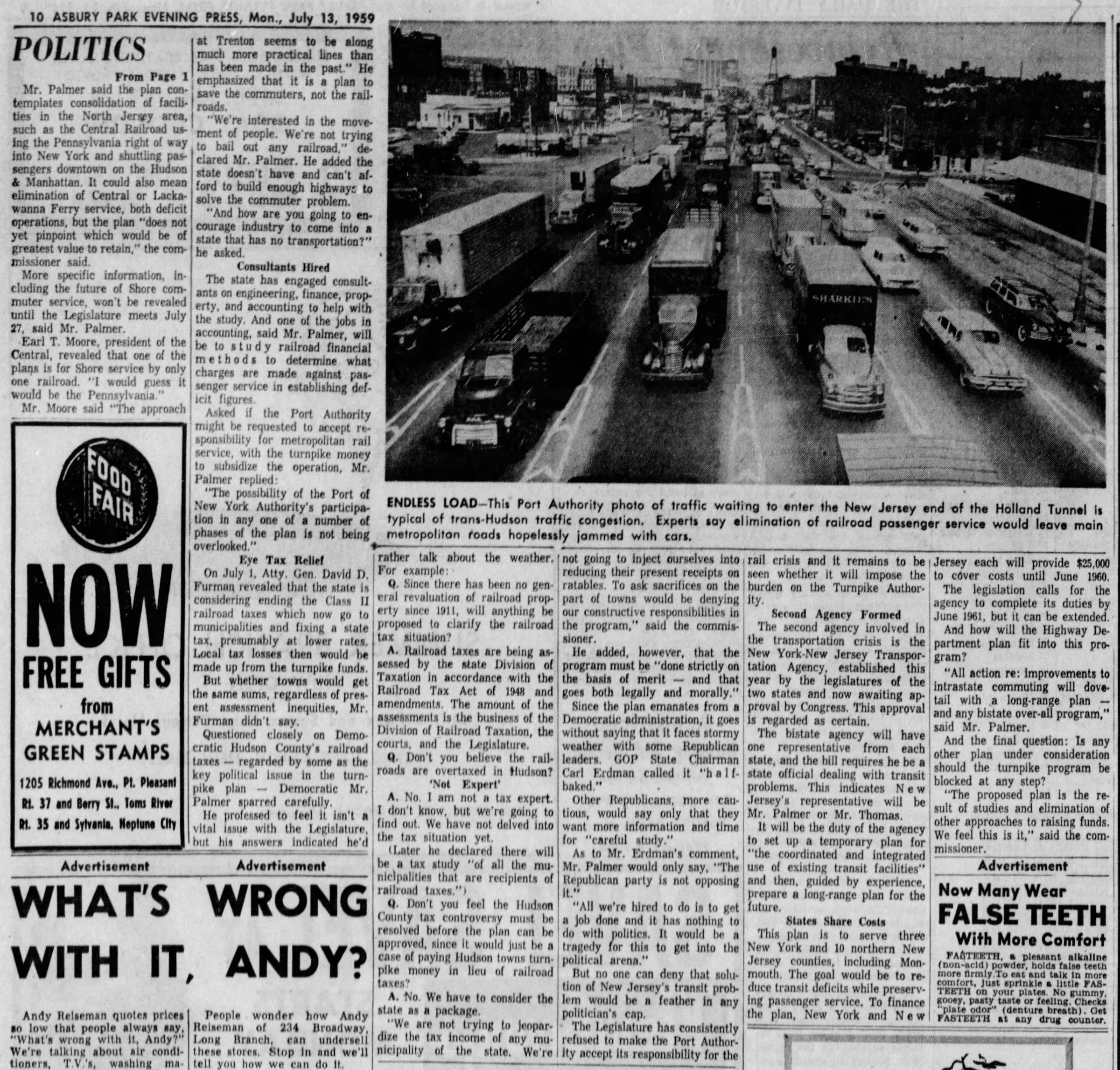
“We’re interested in the movement of people. We’re not trying to bail out any railroad,” declared Mr. Palmer. He added the state doesn’t have and can’t afford to build enough highways to solve the commuter problem.
“And how are you going to encourage industry to come into a state that has no transportation?” he asked.
Consultants Hired
The state has engaged consultants on engineering, finance, property, and accounting to help with the study. And one of the jobs in accounting, said Mr. Palmer, will be to study railroad financial methods to determine what charges are made against passenger service in establishing deficit figures.
Asked if the Port Authority might be requested to accept responsibility for metropolitan rail service, with the turnpike money to subsidize the operation, Mr. Palmer replied:
“The possibility of the Port of New York Authority’s participation in any one of a number of phases of the plan is not being overlooked.”
Eye Tax Relief
On July 1, Atty. Gen. David D. Furman revealed that the state is considering ending the Class II railroad taxes which now go to municipalities and fixing a state tax, presumably at lower rates. Local tax losses then would be made up from the turnpike funds.
But whether towns would get the same sums, regardless of present assessment inequities, Mr. Furman didn’t say.
Questioned closely on Democratic Hudson County’s railroad taxes – regarded by some as the key political issue in the turnpike plan – Democratic Mr. Palmer sparred carefully.
He professed to feel it isn’t a vital issue with the Legislature, but his answer indicated he’d rather talk about the weather. For example:
Q. Since there has been no general revaluation of railroad property since 1911, will anything be proposed to clarify the railroad tax situation?
A. Railroad taxes are being assessed by the state Division of Taxation in accordance with the Railroad Tax Act of 1948 and amendments. The amount of the assessments is the business of the Division of Railroad Taxation, the courts, and the Legislature.
Q. Don’t you believe the railroads are overtaxed in Hudson?
‘Not Expert’
A. No. I am not a tax expert. I don’t know, but we’re going to find out. We have not delved into the tax situation yet.
(Later he declared there will be a tax study “of all the municipalities that are recipients of railroad taxes.”)
Q. Don’t you feel the Hudson County tax controversy must be resolved before the plan can be approved, since it would just be a case of paying Hudson towns turnpike money in lieu of railroad taxes?
A. No. We have to consider the state as a package.
“We are not trying to jeopardize the tax income of any municipality of the state. We’re not going to inject ourselves into reducing their present receipts on ratables. To ask sacrifices on the part of towns would be denying our constructive responsibilities in the program,” said the commissioner.
He added, however, that the program must be “done strictly on the basis of merit – and that goes both legally and morally.”
Since the plan emanates from a Democratic administration, it goes without saying that it faces stormy weather with some Republican leaders. GOP State Chairman Carl Erdman called it “half-baked.”
Other Republicans, more cautious, would say only that they want more information and time for “careful study.”
As to Mr. Erdman’s comment, Mr. Palmer would only say, “The Republican party is not opposing it.”
“All we’re hired to do is to get a job done and it has nothing to do with politics. It would be a tragedy for this to get into the political arena.”
But no one can deny that solution of New Jersey’s transit problem would be a feather in any politician’s cap.
The Legislature has consistently refused to make the Port Authority accept its responsibiltiy for the rail crisis and it remains to be seen whether it will impose the burden on the Turnpike Authority.
Second Agency Formed
The second agency involved in the transportation crisis is the New York-New Jersey Transportation Agency, established this year by the legislatures of the two states and now awaiting approval by Congress. This approval is regarded as certain.
The bistate agency will have one representative from each state, and the bill requires he be a state official dealing with transit problems. This indicates New Jersey’s representative will be Mr. Palmer or Mr. Thomas.
It will be the duty of the agency to set up a temporary plan for “the coordinated and integrated use of existing transit facilities” and then, guided by experience, prepare a long-range plan for the future.
States Share Costs
The plan is to serve three New York and 10 northern New Jersey counties, including Monmouth. The goal would be to reduce transit deficits while preserving passenger service. To finance the plan, New York and New Jersey each will provide $25,000 to cover costs until June 1960.
The legislation calls for the agency to complete its duties by June 1961, but it can be extended.
And how will the Highway Department plan fit into this program?
“All action re: improvements to intrastate commuting will be dovetail with a long-range plan – and any bistate overall program,” said Mr. Palmer.
And the final question: Is any other plan under consideration should the turnpike program be blocked at any step?
“The proposed plan is the result of studies and elimination of other approaches to raising funds. We feel this is it,” said the commissioner.