Lance's Proposed State Agency To Deal with Commuter Issue
Source page
Source page 1
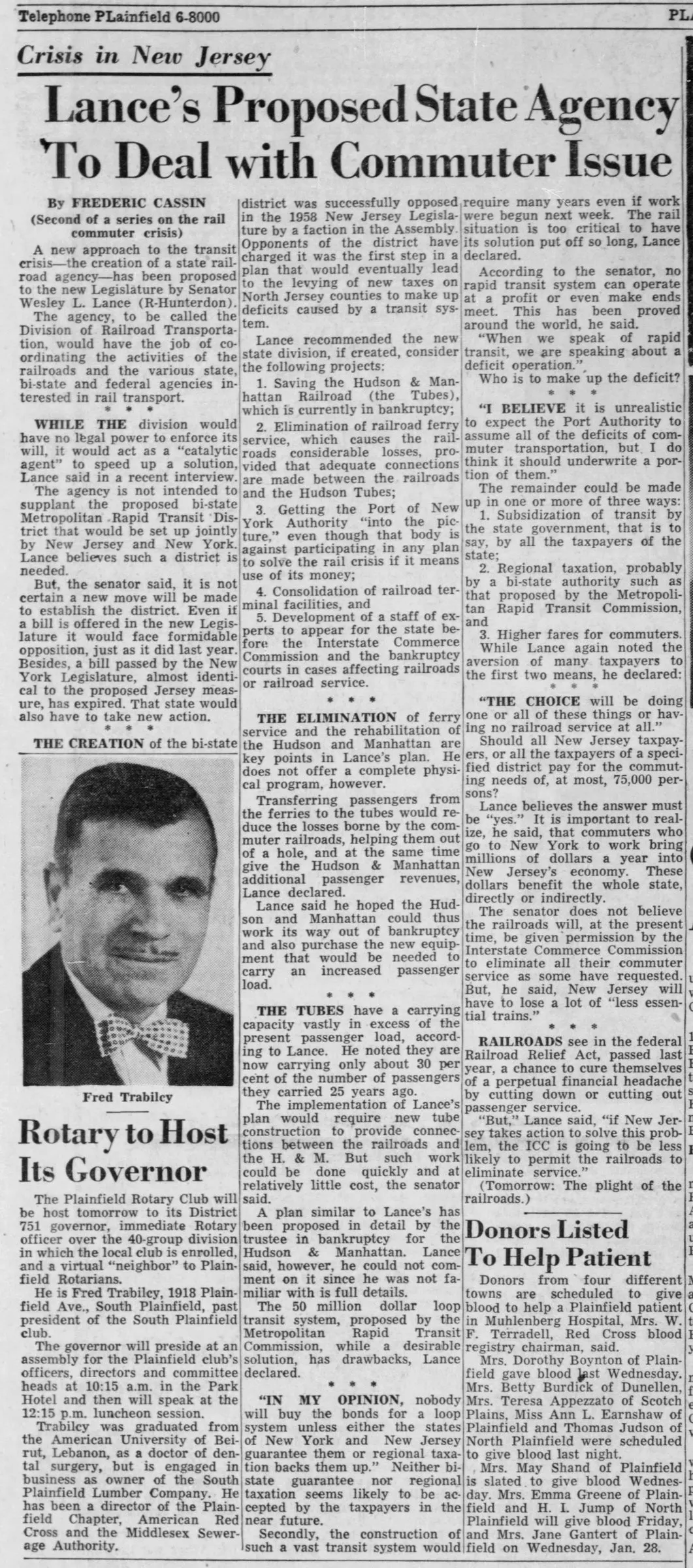
Transcription
Transcriptions may contain errors. Consult the source pages for the original wording and layout.
By Frederic Cassin
(Second of a series on the rail commuter crisis)
A new approach to the transit crisis—the creation of a state railroad agency—has been proposed to the new Legislature by Senator Wesley L. Lance (R-Hunterdon).
The agency, to be called the Division of Railroad Transportation, would have the job of coordinating the activities of the railroads and the various state, bi-state and federal agencies interested in rail transport.
WHILE the division would have no legal power to enforce its will, it would act as a "catalyst agent" to speed up a solution, Lance said in a recent interview.
The agency is not intended to supplant the proposed bi-state Metropolitan Rapid Transit District that would be set up jointly by New Jersey and New York. Lance believes such a district is needed.
But, the senator said, it is not certain a new move will be made to establish the district. Even if a bill is offered in the new Legislature it would face formidable opposition, just as it did last year. Besides, a bill passed by the New York Legislature, almost identical to the proposed Jersey measure, has expired. That state would also have to take new action.
The Creation of the bi-state district was successfully opposed in the 1958 New Jersey Legislature by a faction in the Assembly. Opponents of the district have charged it was the first step in a plan that would eventually lead to the levying of new taxes on New Jersey counties to make up deficits caused by a transit system.
Lance recommended the new district, if created, consider the following projects:
1. Saving the Hudson & Manhattan Railroad (the Tubes), which is currently in bankruptcy;
2. Elimination of railroad ferry service, which causes the railroads considerable losses, provided that adequate connections are made between the railroads and the Hudson Tubes;
3. Getting the Port of New York Authority "into the picture," even though that body is against participating in any plan to solve the rail crisis if it means use of its money;
4. Consolidation of railroad terminal facilities, and
5. Development of a staff of experts to appear for the state before the Interstate Commerce Commission and the bankruptcy courts in cases affecting railroads or railroad service.
The Elimination of ferry service and the rehabilitation of the Hudson and Manhattan Tubes is key in Lance's plan. He does not offer a complete physical program, however.
Transferring passengers from the ferries to the tubes would reduce the losses borne by the commuter railroads, helping them out of a hole, and at the same time give the Hudson & Manhattan additional passenger revenue, Lance declared.
Lance said he hoped the Hudson and Manhattan could thus work its way out of bankruptcy and also purchase the new equipment that would be needed to carry an increased passenger load.
The Tubes have a carrying capacity vastly in excess of the present passenger load, according to Lance. He noted they are now carrying only about 30 percent of the number of passengers they carried 25 years ago.
The implementation of Lance's plan would require new tube construction to provide connections between the railroads and the H. & M. But such work could be done quickly and at relatively little cost, the senator said.
A plan similar to Lance's has been proposed in detail by the trustee in bankruptcy for the Hudson & Manhattan. Lance said, however, he could not comment on it since he was not familiar with its full details.
The 50 million dollar loop transit system, proposed by the Metropolitan Rapid Transit Commission, while a desirable solution, has drawbacks, Lance declared.
"In My Opinion, nobody will buy the bonds for a loop system unless either the states of New York and New Jersey enact new taxes or regional taxation backs them up." Neither bi-state guarantee nor regional taxation seems likely to be accepted by the taxpayers in the near future.
Secondly, the construction of such a vast transit system would require many years even if work were begun next week. The rail situation is too critical to have its solution put off so long, Lance declared.
According to the senator, no rapid transit system can operate at a profit or even make ends meet. This has been proved around the world, he said.
"When we speak of rapid transit, we are speaking about a deficit operation."
Who is to make up the deficit?
"I believe it is unrealistic to expect the Port Authority to assume all of the deficits of commuter transportation, but I do think it should underwrite a portion of them."
The remainder could be made up in one or more of three ways:
1. Subsidization of transit by the state government, that is to say, by all the taxpayers of the state;
2. Regional taxation, probably by a bi-state authority such as that proposed by the Metropolitan Rapid Transit Commission;
3. Higher fares for commuters.
While Lance again noted the aversion of many taxpayers to the first two means, he declared:
"The Choice will be doing one or all of these things or having no railroad service at all."
Should all New Jersey taxpayers, or all the taxpayers of a specified district pay for the commuting needs of, at most, 75,000 persons?
Lance believes the answer must be "yes." It is important to realize, he said, that commuters bring millions of dollars a year into New Jersey's economy. These dollars benefit the whole state, directly or indirectly.
The senator does not believe the railroads will, in the present time, be given permission by the Interstate Commerce Commission to eliminate all their commuter service as some have requested. But, he said, New Jersey will have to lose a lot of "less essential trains."
Railroads see in the federal Railroad Relief Act, passed last year, a chance to cure themselves of a perpetual financial headache by cutting down or cutting out passenger service.
"But," Lance said, "if New Jersey takes action to solve this problem, the ICC is going to be less likely to permit the railroads to eliminate service."
Other editions
- Lance’s Proposed State Agency To Deal with Commuter Issue · The Courier-News · January 20, 1959