Government For A Metropolis: Bergen Ignores The Debating
County Officials Say They Have Local Problems That Need Attention First
Source pages
Source page 1
Source page 2
Transcription
Transcriptions may contain errors. Consult the source pages for the original wording and layout.
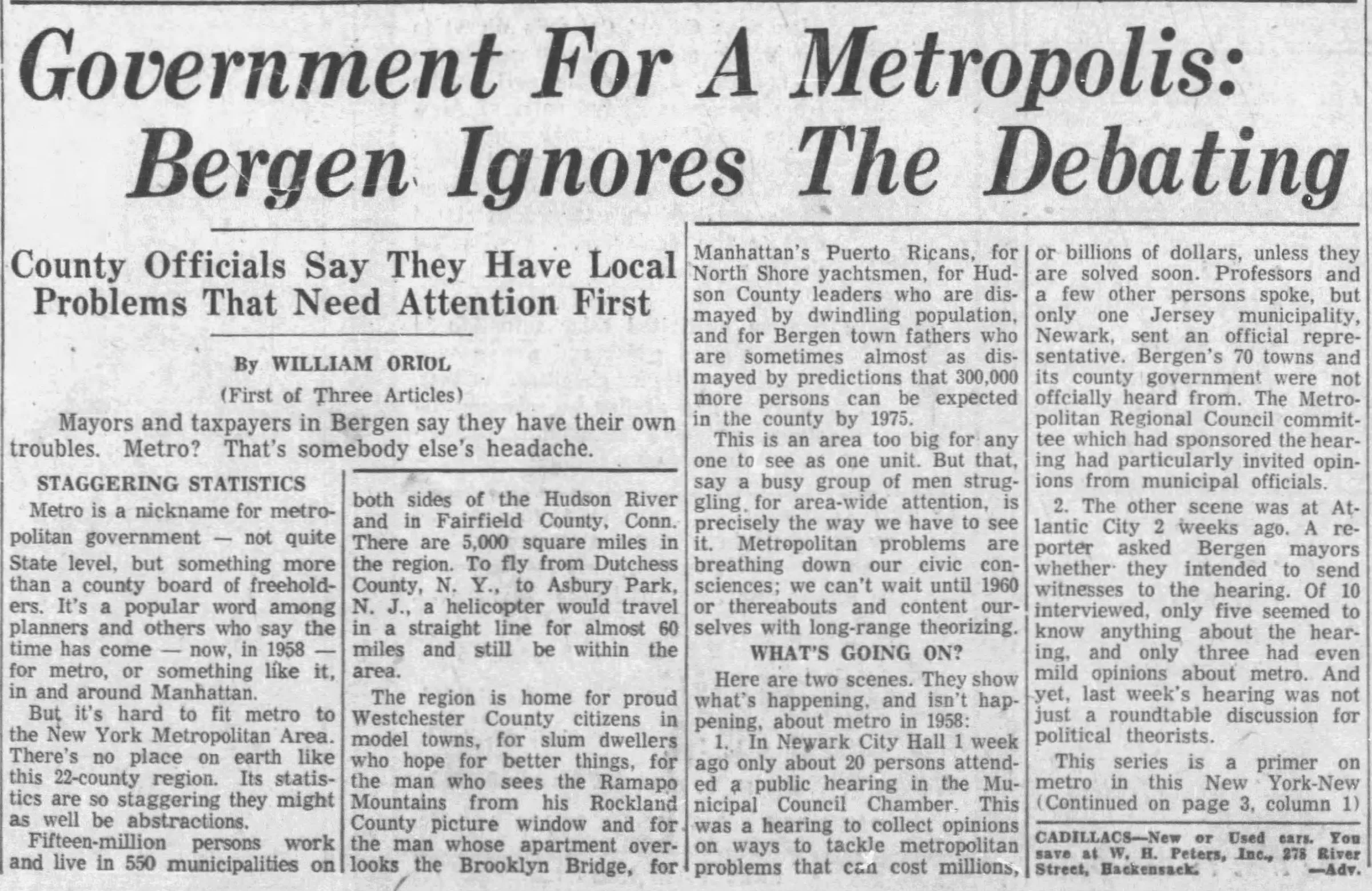
Mayors and taxpayers in Bergen say they have their own troubles. Metro? That’s somebody else’s headache.
Staggering Statistics
Metro is a nickname for metropolitan government – not quite State level, but something more than a county board of freeholders. It's a popular word among planners and others who say the time has come – now, in 1958 – for metro, or something like it, in and around Manhattan.
But it's hard to fit metro to the New York Metropolitan Area. There's no place on earth like this 22-county region. Its statistics are so staggering they might as well be abstractions.
Fifteen-million persons work and live in 550 municipalities on both sides of the Hudson River and in Fairfield County, Conn. There are 5,000 square miles in the region. To fly from Dutchess County, N. Y., to Asbury Park, N. J., a helicopter would travel in a straight line for almost 60 miles and still be within the area.
The region is home for proud Westchester County citizens in model towns, for slum dwellers who hope for better things, for the man who sees the Ramapo Mountains from his Rockland County picture window and for the man whose apartment overlooks the Brooklyn Bridge, for Manhattan's Puerto Ricans, for North Shore yachtsmen, for Hudson County leaders who are dismayed by dwindling population, and for Bergen town fathers who are sometimes almost as dismayed by predictions that 300,000 more persons can be expected in the county by 1975.
This is an area too big for any one to see as one unit. But that, say a busy group of men struggling for area-wide attention, is precisely the way we have to see it.
Metropolitan problems are breathing down our civic consciences; we can't wait until 1960 or thereabouts and content ourselves with long-range theorizing.
What’s Going On?
Here are two scenes. They show what's happening. and isn't happening, about metro in 1958:
1. In Newark City Hall 1 week ago only about 20 persons attended a public hearing in the Municipal Council Chamber. This was a hearing to collect opinions on ways to tackle metropolitan problems that can cost millions, or billions of dollars, unless they are solved soon. Professors and a few other persons spoke, but only one Jersey municipality, Newark, sent an official representative. Bergen's 70 towns and its county government were not offcially heard from. The Metropolitan Regional Council committee which had sponsored the hearing had particularly invited opinions from municipal officials.
2. The other scene was at Atlantic City 2 weeks ago. A reporter asked Bergen mayors whether they intended to send witnesses to the hearing. Of 10 interviewed, only five seemed to know anything about the hearing, and only three had even mild opinions about metro. And yet, last week's hearing was not just a roundtable discussion for political theorists.
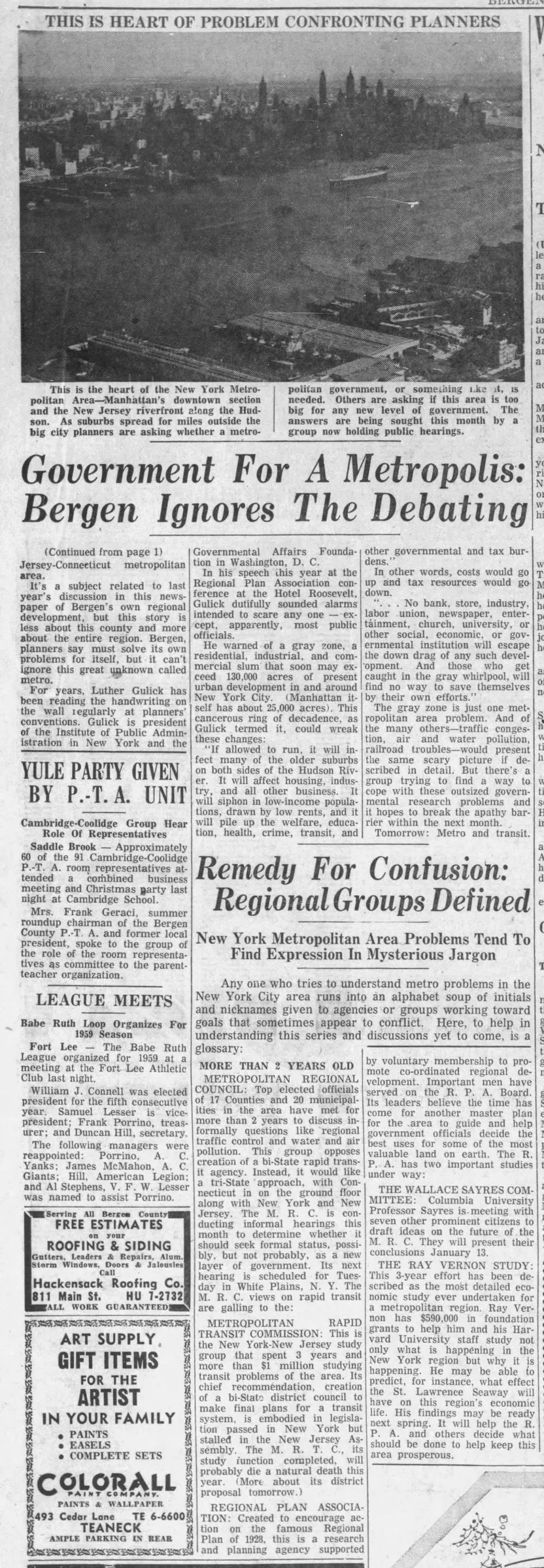
This series is a primer on metro in this New York-New Jersey-Connecticut metropolitan area.
It's a subject related to last year's discussion in this newspaper of Bergen's own regional development, but this story is less about this county and more about the entire region. Bergen, planners say must solve its own problems for itself, but it can't ignore this great unknown called metro.
For years, Luther Gulick has been reading the handwriting on the wall regularly at planners' conventions. Gulick is president of the Institute of Public Administration in New York and the Governmental Affairs Foundation in Washington, D. C.
In his speech this year at the Regional Plan Association conference at the Hotel Roosevelt, Gulick dutifully sounded alarms intended to scare any one except, apparently, most public officials.
He warned of a gray zone, a residential, industrial, and commercial slum that soon may exceed 130,000 acres of present urban development in and around New York City. (Manhattan itself has about 25,000 acres). This cancerous ring of decadence, as Gulick termed it, could wreak these changes:
"If allowed to run, it will infect many of the older suburbs on both sides of the Hudson River. It will affect housing, industry, and all other business. It will siphon in low-income populations, drawn by low rents, and it will pile up the welfare, education, health, crime, transit, and other governmental and tax burdens."
In other words, costs would go up and tax resources would go down.
“...No bank, store, industry, labor union, newspaper, enter-äinment, church, university, or other social, economic, or governmental institution will escape the down drag of any such development. And those who get caught in the gray whirlpool, will find no way to save themselves by their own efforts.”
The gray zone is just one metropolitan area problem. And of the many others--traffic congestion, air and water pollution, railroad troubles--would present the same scary picture if described in detail. But there's a group trying to find a way to cope with these outsized governmental research problems and it hopes to break the apathy barrier within the next month.
Tomorrow: Metro and transit.
Other editions
- Government For A Metropolis: Bergen Ignores The Debating · Bergen Evening Record (The Record) · December 3, 1958 · Page 1, 3