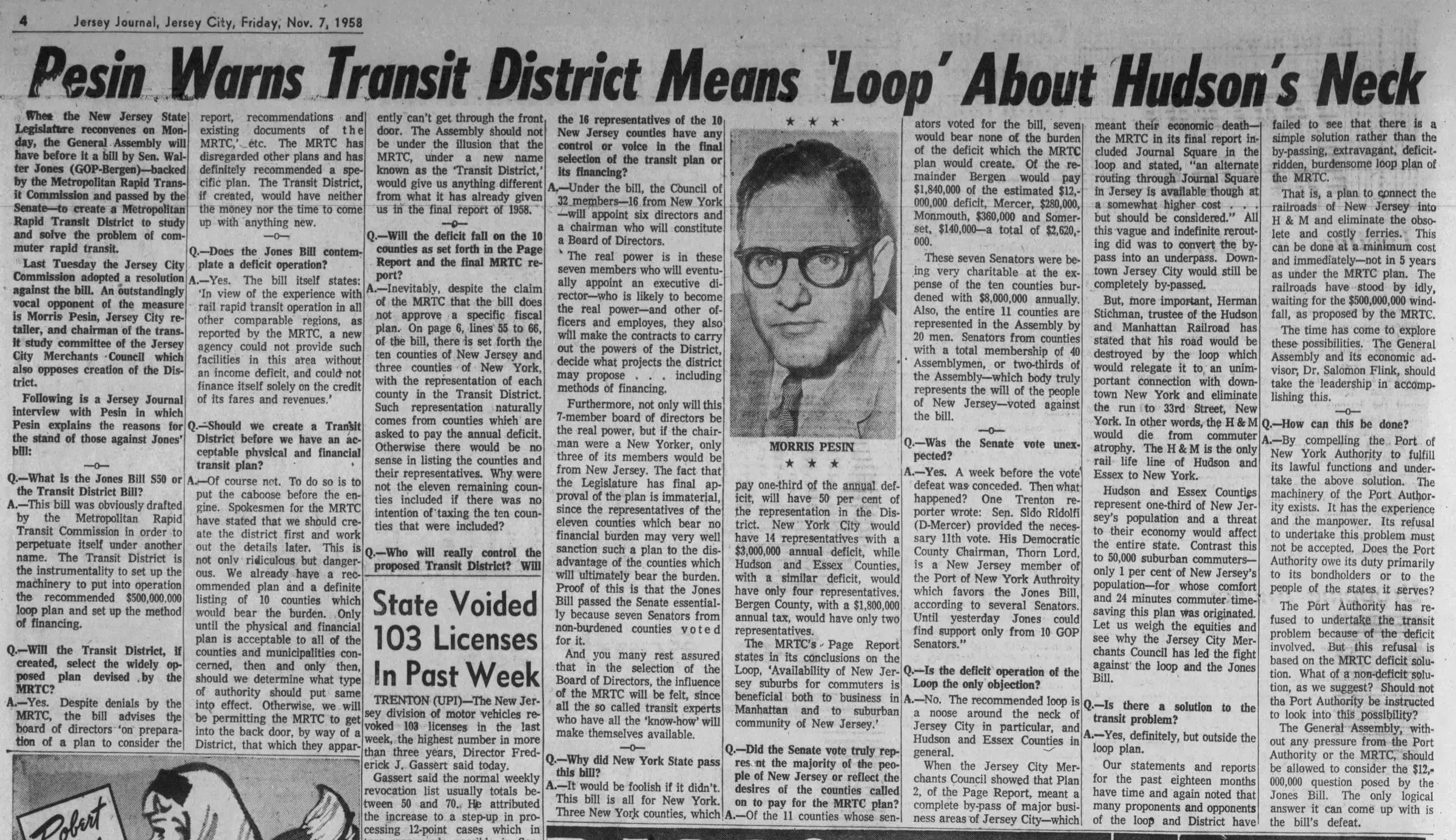
Pesin Warns Transit District Means ‘Loop’ About Hudson’s Neck
Source page
Source page 1
Transcription
Transcriptions may contain errors. Consult the source pages for the original wording and layout.
When the New Jersey State Legislature reconvenes on Monday, the General Assembly will have before it a bill by Sen. Walter Jones (GOP-Bergen)--backed by the Metropolitan Rapid Transit Commission and passed by the Senate–to create a Metropolitan Rapid Transit District to study and solve the problem of commuter rapid transit.
Last Tuesday the Jersey City Commission adopted a resolution against the bill. An outstandingly vocal opponent of the measure is Morris Pesin, Jersey City retailer, and chairman of the transit study committee of the Jersey City Merchants Council which also opposes creation of the District.
Following is a Jersey Journal interview with Pesin in which Pesin explains the reasons for the stand of those against Jones’ bill:
Q.--What is the Jones Bill S50 or the Transit District Bill?
A.--This bill was obviously drafted by the Metropolitan Rapid Transit Commission in order to perpetuate itself under another name. The Transit District is the instrumantality to set up the machinery to put into operation the recommended $500,000,000 loop plan and set up the method of financing.
Q.--Will the Transit District, if created, select the widely opposed plan devised by the MRTC?
A.--Yes. Despite denials by the MRTC, the bill advises the board of directors ‘on preparation of a plan to consider the report, recommendations and existing documents of the MRTC,’ etc. The MRTC has disregarded other plans and has definitely recommended a specific plan. The Transit District, if created, would have neither the money nor the time to come up with anything new.
Q.--Does the Jones Bill contemplate a deficit operation?
A.--Yes. The bill itself states: ‘In view of the experience with rail rapid transit operation in all other comparable regions, as reported by the MRTC, a new agency could not provide such facilities in this area without an income deficit, and could not finance itself solely on the credit of its fares and revenue.
Q.--Should we create a Transit District before we have an acceptable physical and financial transit plan?
A.--Of course not. To do so is to put the caboose before the engine. Spokesmen for the MRTC have stated that we should create the district first and work out the details later. This is not only ridiculous but dangerous. We already have a recommended plan and a definite listing of 10 counties which would bear the burden. Only until the physical and financial plan is acceptable to all of the counties and municipalities concerned, then and only then, should we determine what type of authority should put same into effect. Otherwise, we will be permitting the MRTC to get into the back door, by way of a District, that which they apparently can’t get through the front door. The Assembly should not be under the illusion that the MRTC, under a new name known as the ‘Transit District,’ would give us anything different from what it has already given us in the final report of 1958.
Q.--Will the deficit fall on the 10 counties as set forth in the Page Report and the final MRTC report?
A.--Inevitably, despite the claim of the MRTC that the bill does not approve a specific fiscal plan. On page 6, lines 55 to 66, of the bill, there is set forth the ten counties of New York, with the representation of each county in the Transit District. Such representation naturally comes from counties which are asked to pay the annual deficit. Otherwise there would be no sense in listing the counties and their representatives. Why were not the eleven remaining counties included if there was no intention of taxing the ten counties that were included?
Q.--Who will really control the proposed Transit District? Will the 16 representatives of the 10 New Jersey counties have any control or voice in the final selection of the transit plan or its financing?
A.--Under the bill, the Council of 32 members–16 from New York–will appoint six directors and a chairman who will constitute a Board of Directors.
The real power is in these seven members who will eventually appoint an executive director–who is likely to become the real power–and other officers and employees, they also will make the contracts to carry out the powers of the District, decide what projects the district may propose . . . including methods of financing.
Furthermore, not only will this 7-member board of directors be the real power, but if the chairman were a New Yorker, only three of its members would be from New Jersey. The fact that the Legislature has final approval of the plan is immaterial, since the representatives of the eleven counties which bear no financial burden may very well sanction such a plan to the disadvantage of the counties which will ultimately bear the burden. Proof of this is that the Jones Bill passed the Senate essentially because seven Senators from non-burdened counties voted for it.
And you many rest assured that in the selection of the Board of Directors, the influence of the MRTC will be felt, since all the so called transit experts who have all the ‘know-how’ will make themselves available.
Q.--Why did New York State pass this bill?
A.--It would be foolish if it didn’t. This bill is all for New York. Three New York counties, which pay one-third of the annual, deficit, will have 50 percent of the representation in the District. New York City would have 14 representatives with a $3,000,000 annual deficit, while Hudson and Essex Counties, with a similar deficit, would have only four representatives. Bergen County, with a $1,800,000 annual tax, would have only two representatives.
The MRTC'S Page Report states in its conclusions on the Loop, ‘Availability of New Jersey suburbs for commuters is beneficial both to business in Manhattan and to suburban community of New Jersey.’
Q.--Did the Senate vote truly represent the majority of the people of New Jersey or reflect the desires of the counties called on to pay for the MRTC plan?
A.--Of the 11 counties whose senators voted for the bill, seven would bear none of the burden of the deficit which the MRTC plan would create. of the remainder Bergen would pay $1,840,000 of the estimated $12,000,000 deficit, Mercer, $280,000, Monmouth, $360,000 and Somerset, $140,000–a total of $2,620,000.
These seven Senators were being very charitable at the expense of the ten counties burdened with $8,000,000 annually. Also, the entire 11 counties are represented in the Assembly by 20 men. Senators from counties with a total membership of 40 Assemblymen, or two-thirds of the Assembly–which body truly represents the will of the people of New Jersey–voted against the bill.
Q.--Was the Senate vote unexpected?
A.--Yes. A week before the vote defeat was conceded. Then what' happened? One Trenton reporter wrote: Sen. Sido Ridolfi (D-Mercer) provided the necessary 11th vote. His Democratic County Chairman, Thorn Lord, is a New Jersey member of the Port of New York Authroity which favors the Jones Bill, according to several Senators. Until yesterday Jones could find support only from 10 GOP Senators.
Q.--Is the deficit operation of the Loop the only objection?
A.--No. The recommended loop is a noose around the neck of Jersey City in particular, and Hudson and Essex Counties in general.
When the Jersey City Merchants Council showed that Plan 2, of the Page Report, meant a complete by-pass of major business areas of Jersey City--which meant their economic death–the MRTC in its final report included Journal Square in the loop and stated, “an alternate routing through Journal Square in Jersey is available though at a somewhat higher cost but should be considered.” All this vague and indefinite rerouting did was to convert the bypass into an underpass. Downtown Jersey City would still be completely by-passed.
But, more important, Herman Stichman, trustee of the Hudson and Manhattan Railroad has stated that his road would be destroyed by the loop which would relegate it to, an unimportant connection with downtown New York and eliminate the run to 33rd Street, New York. In other words, the H & Mi would die from commuter atrophy. The H & M is the only rail life line of Hudson and Essex to New York.
Hudson and Essex Counties represent one-third of New Jersey's population and a threat to their economy would affect the entire state. Contrast this to 50,000 suburban commuters–only 1 percent of New Jersey's population--for whose comfort and 24 minutes commuter time-saving this plan was originated. Let us weigh the equities and see why the Jersey City Merchants Council has led the fight against the loop and the Jones Bill.
Q.--Is there a solution to the transit problem?
A.--Yes, definitely, but outside the loop plan.
Our statements and reports for the past eighteen months have time and again noted that many proponents and opponents of the loop and District have failed to see that there is a simple solution rather than the by-passing, extravagant, deficit-ridden, burdensome loop plan of the MRTC.
That is, a plan to connect the railroads of New Jersey into H & M and eliminate the obsolete and costly ferries. This can be done at a minimum cost and immediately not in 5 years as under the MRTC plan. The railroads have stood by idly, waiting for the $500,000,000 windfall, as proposed by the MRTC.
The time has come to explore these possibilities. The General Assembly and its economic advisor, Dr. Salomon Flink, should take the leadership in accomplishing this.
Q.--How can this be done?
A.--By compelling the Port of New York Authority to fulfill its lawful functions and undertake the above solution. The machinery of the Port Authority exists. It has the experience and the manpower. Its refusal to undertake this problem must not be accepted. Does the Port Authority owe its duty primarily to its bondholders or to the people of the states it serves?
The Port Authority has refused to undertake the transit problem because of the deficit involved. But this refusal is based on the MRTC deficit solution. What of a non-deficit solution, as we suggest? Should not the Port Authority be instructed to look into this possibility?
The General Assembly, without any pressure from the Port Authority or the MRTC, should be allowed to consider the $12,000,000 question posed by the Jones Bill. The only logical answer it can come up with is the bill's defeat.
Other editions
- Pesin Warns Transit District Means ‘Loop’ About Hudson’s Neck · The Jersey Journal and Jersey Observer · November 7, 1958 · Page 4