Transit Plan Block Laid To Authority
Source pages
Source page 1
Source page 2
Source page 3
Transcription
Transcriptions may contain errors. Consult the source pages for the original wording and layout.
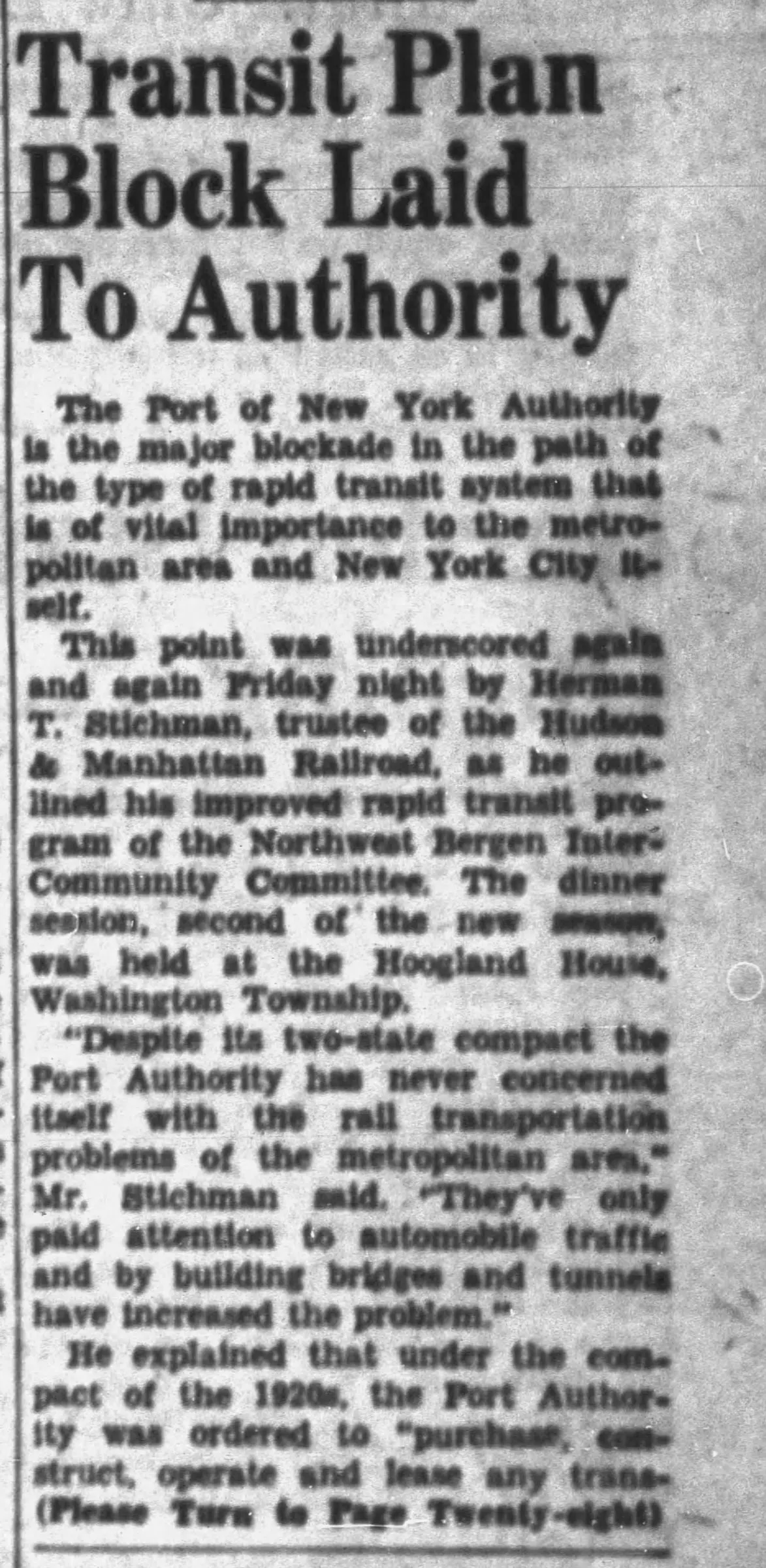
The Port of New York Authority is the major blockade in the path of the type of rapid transit system that is of vital importance to the metropolitan area and New York City itself.
This point was underscored again and again Friday night by Herman T. Stichman, trustee of the Hudson & Manhattan Railroad, as he outlined his improved rapid transit program of the Northwest Bergen Inter-Community Committee. The dinner session, second of the new season, was held at the Hoogland House, Washington Township.
“Despite its two-state compact the Port Authority has never concerned itself with the rail transportation problems of the metropolitan area,” Mr. Stichman said. “They’ve only paid attention to automobile traffic and by building bridges and tunnels have increased the problem.”
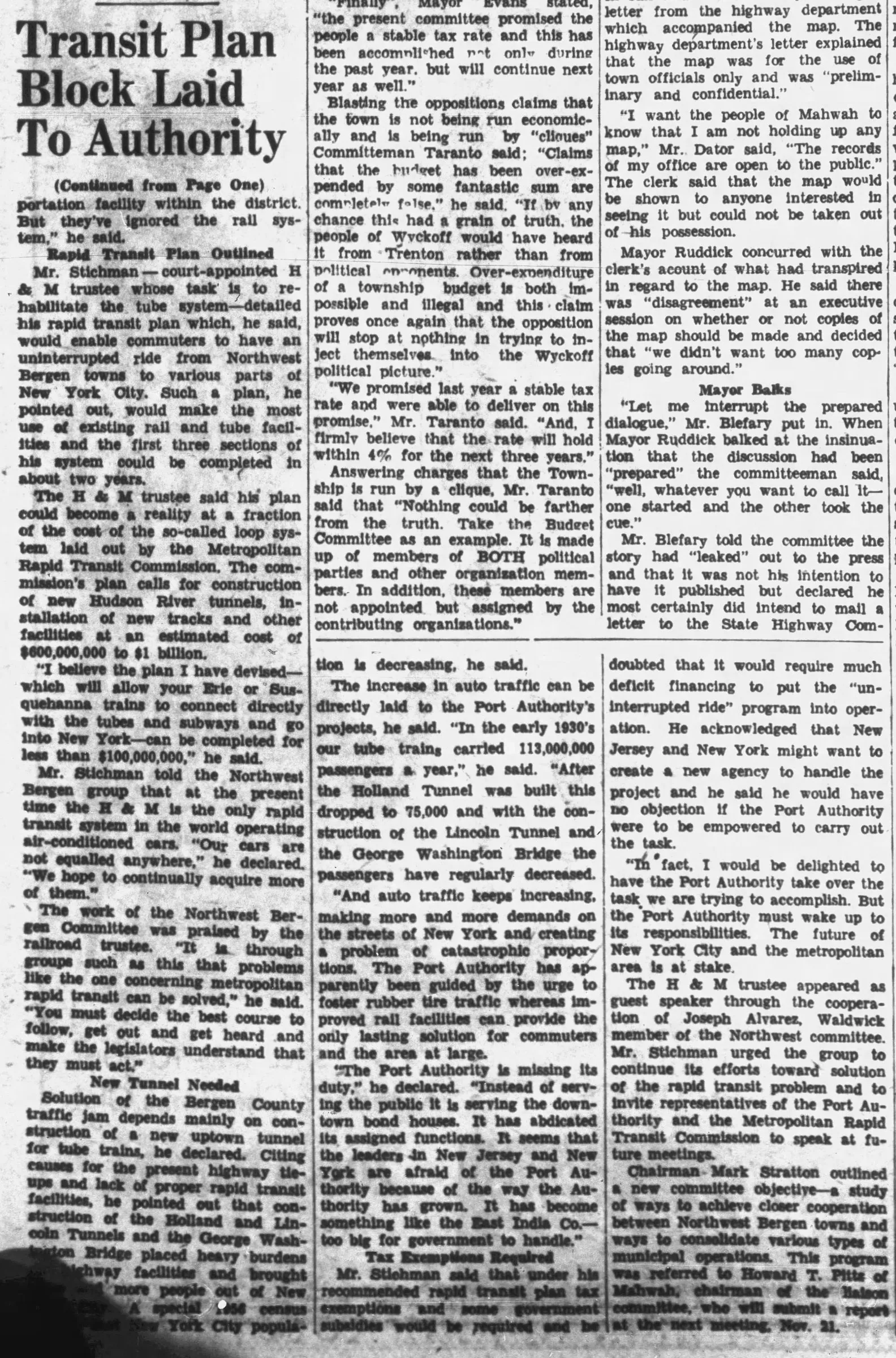
He explained that under the compact of the 1920s, the Port Authority was ordered to “purchase, construct, operate and lease and transportation facility within the district. But they’ve ignored the rail system,” he said.
Rapid Transit Plan Outlined
Mr. Stichman–court-appointed H & M trustee whose task is to rehabilitate the tube system–detailed his rapid transit plan which, he said, would enable commuters to have an uninterrupted ride from Northwest Bergen towns to various parts of New York City. Such a plan, he pointed out, would make the most use of existing rail and tube facilities and the first three sections of his system could be completed in about two years.
The H & M trustee said his plan could become a reality at a fraction of the cost of the so-called loop system laid out by the Metropolitan Rapid Transit Commission. The commission’s plan calls for construction of new Hudson River tunnels, installation of new tracks and other facilities at an estimated cost of $600,000,000 to $1 billion.
“I believe the plan I have devised–which will allow your Erie or Susquehanna trains to connect directly with the tubes and subways and go into New York–can be completed for less than $100,000,000,” he said.
Mr. Stichman told the Northwest Bergen group that at the present time the H & M is the only rapid transit system in the world operating air-conditioned cars. “Our cars are not equalled anywhere,” he declared. “We hope to continually acquire more of them.”
The work of the Northwest Bergen Committee was praised by the railroad trustee. “It is through groups such as this that problems like the one concerning metropolitan rapid transit can be solved,” he said. “You must decide the best course to follow, get out and get heard and make the legislators understand that they must act.”
New Tunnel Needed
Solution of the Bergen County traffic jam depends mainly on construction of a new uptown tunnel for tube trains, he declared. Citing causes for the present highway tie-ups and lack of proper rapid transit facilities, he pointed out that construction of the Holland and Lincoln Tunnels and the George Washington Bridge placed heavy burdens on highway facilities and brought more and more people out of New York City. A special 1956 census showed the New York City population is decreasing, he said.
The increase in auto traffic can be directly laid to the Port Authority’s projects, he said. “In the early 1930’s our tube trains carried 113,000,000 passengers a year,” he said. “After the Holland Tunnel was built this dropped to 75,000 and with the construction of the Lincoln Tunnel and the George Washington Bridge the passengers have regularly decreased.
“And auto traffic keeps increasing, making more and more demands on the streets of New York and creating a problem of catastrophic proportions. The Port Authority has apparently been guided by the urge to foster rubber tire traffic whereas improved rail facilities can provide the only lasting solution for commuters and the area at large.
“The Port Authority is missing its duty,” he declared. “Instead of serving the public it is serving the downtown bond houses. It has abdicated its assigned functions. It seems that the leaders in New Jersey and New York are afraid of the Port Authority because of the way the Authority has grown. It has become something like the East India Co.--too big for government to handle.”
Tax Exemptions Required
Mr. Stichman said that under his recommended rapid transit plan tax exemptions and some government subsidies would be required and he doubted that it would require much deficit financing to put the “uninterrupted ride” program into operation. He acknowledged that New Jersey and New York might want to create a new agency to handle the project and he said he would have no objection if the Port Authority were to be empowered to carry out the task.
“In fact, I would be delighted to have the Port Authority take over the task we are trying to accomplish. But the Port Authority must wake up to its responsibilities. The future of New York City and the metropolitan area is at stake.
The H & M trustee appeared as guest speaker through the cooperation of Joseph Alvarez, Waldwick member of the Northwest committee. Mr. Stichman urged the group to continue its efforts toward solution of the rapid transit problem and to invite representatives of the Port Authority and the Metropolitan Rapid Transit Commission to speak at future meetings.
Chairman Mark Stratton outlined a new committee objective–a study of ways to achieve closer cooperation between Northwest Bergen towns and ways to consolidate various types of municipal operations. This program was referred to Howard T. Pitts of Mahwah, chairman of the liaison committee, who will submit a report at the next meeting, Nov. 21.
Other editions
- Transit Plan Block Laid To Authority · The · October 19, 1958 · Page 28