The Longest Journey Begins With A Step
Source page
Source page 1
Transcription
Transcriptions may contain errors. Consult the source pages for the original wording and layout.
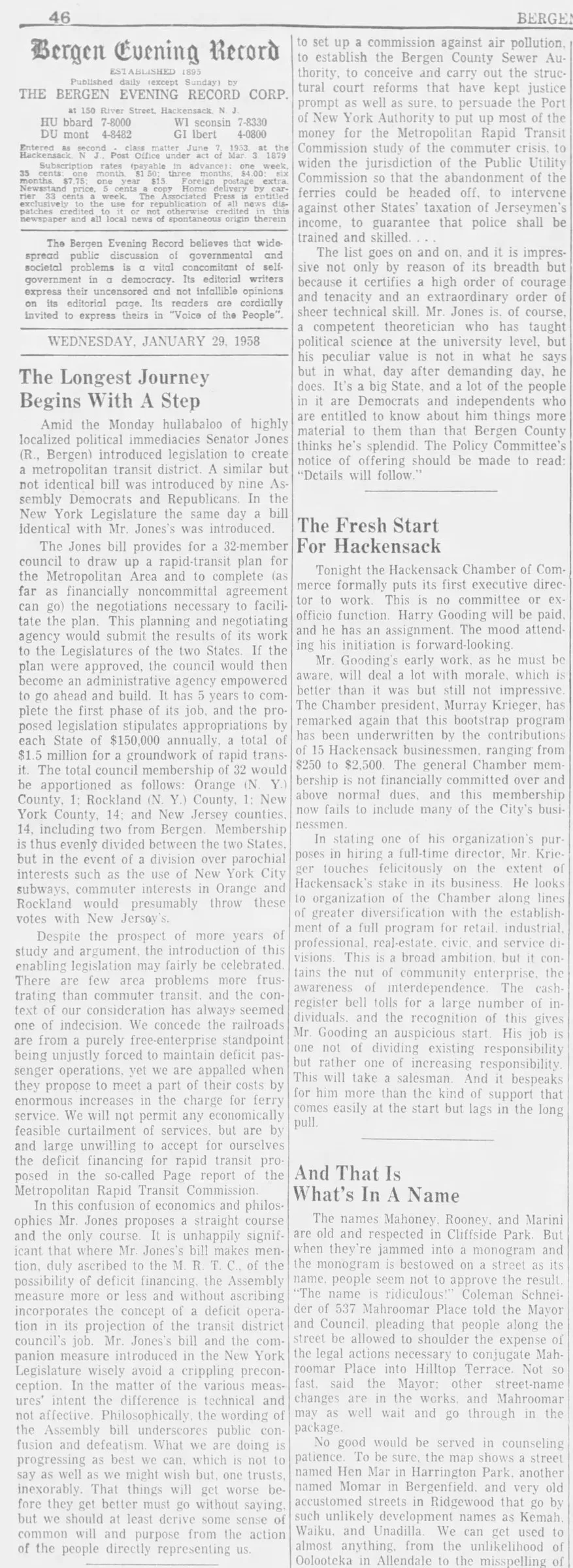
Amid the Monday hullabaloo of highly localized political immediacies Senator Jones (R., Bergen) introduced legislation to create a metropolitan transit district. A similar but not identical bill was introduced by nine Assembly Democrats and Republicans. In the New York Legislature the same day a bill identical with Mr. Jones's was introduced.
The Jones bill provides for a 32-member council to draw up a rapid-transit plan for the Metropolitan Area and to complete (as far as financially noncommittal agreement can go) the negotiations necessary to facilitate the plan. This planning and negotiating agency would submit the results of its work to the Legislatures of the two States. If the plan were approved, the council would then become an administrative agency empowered to go ahead and build. It has 5 years to complete the first phase of its job, and the proposed legislation stipulates appropriations by each State of $150,000 annually, a total of $1.5 million for a groundwork of rapid transit. The total council membership of 32 would be apportioned as follows: Orange (N. Y.) County, 1; Rockland (N. Y.) County, 1; New York County, 14; and New Jersey counties, 14, including two from Bergen. Membership is thus evenly divided between the two States, but in the event of a division over parochial interests such as the use of New York City subways, commuter interests in Orange and Rockland would presumably throw these votes with New Jersey's.
Despite the prospect of more years of study and argument, the introduction of this enabling legislation may fairly be celebrated. There are few area problems more frustrating than commuter transit, and the context of our consideration has always seemed one of indecision. We concede the railroads are from a purely free-enterprise standpoint being unjustly forced to maintain deficit passenger operations, yet we are appalled when they propose to meet a part of their costs by enormous increases in the charge for ferry service. We will not permit any economically feasible curtailment of services, but are by and large unwilling to accept for ourselves the deficit financing for rapid transit proposed in the so-called Page report of the Metropolitan Rapid Transit Commission.
In this confusion of economics and philosophies Mr. Jones proposes a straight course and the only course. It is unhappily significant that where Mr. Jones's bill makes mention, duly ascribed to the M. R. T. C., of the possibility of deficit financing, the Assembly measure more or less and without ascribing incorporates the concept of a deficit operation in its projection of the transit district council's job. Mr. Jones's bill and the companion measure introduced in the New York Legislature wisely avoid a crippling preconception. In the matter of the various measures' intent the difference is technical and not affective. Philosophically, the wording of the Assembly bill underscores public confusion and defeatism. What we are doing is progressing as best we can, which is not to say as well as we might wish but, one trusts, inexorably. That things will get worse before they get better must go without saying but we should at least derive some sense of common will and purpose from the action of the people directly representing us.