Geography Also Stands In Transit Riders’ Way
Service Bogs At The River Crossing; One Answer Is Two New Tunnels
Source pages
Source page 1
Source page 2
Source page 3
Transcription
Transcriptions may contain errors. Consult the source pages for the original wording and layout.
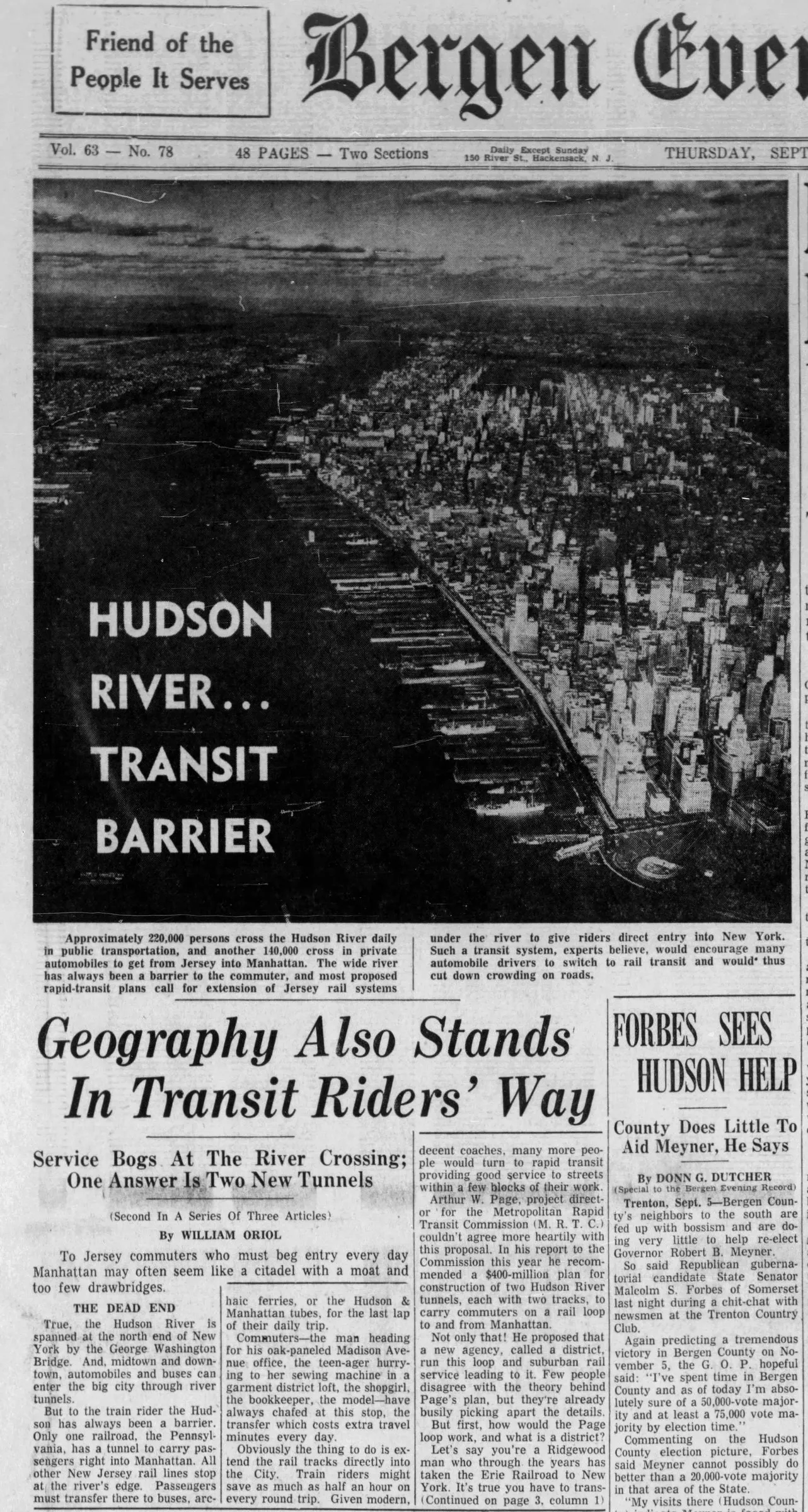
To Jersey commuters who must beg entry every day, Manhattan may often seem to be a citadel with a moat and too few drawbridges.
The Dead End
True, the Hudson River is spanned at the north end of New York by the George Washington Bridge. And, Midtown and downtown, automobiles and buses can enter the big city through river tunnels.
But to the train rider the Hudson has always been a barrier. Only one railroad, the Pennsylvania, has a tunnel to carry passengers right into Manhattan. All other New Jersey rail lines stop at the river’s edge. Passengers must transfer there to buses, archaic ferries, or the Hudson & Manhattan tubes, for the last lap of their daily trip.
Commuters–the man heading for his oak-paneled Madison Avenue office, the teenager hurrying to her sewing machine in a garment district loft, the shopgirl, the bookkeeper, the model–have always chafed at this stop, the transfer which costs extra travel minutes every day.
Obviously the thing to do is extend the rail tracks directly into the City. Train riders might save as much as half an hour on every round trip. Given modern, decent coaches, many more people would turn to rapid transit providing good service to streets within a few blocks of their work.
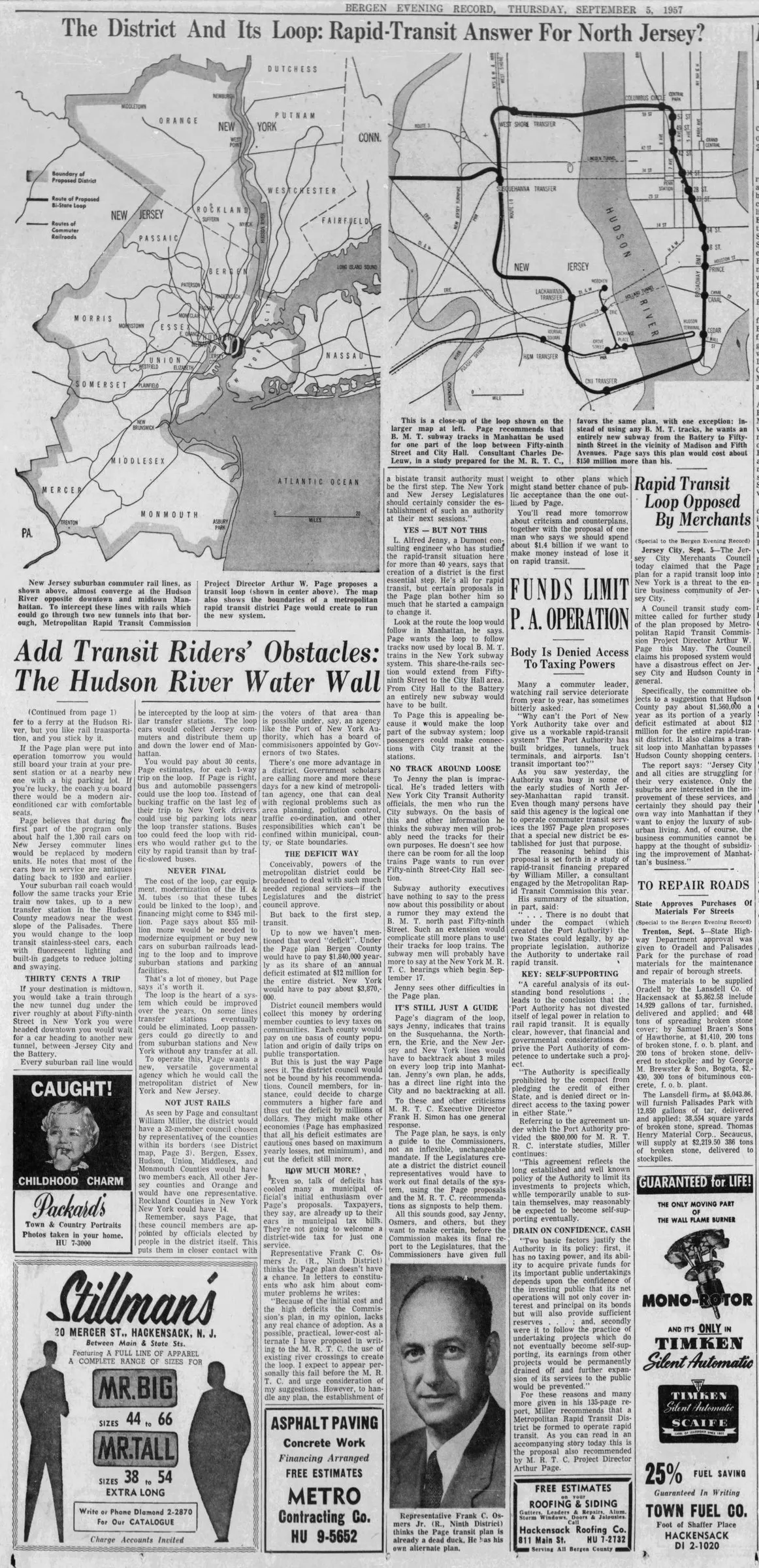
Arthur W. Page, project director for the Metropolitan Rapid Transit Commission (M.R.T.C.) couldn’t agree more heartily with this proposal. In his report to the Commission this year he recommended a $400-million plan for construction of two Hudson River tunnels, each with two tracks, to carry commuters on a rail loop to and from Manhattan.
Not only that! He proposed that a new agency, called a district, run this loop and suburban rail service leading to it. Few people disagree with the theory behind Page’s plan, but they’re already busily picking apart the details.
But first, how would the Page loop work, and what is a district?
Let’s say you’re a Ridgewood man who through the years has taken the Erie Railroad to New York. It’s true you have to transfer to a ferry at the Hudson River, but you like rail transportation, and you stick by it.
If the Page plan were put into operation tomorrow you would still board your train at your present station or at a nearby new one with a big parking lot. If you’re lucky, the coach you board there would be a modern air-conditioned car with comfortable seats.
Page believes that during the first part of the program only about half the 1,300 rail cars on New Jersey commuter lines would be replaced by modern units. He notes that most of the cars now in service are antiques dating back to 1930 and earlier.
Your suburban rail coach would follow the same tracks your Erie train now takes, up to a new transfer station in the Hudson County meadows near the west slope of the Palisades. There you would change to the loop transit stainless-steel cars, each with fluorescent lighting and built-in gadgets to reduce jolting and swaying.
Thirty Cents A Trip
If your destination is midtown, you would take a train through the new tunnel dug under the river roughly at about Fifty-ninth Street in New York. If you were headed downtown you would wait for a car heading to another new tunnel, between Jersey City and the Battery.
Every suburban rail line would be intercepted by the loop at similar transfer stations. The loop cars would collect Jersey commuters and distribute them up and down the lower end of Manhattan.
You would pay about 30 cents, Page estimates, for each 1-way trip on the loop. If Page is right, bus and automobile passengers could use the loop too. Instead of bucking traffic on the last leg of their trip to New York drivers could use big parking lots near the loop transfer stations. Buses too could feed the loop with riders who would rather get to the city by rapid transit than by traffic-slowed buses.
Never Final
The cost of the loop, car equipment, modernization of the H. & M. tubes (so that these tubes could be linked to the loop), and financing might come to $345 million. Page says about $55 million more would be needed to modernize equipment or buy new cars on suburban railroads leading to the loop and to improve suburban stations and parking facilities.
That’s a lot of money, but Page says it’s worth it.
The loop is the heart of a system which could be improved over the years. On some lines, transfer stations eventually could be eliminated. Loop passengers could go directly to and from suburban stations and New York without any transfer at all.
To operate this, Page wants a new, versatile governmental agency which he would call the Metropolitan District of New York and New Jersey.
Not Just Rails
As seen by Page and consultant William Miller, the district would have a 32-member council chosen by representatives of the counties within its borders. Bergen, Essex, Hudson, Union, Middlesex, and Monmouth Counties would have two members each. All other Jersey counties and Orange and Rockland Counties in New York would have one representative. New York could have 14.
Remember, says Page, that these council members are appointed by officials elected by people in the district itself. This puts them in closer contact with the voters of that area than is possible under, say, an agency like the Port of New York Authority, which has a board of commissioners appointed by Governors of two states.
There’s one more advantage in a district. Government scholars are calling more and more these days for a new kind of metropolitan agency, one that can deal with regional problems such as area planning, pollution control, traffic coordination, and othe responsibilities which can’t be confined within municipal, county, or State boundaries.
The Deficit Way
Conceivably, powers of the metropolitan district could be broadened to deal with such much needed regional services–if the Legislatures and the district council approve.
But back to the first step, transit.
Up to now we haven’t mentioned that word “deficit”. Under the Page plan Bergen County would have to pay $1,840,000 yearly as its share of an annual deficit estimated at $12 million for the entire district. New York would have to pay about $3,870,000.
District council members would collect this money by ordering member counties to levy taxes on communities. Each county would pay on the basis of county population and origin of daily trips on public transportation.
But this is just the way Page sees it. The district council would not be bound by his recommendations. Council members, for instance, could decide to charge commuters a higher fare and thus cut the deficit by millions of dollars. They might make other economies (Page has emphasized that all his deficit estimates are cautious ones based on maximum yearly loses, not minimum), and cut the deficit still more.
How Much More?
Even so, talk of deficits has cooled many a municipal official’s initial enthusiasm over Page’s proposals. Taxpayers, they say, are already up to their ears in municipal tax bills. They’re not going to welcome a district-wide tax for just one service.
Representative Frank C. Osmers Jr. (R., Ninth District) thinks the Page plan doesn’t have a chance. In letters to constituents who ask him about commuter problems he writes:
“Because of the initial cost and the high deficits the Commission’s plan, in my opinion, lacks any real chance of adoption. As a possible, practical, lower-cost alternative I have proposed in writing to the M.R.T.C. the use of existing river crossings to create the loop. I expect to appear personally this fall before the M.R.T.C. and urge consideration of my suggestions. However, to handle any plan, the establishment of a bistate transit authority must be the first step. The New York and New Jersey Legislatures should certainly consider the establishment of such an authority at their next sessions.”
Yes – But Not This
L. Alfred Jenny, a Dumont consulting engineer who has studied the rapid-transit situation here for more than 40 years, says that creation of a district is the first essential step. He’s all for rapid transit, but certain proposals in the Page plan bother him so much that he started a campaign to change it.
Look at the route the loop would follow in Manhattan, he says. Page wants the loop to follow tracks now used by local B.M.T. trains in the New York subway system. This share-the-rails section would extend from Fifty-ninth Street to the City Hall area. From City Hall to the Battery an entirely new subway would have to be built.
To Page this is appealing because it would make the loop part of the subway system; loop passengers could make connections with city transit at the stations.
No Track Around Loose
To Jenny the plan is impractical. He’s traded letters with New York City Transit Authority officials, the men who run the City subways. On the basis of this and other information he thinks the subway men will probably need the tracks for their own purposes. He doesn’t see how there can be room for all the loop trains Page wants to run over Fifty-ninth Street-City Hall section.
Subway authority executives have nothing to say to the press now about this possibility or about a rumor they may extend the B.M.T. north past Fifty-ninth Street. Such an extension would complicate still more plans to use their tracks for loop trains. The subway men will probably have more to say at the New York M.R.T.C. hearings which begins September 17.
Jenny sees other difficulties in the Page plan.
It’s Still Just A Guide
Page’s diagram of the loop, says Jenny, indicates that trains on the Susquehanna, the Northern, the Erie, and the New Jersey and New York lines would have to backtrack about 3 miles on every loop trip into Manhattan. Jenny’s own plan, he adds, has a district line right into the City and no backtracking at all.
To these and other criticisms M.R.T.C. Executive Director Frank H. Simon has one general response.
The Page plan, he says, is only a guide to the Commissioners, not an inflexible, unchangeable mandate. If the Legislatures create a district the district council representatives would have to work out final details of the system, using the Page proposals and the M.R.T.C. recommendations as signposts to help them.
All this sounds good, say Jenny, Osmers, and others, but they want to make certain, before the Commission makes it final report to the Legislatures, that the Commissioners have given full weight to other plans which might stand better chance of public acceptance than the one outline by Page.
You’ll read more tomorrow about criticism and counterplans, together with the proposal of one man who says we should spend about $1.4 billion if we want to make money instead of lose it on rapid transit.
Other editions
- Add Transit Riders’ Obstacles: The Hudson River Water Wall · The Record · September 5, 1957 · Page 3