Q. And A. On Transit, The Orphan Of Growth
North Jersey-Manhattan Transportation Long On Study, Short On Action
Source pages
Source page 1
Source page 2
Source page 3
Source page 4
Transcription
Transcriptions may contain errors. Consult the source pages for the original wording and layout.
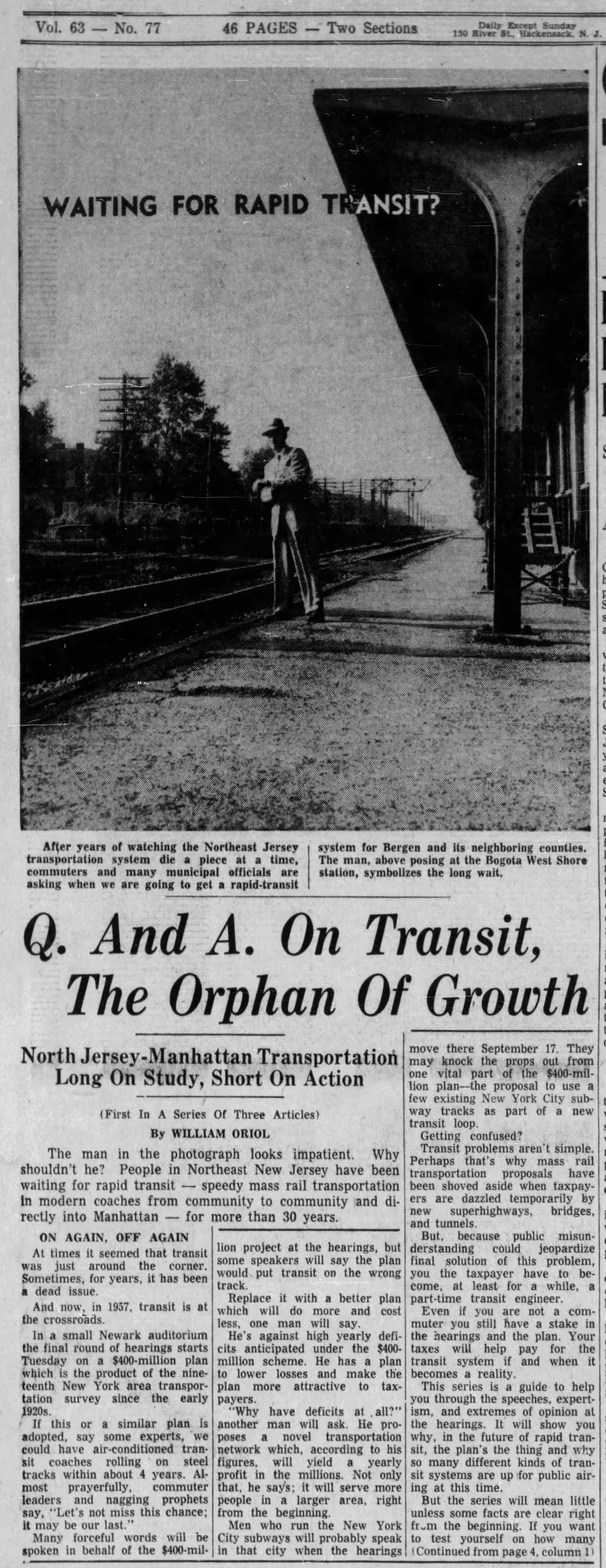
The man in the photograph looks impatient. Why shouldn’t he? People in Northeast New Jersey have been waiting for rapid transit – speedy mass trail transportation in modern coaches from community to community and directly into Manhattan – for more than 30 years.
On Again, Off Again
At times it seemed that transit was just around the corner. Sometimes, for years, it has been a dead issue.
And now, in 1957, transit is at the crossroads.
In a small Newark auditorium the final round of hearings starts Tuesday on a $400-million plan which is the product of the nineteenth New York area transportation survey since the early 1920s.
If this or a similar plan is adopted, say some experts, we could have air-conditioned transit coaches rolling on steel tracks within about 4 years. Almost prayerfully, commuter leaders and nagging prophets say, “Let’s not miss this chance; it may be our last.”
Many forceful words will be spoken in behalf of the $400-million project at the hearings, but some speakers will say the plan would put transit on the wrong track.
Replace it with a better plan which will do more and cost less, one man will say.
He’s against high yearly deficits anticipated under the $400-million scheme. He has a plan to lower losses and make the plan more attractive to taxpayers.
“Why have deficits at all?” another man will ask. He proposes a novel transportation network which, according to his figures, will yield a yearly profit in the millions. Not only that, he says; it will serve more people in a larger area, right from the beginning.
Men who run the New York City subways will probably speak in that city when the hearings more there September 17. They may knock the props out from one vital part of the $400-million plan–the proposal to use a few existing New York City subway tracks as part of a new transit loop.
Getting confused?
Transit problems aren’t simple. Perhaps that’s why mass rail transportation proposals have been shoved aside when taxpayers are dazzled temporarily by new superhighways, bridges, and tunnels.
But, because public misunderstanding could jeapordize final solution of this problem, you the taxpayer have to become, at least for a while, a part-time transit engineer.
Even if you are not a commuter you still have a stake in the hearings and the plan. Your taxes will help pay for the transit system if and when it becomes a reality.
This series is a guide to help you through the speeches, expertism, and extremes of opinion at the hearings. It will show you why, in the future of rapid transit, the plan’s the thing and why so many different kinds of transit systems are up for public airing at this time.
But the series will mean little unless some facts are clear right from the beginning. If you want to test yourself on how many facts you have straight now, try answering the following questions before you read the answers:
Q.--Who is holding the hearings?
A.--The Metropolitan Rapid Transit Commission is running the show. This is an agency formed 3 years ago by New York and New Jersey after years of pressure for bi-State study and action. Hearings start in Newark at 70 Park Place at 10 A. M. Tuesday and at the same time the following Tuesday at 42 West Forty-fourth Street, New York. Yes, the meetings are open to the public.
Q.--Why should people be worried about transit?
A.--New Jersey train riders have dwindled in numbers since about 1930. Commuters say they are victims of old-fashioned, out-moded service which nevertheless could be made more attractive if the railroads would modernize equipment and methods.
The Fight To Quit
Railroad men, though, see commuter service only as a costly in-the-red operations. They have tried to reduce or abandon commuter service; in Bergen County right now practically all suburban rail passenger service is in jeopardy.
Thousands of train riders had a narrow escape this August, when the Interstate Commerce Commission granted requests to discontinue Hudson River ferry lines essential to riders on three railroads serving Bergen. Only a federal court order kept the ferries going. The cases come up for final decision this fall.
As rail service falters, highways become more crowded. Buses get many disgruntled train riders, but most bus operators report losses every year or little profit.
Q.--Why not have mass transportation by automobile?
A.--Metropolitan Rapid Transit Commission Cochairman Edward O'Mara gave this answer in a recent speech:
The Figures Tell
“...It must be remembered that a car carries an average of less than two passengers and requires from 200 to 350 square feet of parking area at its destination. One lane of expressway traffic will accommodate only 2,500 passengers per hour, whereas one lane of rapid transit can accommodate up to 60,000 passengers per hour, depending on the number of standees.”
An M.R.T.C. report this year speculated on what would happen if the 75,000 persons who now use railroads to get from New Jersey to Manhattan daily suddenly had to switch to automobiles tomorrow.
Twenty new expressway lanes would have to be built in New Jersey. Ten new vehicular river tubes would be needed, and 250 acres of Manhattan property would have to be cleared for new parking lots.
Faced by this, commuters and others say we can't afford to let rail service wither away. Men like Teaneck Mayor T. J. E Brown envision losses in property values in communities which permit railroad stations to become ghost buildings. Taxpayers will abandon towns lacking transportation; they have to find easy ways to get to work.
Q.--What has the M.R.T.C. done to get rapid transit?
A.--Commissioners–five from each State, appointed by the Governors--have taken turns warning that rapid transit is overdue. They've done more than make speeches. They were overseers of a study described as the most extensive undertaken to survey transportation needs in a metropolitan area.
Q.--How was this survey made?
A.--The Commission got $800,000 from the Port of New York Authority, another bi-State agency, but the Authority has long resisted suggestions that it take on rapid transit as one of its many operations.
Port Authority money was used to study the interstate problem and find ways to carry people back and forth from New York and New Jersey. Another $300,000 ($150,000 from each State) was used to study local, intra-state problems.
Splitting up the $800,000, the Commission parceled it out to consultants. Engineer Charles DeLeuw of Chicago was given up to $290,000 to check travel habits of present commuters and to study physical plans for Manhattan-Jersey rail service. A Princeton government expert got $87,000 to find a workable, constitutional method to finance and administer a transit system. The Regional Plan Association charted the future of the New York metropolitan region, and concluded that growth past the fringes of present suburban areas would continue at a fast pace. Smaller separate studies were made of everything from existing bus service to present railroad deficits.
All of this, more than a year and a half of work by experts, led up to the Page report of, May 1957.
Q.--What is the Page report, and what is the Page plan?
A.--Arthur W. Page, a former vice-president of the American Telephone and Telegraph Company and onetime director of the President's Committee on Transport Policy, was co-ordinator of the studies. He had to wade through the consultants' thick technical reports. On the basis of their findings, he arrived at his own conclusions, and made his recommendations in a 60-page report this May.
No Commitment Yet
In it he told why he favors a new $400-million rail loop to carry New Jersey train passengers directly into Manhattan through two new Hudson River tunnels. Details on this and Page's proposals for a new agency called a metropolitan district will appear tomorrow.
Q.--Is the Page plan the final M.R.T.C. plan?
A.--Not necessarily, say the M.R.T.C. Commissioners. Even though some of them have at public meetings have given the impression they are defending the Page plan, they say they are behind no single plan as yet.
William F. Young, a Ridgewood man serving on the Commission, says: "We're giving great thought to many plans, and we're considering variations and combinations. But I think we have open minds on the subject, and we're not yet backing any one plan in particular."
Q.--What are the hearings for?
Springboard, Not Target
A.--To help them decide on a plan, the Commissioners held hearings in June to get first-impression reaction to the Page plan. They heard much criticism and some praise. They want details on alternate plans in this round of hearings, as well as clearer indications of public sentiment.
After the hearings they will mull their many reports, then write up their own recommendations and give them to the two State Legislatures by early 1958. Then it will be up to the legislators to act upon the recommendations. The job of the M.R.T.C., a study-making, temporary commission, will be done. If the transit plan is adopted, the Legislatures may create a new agency to operate the system.
Q.--Is it, then, clear sailing ahead?
A.--That's where this little quiz ends and the theme of this series comes up for amplification. From all indications, there is great confusion already about the Page plan.
Angrily, some critics are ripping the Page proposals apart, which is a little like shooting at a straw man. Ignoring the fact that this is not the final word of the M.R.T.C.--it is only a springboard for discussion–they are attacking individual features of the plan.
On the other hand, others say the M.R.T.C. is too closely identified with the Page plan. They say this plan, with its talk of deficits, is a harsh dose for tax-minded-citizens to swallow. Unless the Commission makes clear that it will recommend a better plan, say these critics, rapid transit will once again be filed in a dusty drawer reserve for forgotten causes.
Will the Commission propose a plan nobody wants? You'll see Friday why some outspoken experts think this is a possibility. Tomorrow's article will tell you more about the Page plan and why it's been attacked and praised.
Rapid Transit: Groups Didn’t Overlook This
The Public Just Forgot In Excitement Over New Highways
The Record
September 4, 1957
Thousands Spent
Rapid transit has been called the forgotten plan of the New York City area, the victim of big highway projects and other costly improvements which have drained off public funds.
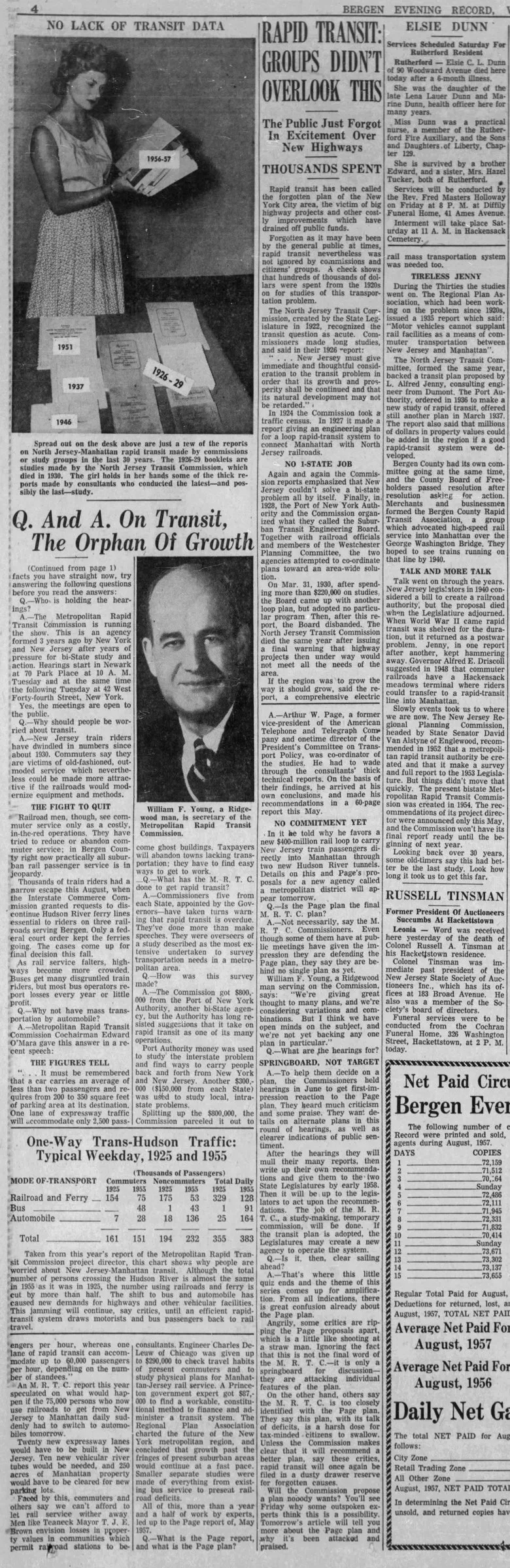
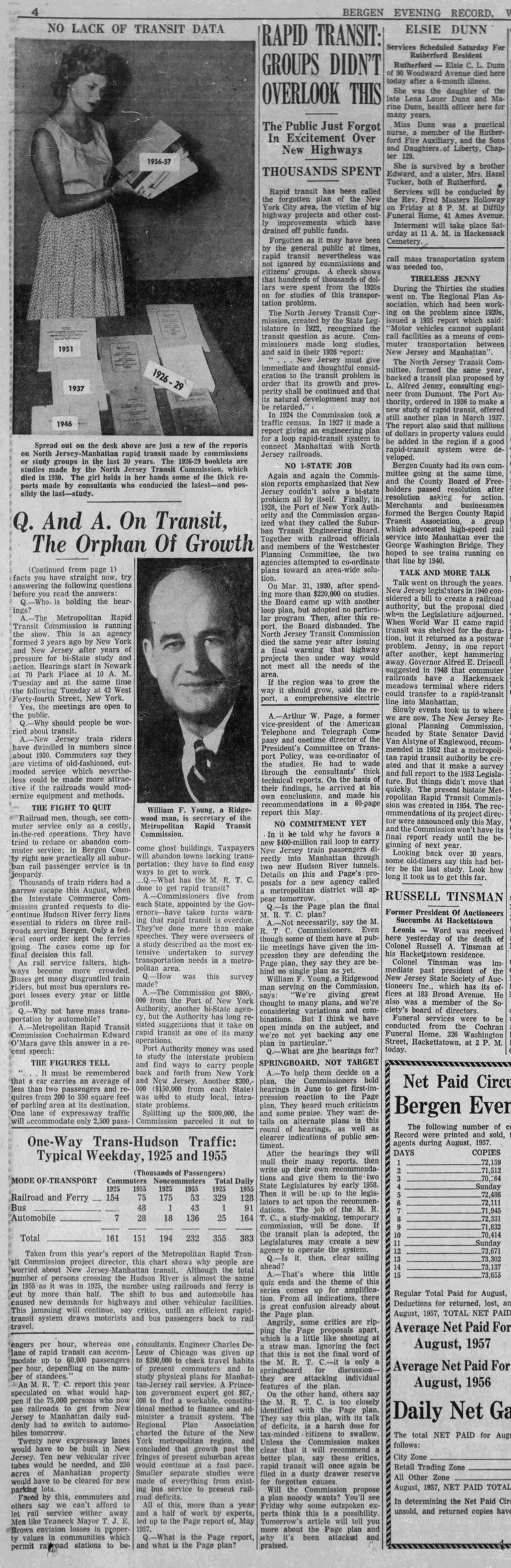
Forgotten as it may have been by the general public at times, rapid transit nevertheless was not ignored by commissions and citizens' groups. A check shows that hundreds of thousands of dollars were spent from the 1920s on for studies of this transportation problem.
The North Jersey Transit Commission, created by the State Legislature in 1922, recognized the transit question as acute. Commissioners made long studies, and said in their 1926 report:
“...New Jersey must give immediate and thoughtful consideration to the transit problem in order that its growth and prosperity shall be continued and that its natural development may not be retarded.”
In 1924 the Commission took a traffic census. In 1927 it made a report giving an engineering plan for a loop rapid-transit system to connect Manhattan with North Jersey railroads.
No 1-State Job
Again and again the Commission reports emphasized that New Jersey couldn't solve a bi-state problem all by itself. Finally, in 1928, the Port of New York Authority and the Commission organized what they called the Suburban Transit Engineering Board. Together with railroad officials and members of the Westchester Planning Committee, the two agencies attempted to co-ordinate plans toward an area-wide solution.
On Mar. 31, 1930, after spending more than $220,000 on studies, the Board came up with another loop plan, but adopted no particular program. Then, after this report, the Board disbanded. The North Jersey Transit Commission died the same year after issuing a final warning that highway projects then under way would not meet all the needs of the area.
If the region was to grow the way it should grow, said the report, a comprehensive electric rail mass transportation system was needed too.
Tireless Jenny
During the Thirties the studies went on. The Regional Plan Association, which had been working on the problem since 1920s, issued a 1935 report which said: "Motor vehicles cannot supplant rail facilities as a means of commuter transportation between New Jersey and Manhattan.”
The North Jersey Transit Committee, formed the same year, backed a transit plan proposed by L. Alfred Jenny, consulting engineer from Dumont. The Port Authority, ordered in 1936 to make a new study of rapid transit, offered still another plan in March 1937. The report also said that millions of dollars in property values could be added in the region if a good rapid-transit system were developed.
Bergen County had its own committee going at the same time, and the County Board of Freeholders passed resolution after resolution asking for action. Merchants and businessmen formed the Bergen County Rapid Transit Association, a group which advocated high-speed rail service into Manhattan over the George Washington Bridge. They hoped to see trains running on that line by 1940.
Talk And More Talk
Talk went on through the years. New Jersey legislators in 1940 considered a bill to create a railroad authority, but the proposal died when the Legislature adjourned. When World War II came, rapid transit was shelved for the duration, but it returned as a postwar problem. Jenny, in one report after another, kept hammering away. Governor Alfred E. Driscoll suggested in 1948 that commuter railroads have a Hackensack meadows terminal where riders could transfer to a rapid-transit line into Manhattan.
Slowly events took us to where we are now. The New Jersey Regional Planning Commission, headed by State Senator David Van Alstyne of Englewood, recommended in 1952 that a metropolitan rapid transit authority be created and that it make a survey and full report to the 1953 Legislature. But things didn't move that quickly. The present bi-state Metropolitan Rapid Transit Commission was created in 1954. The recommendations of its project director were announced only this May, and the Commission won't have its final report ready until the beginning of next year.
Looking back over 30 years, some old-timers say this had better be the last study. Look how long it took us to get this far.
Other editions
- Q. And A. On Transit, The Orphan Of Growth · The Record · September 4, 1957 · Page 4
Related events
- New Jersey creates the North Jersey Transit Commission
- First engineering plan for a Manhattan–North Jersey transit loop
- Port Authority and New Jersey form the Suburban Transit Engineering Board
- Suburban Transit Engineering Board reports, then disbands
- Regional Plan Association: cars cannot replace commuter rail
- Port Authority proposes a new tunnel at 51st Street, then lets it drop
- New Jersey railroad-authority bill dies
- Driscoll suggests a Hackensack meadows transfer terminal
- New Jersey planning commission calls for a metropolitan transit authority
- The two state commissions become one bi-state commission
- The Page report: a $400 million loop and a new Metropolitan District
- Federal court keeps Hudson ferries running
- Final round of hearings on the loop plan opens