Coming by Trolley: A Waterfront Transit Revolution
Source page
Source page 1
Transcription
Transcriptions may contain errors. Consult the source pages for the original wording and layout.
EARLY IN the century, Henry Ford ignited a revolution by lowering auto prices to within reach of middle-class families. That revolution led to another when those families and their cars moved to the suburbs. That, in turn, led to suburban shopping malls, a network of new highways, and a vast flood of traffic.
Now a panel of state transportation experts is proposing a plan to limit auto access to the rapidly developing Hudson waterfront in favor of a more modern and efficient form of mass transit. Taken in conjunction with this week's "River City" report by Regional Plan Association — which calls for a waterfront planning agency with the power to override local zoning — the state transit plan amounts to a revolution of another kind.
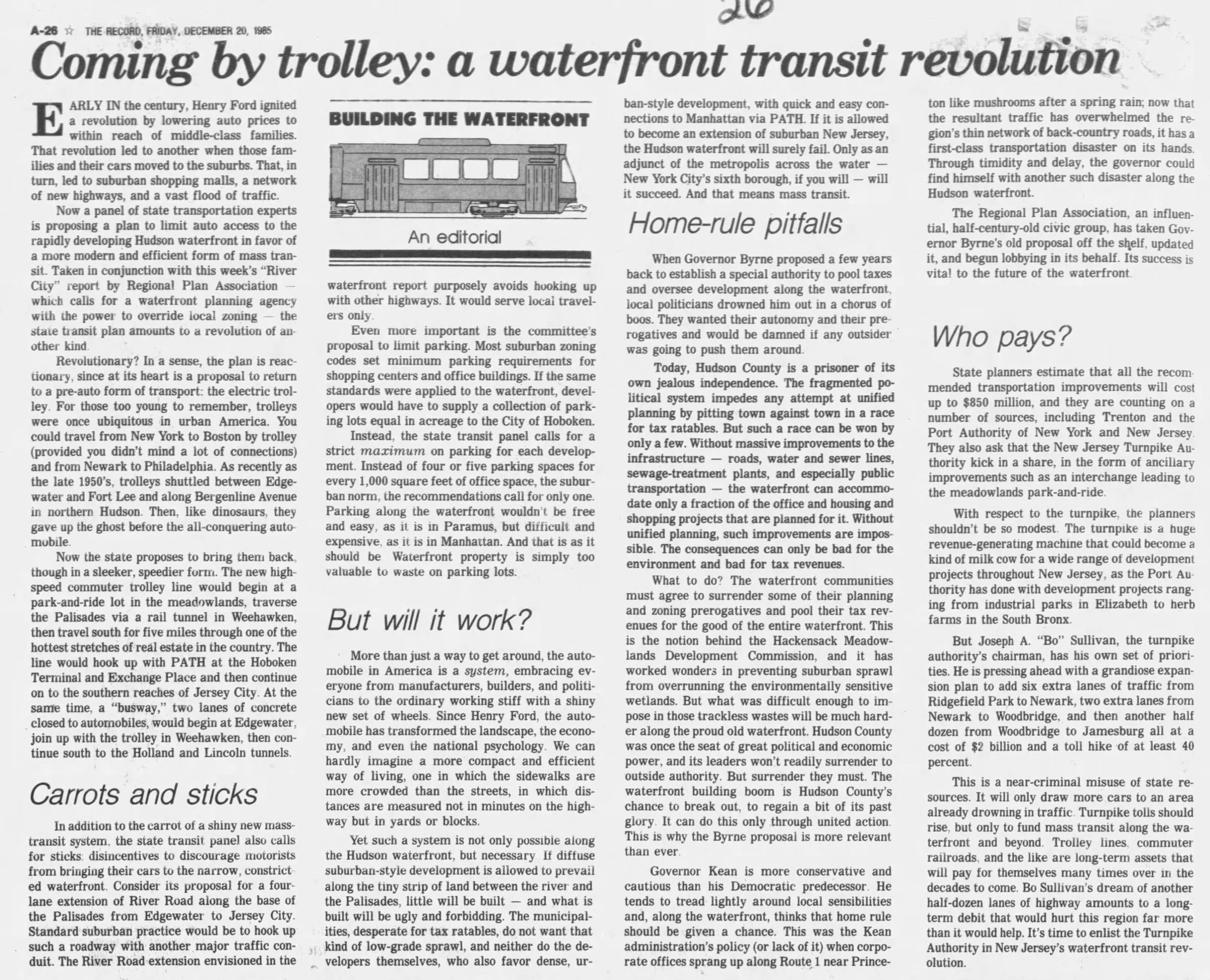
Revolutionary? In a sense, the plan is reactionary, since at its heart is a proposal to return to a pre-auto form of transport: the electric trolley. For those too young to remember, trolleys were once ubiquitous in urban America. You could travel from New York to Boston by trolley (provided you didn't mind a lot of connections) and from Newark to Philadelphia. As recently as the late 1950's, trolleys shuttled between Edgewater and Fort Lee and along Bergenline Avenue in northern Hudson. Then, like dinosaurs, they gave up the ghost before the all-conquering automobile.
Now the state proposes to bring them back, though in a sleeker, sportier form. The new high-speed commuter trolley line would begin at a park-and-ride lot in the Meadowlands, traverse the Palisades via a rail tunnel in Weehawken, then travel south for five miles through one of the hottest stretches of real estate in the country. The line would hook up with PATH at the Hoboken Terminal and Exchange Place and then continue on to the southern reaches of Jersey City. At the same time, a "busway," two lanes of concrete closed to automobiles, would begin at Edgewater, join up with the trolley in Weehawken, then continue south to the Holland and Lincoln tunnels.
Carrots and sticks
In addition to the carrot of a shiny new mass-transit system, the state transit panel also calls for sticks disincentives to discourage commuters from bringing their cars to the narrow, constricted waterfront. Consider its proposal for a four-lane extension of River Road along the Hudson Palisades from Edgewater to Jersey City. Standards should be adjusted to allow a four-lane road wide enough for car pools and bans on single-occupant vehicles. The River Road extension as well as the waterfront report properly avoids hooking up with other highways. It also reserves local travel lanes only.
Even more important to the state panel's proposal is limiting parking. Most suburban zoning codes set minimum parking lot requirements for shopping centers and office buildings. If the same standards were applied to the waterfront, developers would be obliged to pave a lot of green space into lots equal in area to the City of Hoboken. Instead, the state transit panel calls for a strict limit on acreage to be used for parked pavement. Instead of four parking spaces for every 1,000 square feet of office and shop space, for example, the recommendation calls for one. Parking along the waterfront would be free and easy, as it is in Paramus, but difficult and expensive, as it is in Manhattan. And that is as it should be. The waterfront property is simply too valuable to waste on parking.
But will it work?
More than just a way to get around, the automobile in America is a statement, argues everyone from manufacturers, builders, and politicians to ordinary working stiff who feel they have to shed wheels. Since Henry Ford, the automobile has transformed social as well as physical mores. We can theorize psychology. Who would hardly imagine a more compact and quicker way of living, one in which the sidewalks are more crowded than the streets, in which differences are measured in blocks not miles and everyone in between.
But such a system, not just a shiny new trolley but the River Road proposal to disallow suburban-style development, might actually preserve the tiny strip of land between the river and the Palisades, keeping it alive and vibrant for all its citizens. Would the trolley work? Perhaps. Its desperate star trek across Hudson County is the idea. Perhaps would engender the same kind of low-grade graffiti covered. Suburban development by a spur of the magnificent plan as the Model T Ford did to Americans.
Home-rule pitfalls
When Governor Byrne proposed a few years back to establish a special authority to pool taxes and oversee development along the waterfront, local politicians drowned him out in a chorus of boos. They wanted their autonomy and their prerogatives and would be damned if any outsider was going to push them around.
Today, Hudson County has recovered some of its own jealous independence. The fragmented political bodies impede any attempt at unified planning by giving Hudson County to private capital for tax abatements. But such a race can be won by only a few. Without massive improvements to the infrastructure - roads, water and sewer lines, sewage-treatment plants, and especially public transportation - the waterfront can accommodate only a fraction of the office and housing and shopping projects that are planned for it. Without unified planning, such improvements are impos-sible. The consequences can only be bad for the environment and bad for tax revenues.
What to do? The waterfront communities must agree to surrender some of their planning powers and jurisdictions and pool their tax revenues for the good of the entire waterfront. This might be done through the Hackensack Meadowlands Development Commission, and it has worked wonders in preventing suburban sprawl along the east and west sides of the complex.
In the process, the waterfront communities might also ensure that taxes would still flow to the towns that lacked sufficient enough income. Businesses that were lured by the waterfront, on the other hand, have no great political connection to the area, so the seat of political and economic power would be gradually returned to the towns. With new roads, with less smog, with empty parking spaces and more people going to work, the city would be restored in some part to the old-time feeling of independence that it once enjoyed. By not holding the next blue-ribbon commission to utter inaction before the Byrne proposal is ever realized.
Who pays?
State planners estimate that all the recommended transportation improvements will cost up to $850 million, and they are counting on a number of sources, including Trenton and the Port Authority of New York and New Jersey. They also ask that the New Jersey Turnpike Authority kick in a share, in the form of ancillary improvements such as an interchange leading to the Meadowlands park-and-ride.
With respect to the turnpike, the planners shouldn't be timid. The turnpike is a huge revenue-generating machine that could become a kind of milk cow for a wide range of development projects throughout New Jersey, as the port authority has done with development projects ranging from Industrial Parkers in Elizabeth to new farms in South Brunswick.
But Joseph A. "Bo" Sullivan, the turnpike authority's chairman, has his own set of priorities. He is preoccupied with a grandiose expansion plan that has six extra lanes of traffic from Ridgefield Park to Newark, two extra lanes from Newark to Bordentown, and then another half dozen from Woodbridge to Jamesburg. At a cost of $2 billion and a toll hike of at least 60 percent.
This is a near-criminal misuse of state resources. It will drive more cars on to already overcrowded roads. The resources should be used, not only to finish mass transit along the waterfront and beyond. Valley times, income and parking fees for long-term users at the tolls will need to be done. Bo Sullivan's dream of another land-bridge doesn't help. All that does is encourage bad land development along this region far more than any help to Hudson's dreams of revitalizing the Jersey waterfront transit revolution.