Tri-State Council is Formed
Source page
Source page 1
Transcription
Transcriptions may contain errors. Consult the source pages for the original wording and layout.
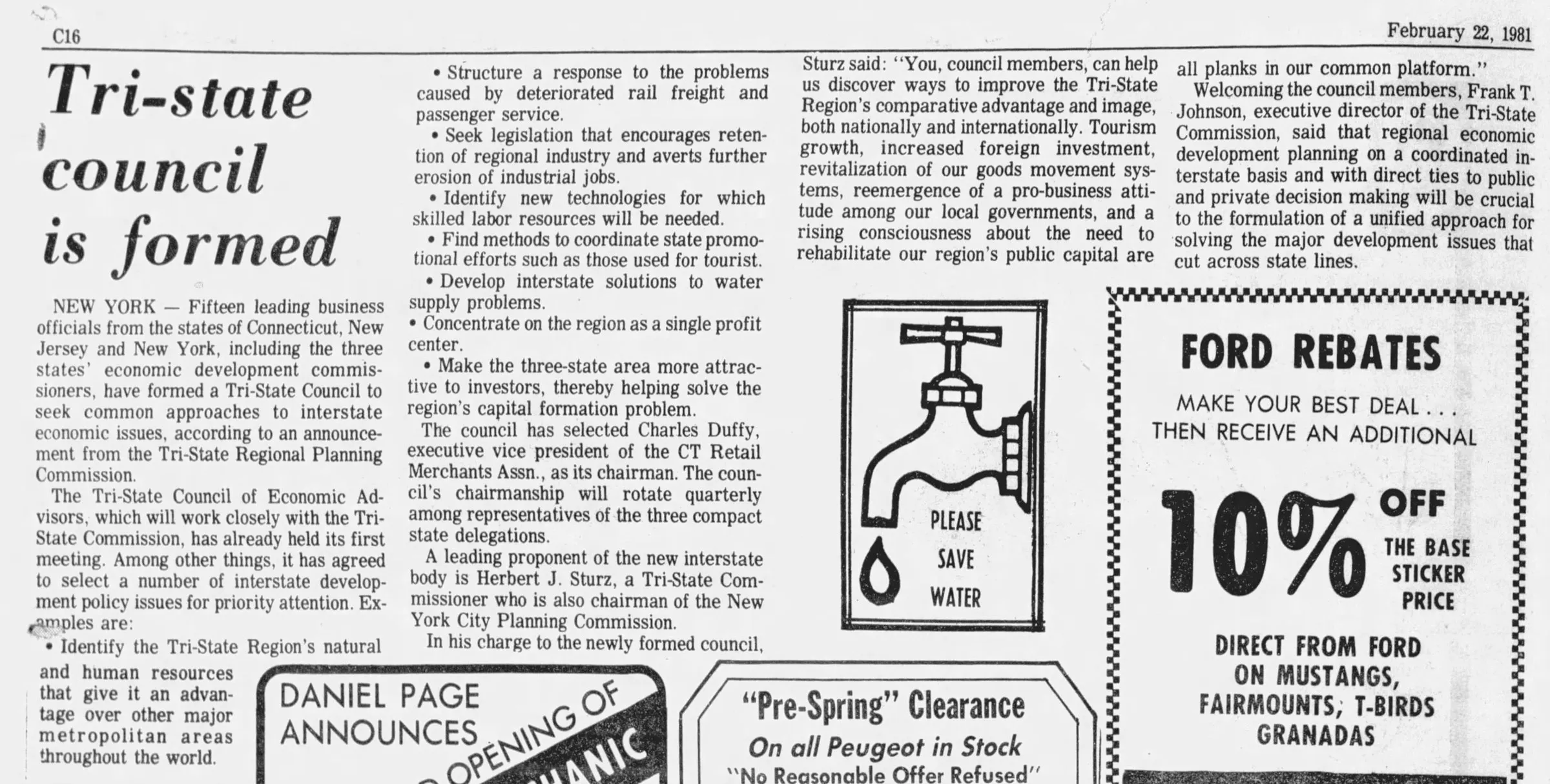
NEW YORK - Fifteen leading business officials from the states of Connecticut, New Jersey and New York, including the three states' economic development commissioners, have formed a Tri-State Council to seek common approaches to interstate economic issues, according to an announcement from the Tri-State Regional Planning Commission.
The Tri-State Council of Economic Advisors, which will work closely with the Tri-State Commission, has already held its first meeting. Among other things, it has agreed to select a number of interstate development policy issues for priority attention. Examples are:
* Identify the Tri-State Region's natural and human resources that give it an advan- tage over other major metropolitan areas throughout the world.
* Structure a response to the problems caused by deteriorated rail freight and passenger service.
* Seek legislation that encourages retention of regional industry and averts further erosion of industrial jobs.
* Identify new technologies for which skilled labor resources will be needed.
* Find methods to coordinate state promo- tional efforts such as those used for tourist.
* Develop interstate solutions to water supply problems.
* Concentrate on the region as a single profit center.
* Make the three-state area more attractive to investors, thereby helping solve the region's capital formation problem.
The council has selected Charles Duffy, executive vice president of the CT Retail Merchants Assn., as its chairman. The council's chairmanship will rotate quarterly among representatives of the three compact state delegations.
A leading proponent of the new interstate body is Herbert J. Sturz, a Tri-State Commissioner who is also chairman of the New York City Planning Commission.
In his charge to the newly formed council, Sturz.said: "You, council members, can help us discover ways to improve the Tri-State Region's comparative advantage and image, both nationally and internationally. Tourism growth, increased foreign investment, revitalization of our goods movement systems, reemergence of a pro-business attitude among our local governments, and a rising consciousness about the need to rehabilitate our region's public capital are all planks in our common platform."
Welcoming the council members, Frank T. Johnson, executive director of the Tri-State Commission, said that regional economic development planning on a coordinated interstate basis and with direct ties to public and private decision making will be crucial to the formulation of a unified approach for solving the major development issues that cut across state lines.