New ‘Metro’ Lines Prompt Mixed Reaction in Jersey
Source page
Source page 1
Transcription
Transcriptions may contain errors. Consult the source pages for the original wording and layout.
By PAUL OVERBERG
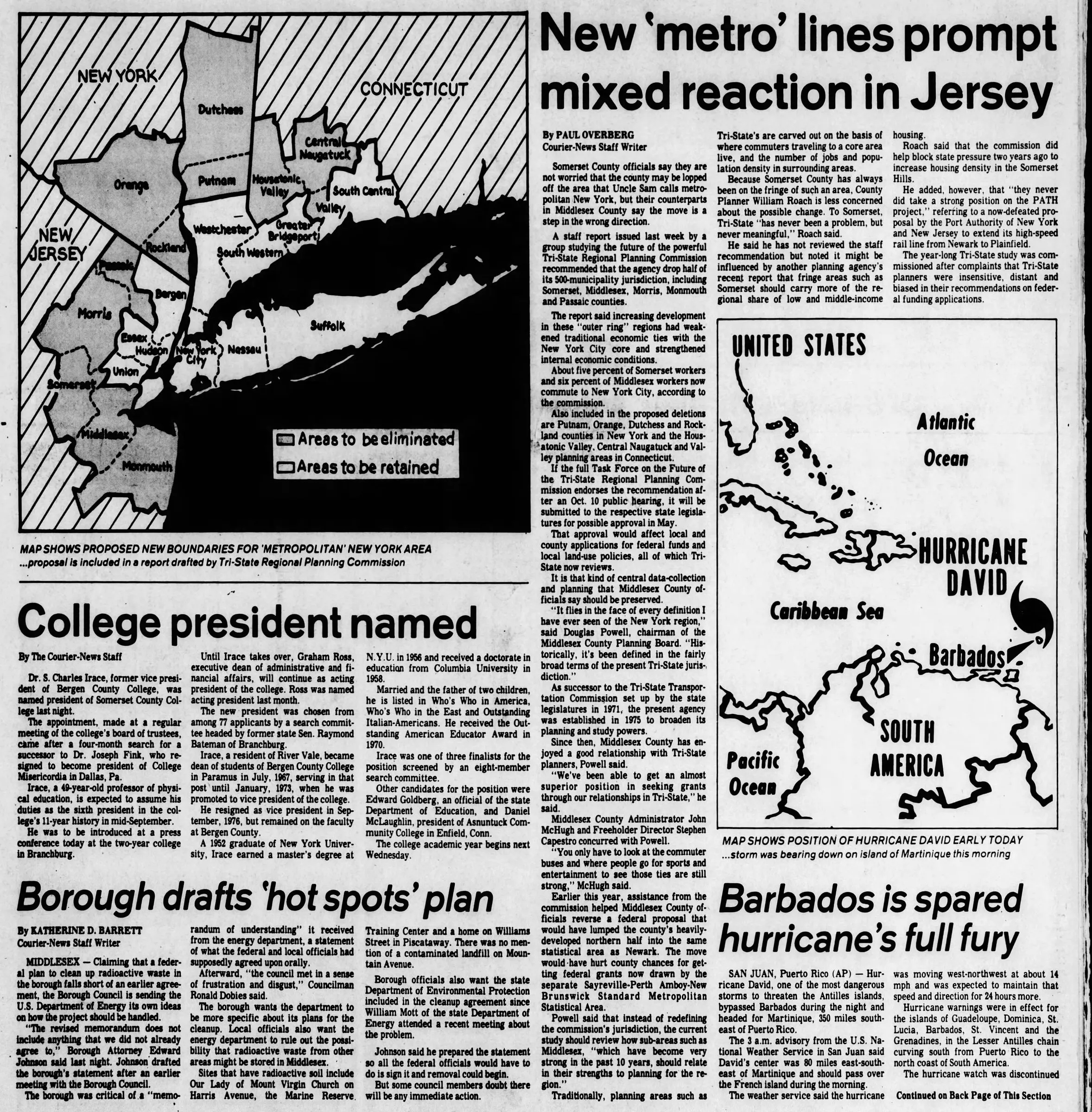
A staff report issued last week by a group studying the future of the powerful Tri-State Regional Planning Commission recommended that the agency drop half of its 100-municipality jurisdiction, including Somerset, Middlesex, Morris, Monmouth, and Passaic counties.
The report said increasing development in these “outer ring” regions has weakened traditional economic ties with the New York City core and strengthened internal economic conditions.
About five percent of Somerset workers and six percent of Middlesex workers now commute to New York City, according to the commission.
Also included in the proposed deletions are Putnam, Orange, Dutchess, and Rockland counties in New York and the Housatonic Valley, Central Naugatuck, and Valley planning areas in Connecticut.
If the full Task Force on the Future of the Tri-State Regional Planning Commission endorses the recommendation after an Oct. 10 public hearing, it will be submitted to the respective state legislatures for possible approval in May.
That approval would affect local and county applications for federal funds and local land-use policies, all of which Tri-State now reviews.
“It flies in the face of every definition I have ever seen of the New York region,” said Douglas Powell, chairman of the Middlesex County Planning Board. “Historically, it’s been defined in the fairly broad terms of the present Tri-State jurisdiction.”
A successor to the Tri-State Transportation Commission set up by the state legislatures in 1971, the present agency was established in 1975 to broaden its planning and study powers.
Since then, Middlesex County has enjoyed a good relationship with Tri-State planners, Powell said.
“We’ve been able to get an almost superior position in seeking grants through our relationships in Tri-State,” he said.
Middlesex County Administrator John McHugh and Freeholder Director Stephen Roach concurred with Powell.
“You only have to look at the commuter buses and where people go for sports and entertainment to see those ties are still strong,” McHugh said.
He added that assistance from the commission helped Middlesex County officials reverse a federal proposal that would have lumped the county’s heavily-developed northern half into the same statistical area as Newark. The move would have hurt county chances for getting federal grants now drawn by the separate Sayreville-Perth Amboy-New Brunswick Standard Metropolitan Statistical Area.
Powell said that instead of redefining the commission’s jurisdiction, the current study should review how sub-areas such as Middlesex, “which have become very strong in the past 10 years, should relate in their strengths to planning for the region.”
Traditionally, planning areas such as Tri-State’s are carved out on the basis of where commuters traveling to a core area live, and the number of jobs and population density in surrounding areas.
Because Somerset County has always been on the fringe of such an area, County Planner William Roach is less concerned about the possible change. To Somerset, Tri-State “has never been a problem, but never meaningful,” Roach said.
He said he has not reviewed the staff recommendation but noted it might be influenced by another planning agency’s report that fringe areas such as Somerset should carry more of the regional share of low and middle-income housing.
Roach said that the commission did help block state pressure two years ago to increase housing density in the Somerset Hills.
He added, however, that “they never did take a strong position on the PATH project,” referring to a now-defeated proposal by the Port Authority of New York and New Jersey to extend its high-speed rail line from Newark to Plainfield.
The year-long Tri-State study was commissioned after complaints that Tri-State planners were insensitive, distant, and biased in their recommendations on federal funding applications.
Other editions
- New ‘metro’ lines prompt mixed reaction in Jersey · The Courier-News · August 29, 1979 · Page 1