Who Should Be Making Decisions on Metropolitan Issues?
Source pages
Source page 1
Source page 2
Source page 3
Transcription
Transcriptions may contain errors. Consult the source pages for the original wording and layout.
By MICHAEL J. McMANUS
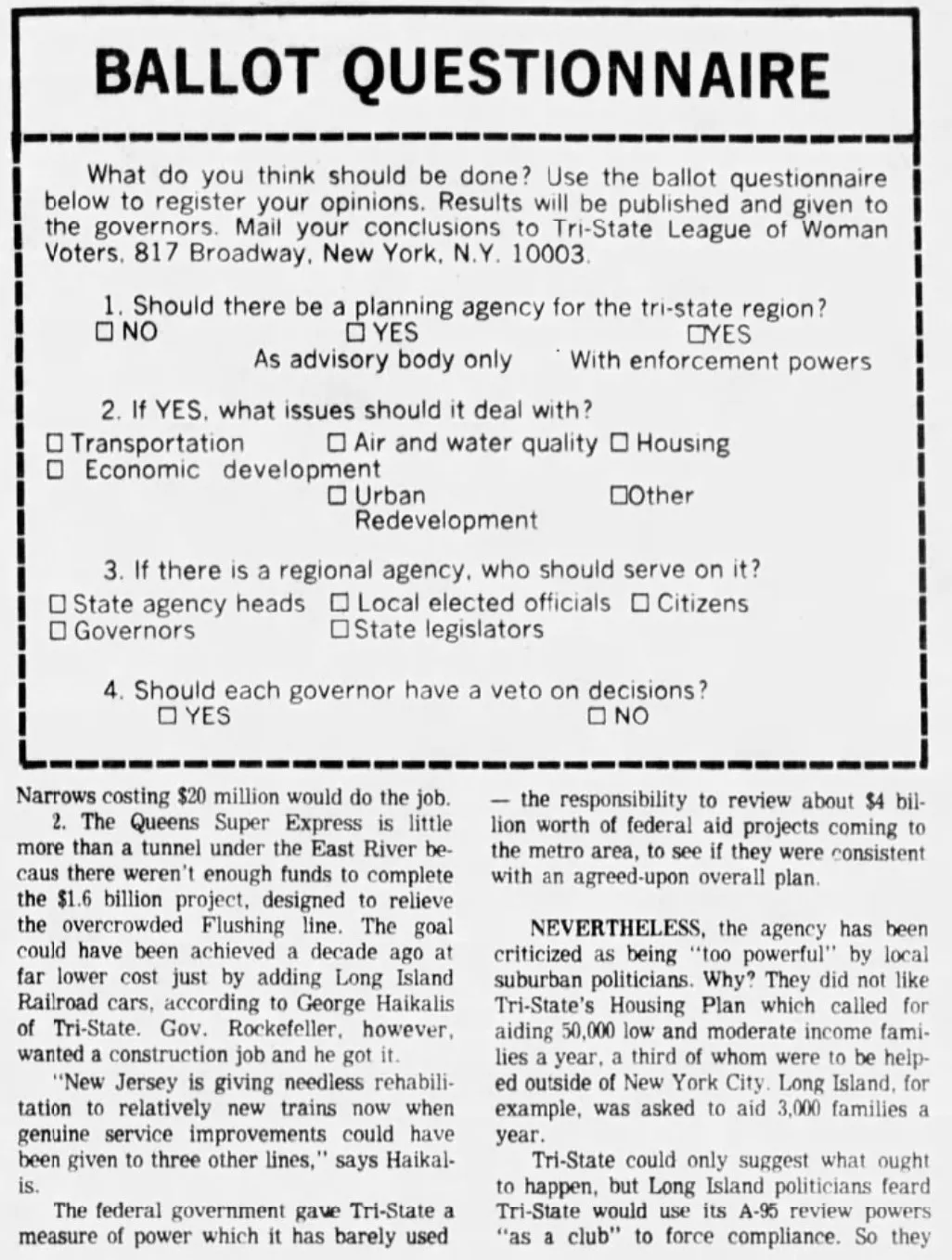
This is the last of a series of columns to be published as part of a “Tri-State Town Meeting” sponsored by the League of Women Voters. The issues in this column will be debated at 10 p.m. tonight on Channel 9. You are urged to use the accompanying ballot to register your opinions on the issues.
HOW SHOULD DECISIONS be made in the New York-New Jersey-Connecticut metropolitan area on issues that are of more than local consequence? Should the governor of each state have the final word, or should major decisions be required to fit in with a mutually-agreed upon tri-state plan? If plans reign supreme, who should make them?
That’s the issue that lies at the heart of the final and most controversial “Tri-State Town Meeting” sponsored by the League of Women Voters. For a very lively debate on the matter, tune in tonight at 10 o’clock to Channel 9 to see the issue slugged out by New York City Deputy Mayor Herman Badillo, prominent suburbanites, and planners.
The subject of tonight’s TV debate is a largely unknown agency, the Tri-State Regional Planning Commission. Various panelists will call Tri-State “inept ... impotent ... fearful of controversy.” One critic says: “After 20 years of activity, Tri-State has yet to take a public stand on any public issue.”
INDEED, ON THE DAY that the TV show was taped last week, the Tri-State Commission refused for a third consecutive meeting to explain how it could approve of the construction of Westway, when its own plan says that travel by auto, gasoline use, vehicular air pollution and congestion must all be reduced, and public transportation strengthened.
“You are violating virtually all of your own well thought-out criteria for regional growth,” charged Ruth Messinger, a New York City Councilwoman. She asked for a “full scale technical, environmental evaluation of why it would not be better to trade in” the $1.2 billion earmarked for Westway for a modest replacement road so that hundreds of millions could be spent to upgrade the subway system used by 3 million people.
Not one commissioner would defend Tri-State’s approval of Westway, but the Commission did agree to have its staff investigate the matter. That’s progress, since Tri-State’s staff has been prevented from making a comparative analysis! Why? Tri-State is dominated by state agencies who don’t want their projects reviewed seriously.
Last year’s Tri-State Chairman was William Hennessy, who also is New York’s Commissioner of Transportation, and Westway’s most ardent defender. When Ruth Messinger tried to get him to defend the agency’s OK of Westway, or to at least open the subject up for debate, he simply refused, saying “Tri-State’s opinion is irrelevant, not worth the paper it is written on.”
THE RESULT of this cynical manipulation of power is that the public gets unneeded or vastly bloated projects that both drive up taxes and prevent the public from seeing any benefits from some investments. For example:
1. The North River Pollution Control Plant was supposed to cost $100 million, but $365 million had been spent at last count simply to drive pilings into the Hudson River. Construction stopped because costs inflated to $1 billion and New York is broke — partly because the city started building sewage treatment plants for a population of 12 million, though its population has dropped to 7.2 million.
If North River is ever opened, it will still dump a million gallons of raw sewage into the Hudson when it rains. So the facility won’t open any of the 15 miles of beaches in New York and New Jersey closed due to pollution. However a simple dike built in Narrows costing $20 million would do the job.
2. The Queens Super Express is little more than a tunnel under the East River because there weren’t enough funds to complete the $1.6 billion project, designed to relieve the overcrowded Flushing line. The goal could have been achieved a decade ago at far lower cost just by adding Long Island Railroad cars, according to George Haikalis of Tri-State. Gov. Rockefeller, however, wanted a construction job and he got it.
"New Jersey is giving needless rehabilitation to relatively new trains now when genuine service improvements could have been given to three other lines," says Haikalis.
The federal government gave Tri-State a measure of power which it has barely used — the responsibility to review about $4 billion worth of federal aid projects coming to the metro area, to see if they were consistent with an agreed-upon overall plan.
NEVERTHELESS, the agency has been criticized as being "too powerful" by local suburban politicians. Why? They did not like Tri-State’s Housing Plan which called for aiding 50,000 low and moderate income families a year, a third of whom were to be helped outside of New York City. Long Island, for example, was asked to aid 3,000 families a year.
Tri-State could only suggest what ought to happen, but Long Island politicians feared Tri-State would use its A-95 review powers "as a club" to force compliance. So they pressured Gov. Carey to allow Nassau-Suffolk to provide its own A-95 review of federal aid applications. This spring, Connecticut passed laws that would permit any town to petition the General Assembly for permission to withdraw from Tri-State's jurisdiction. Another law would take away Tri-State’s right to develop plans for the metro area, if identical legislation is passed in New York and New Jersey.
In the midst of this firestorm, the three governors appointed a 15-member citizen Task Force to consider what the future of Tri-State ought to be. And the Tri-State League of Women Voters launched a series of “Tri-State Town Meetings” to see if there was any consensus on the need for regional action to deal with problems of housing, transportation, economic development, taxes and land use.
INFORMATION on the issues and on pros and cons of possible solutions was packaged in a rare collaboration of television and newspapers. An average of 250,000 people have seen the League's five panel discussions, and 10 newspapers published columns I’ve written on the same issues on the day of the broadcast. Many newspapers and TV Guide published a questionnaire for citizen response.
Local Leagues organized more than 2,500 people to participate in the Town Meetings by watching the shows, discussing the issues in small groups, and responding. Participants tended to be suburban community leaders, not a scientific sample of the population.
Nevertheless, there was substantial support for suburban changes of home rule policy:
1. By 5-1 ratios in each state, people said future development should be concentrated in the region's urban centers, rather than dispersed in suburbia. And by a 71-29 vote, participants felt responsibility to implement that decision could not be left up to individual communities, though Connecticut residents disagreed.
2. In two separate programs, two-thirds said “suburban areas should be required to assure housing and other services for workers.” Some 62 percent favored “less restrictive zoning and innovations in local building codes” to bring costs down.
3. An astonishing 98 percent (even in Connecticut) would like to see regional decision-making imposed on the splintered transportation agencies, or even a consolidation of toll roads, bus companies, rail, etc.
4. A 2-1 ratio wants to replace local property taxes for schools with some form of a statewide tax. And 71 percent favor a “tax base sharing” program that would share future growth of business properties with surrounding communities.
What kind of a tri-state body could best push for those changes? First, the Commission should represent the region itself, rather than state agencies, who will always rubber-stamp their own plans. If each Commissioner represented a million people (perhaps as defined by two Congressional Districts), they would tend to ask hard questions and demand alternative spending plans that staff would be happy to provide.
AT THE MINIMUM, Tri-State should be a center for trusted, dispassionate analysis and untrammeled debate. Even if it is granted no substantive powers Tri-State could perform a valuable service of public education. And its inquiries could save billions.
One key step to help Tri-State move toward that goal, according to Lee Koppelman, Director of Long Island's Planning Commission, is to give a five-year contract to Frank Johnson, Tri-State’s new Executive Director “who is a breath of fresh air,” he says. “That would give staff a sense of independence from short-term political pressures.”
A case can be made for giving Tri-State a veto over large capital investments, perhaps those over $100 million. However, if this step is taken, each governor should retain a veto and have a trusted aide attend all meetings.