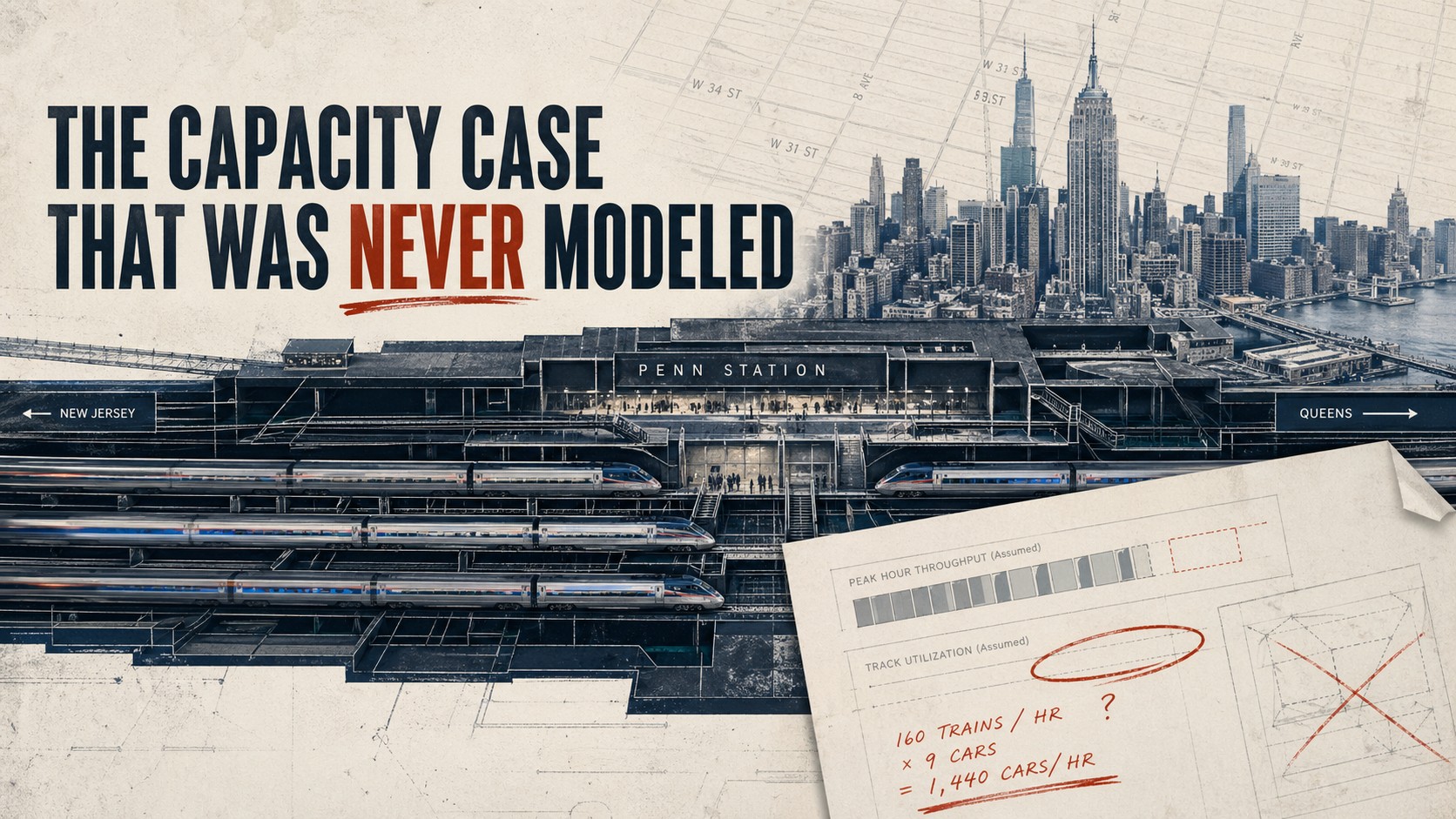
The Capacity Case That Was Never Modeled
Executive Overview
The Headline, in Brief
The Regional Plan Association's April 2026 report concludes that converting Penn Station entirely to revenue-to-revenue through-running within its existing footprint would likely reduce regional rail capacity and one-seat service, and that meeting projected post-Gateway demand of 90 peak-direction trains per hour will therefore require physical expansion somewhere in the system.[1] The report walks the reader through current operational constraints, presents dwell-time and platform-utilization parameters that yield headline capacity figures of 66 trains per hour under existing-footprint through-running and 63 trains per hour under a wider-platform variant with reduced track count, and concludes that operational reform alone cannot match the Gateway-induced tunnel capacity. The report recommends three near-term measures — special-event through-running, peak-shoulder second runs, rolling stock standardization, and through-ticketing — while reserving the central capacity question for future expansion.
The strongest technical vulnerabilities in this reasoning are concentrated in five areas: dwell-time parameters that are substantially more conservative than achieved performance at peer through-running stations and lack methodological provenance; a binary "all current vs. all through-running" framing that ignores the partial and hybrid regimes standard in international practice; the treatment of rolling stock incompatibilities, labor rules, and three-agency governance as exogenous constraints rather than as policy variables on the same horizon as physical expansion; a connectivity argument that applies a random-pairing logic that no real-world through-running system uses; and an asymmetric risk treatment in which through-running implementation challenges are foregrounded while expansion-side displacement, schedule, and disruption costs receive cursory treatment.
1. Detailed Annotated Critique
1.1 Overview Framing — "Penn Station is operating at three times its design capacity"
Penn Station is largely unchanged at track level since its creation over 115 years ago and currently operates at three times its design capacity, with 600,000 daily passengers, 1,345 trains daily, and only five of ten NJ TRANSIT branch lines providing peak one-seat rides.[1]
1.2 The 90-Trains-Per-Hour Demand Anchor
"To match the future tunnel capacity (42 trains to and from east, 48 trains to and from west) our station capacity must be able to reach 90 trains per hour in the peak direction."[1]
Modeling assumption presented as derived requirement.
This is the load-bearing quantitative claim of the entire report. The 66-tph and 63-tph through-running figures are evaluated against this 90-tph anchor and found wanting. Without this anchor, the headline conclusion does not hold.
The 90-tph figure is presented as if it were a derived demand requirement, but it is in fact a tunnel-capacity ceiling. The report conflates the engineering capacity of the tunnels with the operational requirement to use that capacity. No demand analysis is presented showing that 90 peak-direction trains will actually be required, or that such a service plan would be operationally optimal once Gateway is complete. The 24+24=48 NJ-side and 21+21=42 East-side figures are tunnel maxima, not demand-driven targets. Real-world systems generally operate below their tunnel maxima for reliability reasons.
International peer systems generally do not size station throughput to tunnel maxima. The London Crossrail/Elizabeth Line tunnel was designed for 24 trains per hour but operates at 22 to 24 in peak with reliability margins.[4] The Paris RER A operates at 30 trains per hour in the central tunnel section, well above what the Penn tunnels would carry, but the central stations are sized to handle that throughput because they were built for through-running.[5] The relevant question is not "can Penn Station match tunnel maxima" but "what is the peak service requirement implied by demand projections under various network configurations."
The 90-tph anchor is an arbitrary target dressed as a derived requirement. A demand-driven analysis would start from projected ridership patterns under various service configurations, derive the peak service plan necessary to serve those patterns at acceptable load factors and reliability levels, and then evaluate whether through-running, terminal expansion, or hybrid configurations can deliver that service. The report skips this entire analytical step.
A demand-anchored target of 70 to 80 peak-direction trains per hour, operating with 95%+ reliability and tunnel-maximum utilization across the 6–10 AM peak period rather than just the 8–9 AM peak hour, would deliver greater total person-throughput than the 90-tph peak-hour anchor. Under this target, through-running configurations move from being "72% of tunnel capacity" to being "fully sufficient with margin."
1.3 Dwell-Time Parameters — Section 3, Through-Running Scenarios
Revenue-to-revenue through-running at existing platform widths requires 6 minutes for passengers to deboard and clear the platform, 4 minutes for boarding passengers to descend and load, 2 minutes of schedule buffer, and 2.5 minutes for interlocking clearance, yielding 4 trains per track per hour and 8 trains per platform per hour. Wider platforms reduce this to 7 minutes total dwell plus 2.5 minutes interlocking clearance.[1]
Modeling assumption, presented as derived parameter.
These numbers are the second load-bearing element of the analysis. They drive the 66-tph and 63-tph headline figures.
No methodological provenance is given. The report does not cite a simulation, a peer review, an empirical observation, or an international benchmark. The parameters are simply asserted. This is the same pattern that the October 2024 WSP/FXC feasibility study followed in Appendix B, where dwell-time assumptions were similarly asserted without simulation backing.[6] The Amtrak FOIA responses from August 2025 and February 2026 confirm that no operational simulations underlie the 2024 study's dwell figures.[7][8] The April 2026 RPA report extends those figures with longer assumed dwells and provides no additional methodological foundation.
Achieved dwell times at peer through-running stations are substantially shorter:
- London Elizabeth Line at central core stations operates with station dwells of 45 to 60 seconds (45 seconds typical; 60 seconds at major interchange stations such as Paddington and Liverpool Street), with 24 trains per hour throughput.[4]
- Paris RER A at Châtelet-Les Halles operates with peak station dwells of approximately 60 to 105 seconds, with 90 seconds as an approximate peak-stress midpoint.[5]
- Munich S-Bahn Stammstrecke central stations operate with a scheduled core dwell of 30 seconds, supporting 30 trains per hour.[9]
- Zurich HB S-Bahn through-platforms operate with station dwells of approximately 55 to 60 seconds.[3]
RPA's assumed station dwell time of 12 minutes for existing-width through-running (excluding the separate 2.5-minute interlocking/safety separation that RPA adds on top) is approximately six to twelve times longer than achieved dwell performance at international peer central through-running stations.
The mechanism RPA identifies for the long dwell — that boarding passengers cannot descend until alighting passengers have completely cleared the platform — is a constraint imposed by Penn's narrow platforms and by current passenger management practices, not an immutable feature of through-running operations. International systems with comparable or higher passenger volumes do not face this constraint because their platforms are wider, their vertical circulation is differently configured, or their station design separates the two passenger flows.
The dwell-time framework conflates Penn-specific narrow-platform constraints with through-running as an operational concept. Through-running at international peer systems operates with dwell times that are a fraction of what RPA assumes. If Penn's platforms and vertical circulation are inadequate to support shorter dwells, that is an argument for investing in platform widening and vertical circulation enhancement, not an argument against through-running. The report uses Penn's current physical limitations as the parameter set for evaluating an alternative that is specifically designed to address those limitations.
Under a wider-platform configuration with modern vertical circulation, signaling, and rolling stock with high-capacity doors:
- A 3-minute revenue-to-revenue dwell (achievable at peer systems with comparable passenger volumes) plus 90-second interlocking clearance yields capacity of 13 to 14 trains per track per hour.
- Even allowing for Penn-specific complexity factors (Amtrak intercity train mix, longer commuter consists than RER trains), a 5-minute dwell plus 2-minute interlocking clearance yields 8 to 9 trains per track per hour, double the RPA figure.
1.4 Platform Utilization and Staggering — Section 2
"Two trains should not arrive on either side of a platform and have their passengers disembark simultaneously. The crowding from people standing on the platform, waiting to access the stairs and elevators prevents the next train from using the platform. However, by staggering when trains arrive on a common platform, the platforms can serve 9 trains per hour in drop-and-go operations."[1]
Engineering constraint, conditional on current platform widths and current vertical circulation.
Internally coherent given the parameter set. The report acknowledges that Platform 10, at 33 feet wide, can support pre-boarding similar to subway operations.
Platform widening is the standard international solution to this exact constraint. London's Elizabeth Line constructed new platforms 30+ feet wide specifically to enable simultaneous boarding and alighting at high throughput.[4] The October 2024 feasibility study evaluated a wider-platform configuration (Concept 2) and found it passed track geometry, constructability, and fire-life safety screening.[6] The RPA report acknowledges this configuration but evaluates it under unfavorable assumptions about track count reduction.
The "narrow platform" constraint is a constraint of Penn's current configuration, not of through-running as an operational paradigm. The report's analytical move is to take the most binding current constraint, freeze it as a parameter, and use it to argue against an operational reform whose entire point is to relax that constraint. If platform widening is feasible (as the 2024 study found), then the question is not "can through-running work with current platforms" but "what is the optimal platform configuration to support through-running, and what does that cost relative to terminal expansion?"
Evaluate platform widening as a capital project on the same time horizon as Penn South. The 2024 feasibility study's Concept 2, which decks over alternating tracks to widen platforms to 30 feet while retaining 12 through-tracks, should be evaluated under modern dwell-time assumptions rather than the assumed 10-to-12-minute dwells. Under achievable peer-system dwells, 12 wide platforms supporting 8 to 10 trains per hour each yields 96 to 120 peak-direction trains per hour, exceeding even the RPA 90-tph anchor.
1.5 The 100 Branch-to-Branch Combinations Argument
"With 10 branch lines on either side of Penn Station there are 100 branch-to-branch combinations. With through-running, the odds that the branch you started on is scheduled to continue on your destination branch are very low. Hence the connectivity upgrade would also be very low."[1]
Modeling assumption with embedded probabilistic logic.
This argument is internally inconsistent with the report's own demand analysis. Two paragraphs earlier, the report acknowledges that "the most effective utilization of through-running would be for relatively short runs making stops within the metropolitan core and then turning back" and that station pairing would be demand-driven. Yet the connectivity argument then reverts to a random-pairing logic ("the odds that the branch you started on is scheduled to continue") that no operational planner would actually deploy.
No real-world through-running system uses random branch pairing. The Paris RER pairs branches based on demand patterns, not stochastically.[5] London Thameslink pairs Bedford-Brighton, St Albans-Sutton, and similar high-demand combinations.[10] The Munich S-Bahn pairs branches based on travel-pattern analysis.[9] The "100 branch-to-branch combinations" framing is a strawman that bears no resemblance to how through-running pairings are actually planned.
Standard international practice is to identify high-demand origin-destination pairs and pair branches accordingly, with through-ticketing and timed transfers handling lower-demand pairings. A Penn through-running plan would pair, for example, Hempstead-Secaucus, Babylon-Trenton (for express service), Port Washington-Newark, and similar high-demand combinations. The "Hempstead to Gladstone" example RPA uses to dismiss connectivity is exactly the kind of pairing that no operational plan would attempt.
A demand-weighted connectivity analysis that identifies the top 20-to-30 cross-Hudson O-D pairs by ridership, evaluates which of those pairs would benefit from one-seat rides under various pairing scenarios, and quantifies the connectivity benefit in passenger-minutes saved. This is the analysis the report would need to do in order to make a defensible connectivity claim either way.
1.6 Yard and Layover Analysis
Through-running would require additional yard capacity (40 acres in the Bronx, 46 acres in Secaucus per advocacy proposals), exceeding the land required for terminal expansion.[1]
Empirical/engineering claim with implicit normative framing.
The report compares yard land requirements unfavorably to expansion land requirements, but the comparison is incomplete. Terminal expansion at Block 780 displaces approximately 200 residents, multiple businesses, and a Gothic Revival church listed as eligible for the National Register, on a city block in central Manhattan.[11] Yard expansion at Sunnyside or in the Bronx involves industrial and railyard-adjacent parcels with very different displacement profiles. Comparing these on raw acreage alone is analytically misleading.
The acreage figures are reasonable order-of-magnitude estimates, but the report does not compare cost per acre (Manhattan core vs. Sunnyside vs. Secaucus), displacement impacts (residential vs. industrial), construction complexity (deep-cavern excavation under active tracks vs. yard construction on existing rail rights-of-way), or schedule risk.
Through-running implementations in international cities have generally relied on existing yard infrastructure plus modest peripheral expansion. Munich, Paris, and London did not require multi-acre new yard development to support through-running. The RPA framing assumes a maximalist yard requirement (full layover for all through-running trainsets) that does not match international practice.
The yard argument compares a maximalist through-running yard requirement against an idealized expansion footprint without accounting for the asymmetric costs of Manhattan core demolition versus peripheral yard expansion. Sunnyside Yards, in particular, is already a railyard; modest expansion or re-configuration is operationally and politically very different from clearing a Manhattan block. The comparison should be conducted on a cost, schedule, displacement, and risk basis, not on raw acreage.
1.7 Power Systems and Rolling Stock
NJ TRANSIT uses overhead catenary, LIRR uses third rail, and full through-running requires hybrid rolling stock or power-system conversion. Future rolling stock should be hybrid.[1]
Engineering constraint, addressable on a procurement timeline.
The constraint is real. Dual-mode rolling stock exists (Bombardier ALP-45DP, NJT Multilevel III dual-modes, various European examples) and is in active service.[12] Battery-electric multiple units with overhead pickup are emerging technology. Full power-system conversion is feasible but expensive.
International peer systems achieved through-running by either converging on a single power standard over decades (Munich S-Bahn, Paris RER), or deploying dual-mode equipment for specific corridors (various German and Swiss applications). Both paths have 10-to-30-year implementation timelines, comparable to the timeline for terminal expansion.
The report treats power-system incompatibility as a current constraint rather than as a procurement-cycle planning question. A 30-year capital plan that mandates hybrid rolling stock for all replacement procurements at NJT and LIRR, combined with selective electrification investments, would deliver fleet compatibility on a timeline that aligns with through-running implementation. This is a governance and procurement coordination problem, not a technical impossibility.
1.8 The Treatment of Hybrid and Partial Through-Running
Limited applications of revenue-to-revenue through-running could increase efficiency at the shoulder of peak periods and serve special events, and peak-shoulder "second runs" could replace deadheading.[1]
Operational recommendation.
This recommendation is significant. The report acknowledges that some through-running is operationally beneficial. But the report does not analyze a hybrid regime in which 30-50% of peak service is revenue-to-revenue through-running and the remainder is drop-and-go or load-and-go. Instead, the analysis evaluates only the binary "all through-running vs. all current operations" framings, then recommends marginal through-running expansion.
International peer systems generally operate hybrid regimes. London Thameslink runs revenue-to-revenue through-running on the central core but turns trains at peripheral terminals.[10] The Paris RER mixes through-running on the central trunk with terminal operations at peripheral stations. Munich and Zurich operate Takt-patterned schedules that combine through-running with timed connections.
The report's binary framing is the wrong question. The right question is what mix of operations maximizes capacity, connectivity, and reliability. A hybrid regime that uses revenue-to-revenue through-running for the highest-demand cross-Hudson O-D pairs, drop-and-go for lower-demand commuter flows, and selective terminal turnbacks where operationally optimal could deliver capacity exceeding either the all-current or the all-through baseline.
2. Methodology and Modeling Critique
Most Consequential Methodological ObservationNo operational simulation appears to underlie this report's capacity claims. The dwell-time figures are asserted. The throughput calculations are arithmetic derivations from those assertions. The 66-tph and 63-tph headline figures are products of assumed parameters multiplied by track counts, not outputs of a modeled operating environment.
2.1 Absence of Simulation
This stands in sharp contrast to international practice. Capacity claims at peer through-running systems are generally supported by RTC modeling (Rail Traffic Controller), Viriato timetabling simulations, or equivalent tools that capture the dynamic interactions among train movements, dwell variability, interlocking conflicts, and recovery margins.[13] A capacity analysis without such modeling is a paper-and-pencil exercise that cannot reliably distinguish between operationally robust configurations and configurations that work on paper but collapse under real-world variability.
The RPA report's reliance on asserted parameters places it in the same methodological category as the October 2024 WSP/FXC feasibility study, which was the subject of the City Club FOIA investigation that produced Amtrak's admissions that no simulations were performed.[7][8] The April 2026 report extends and reinforces the conclusions of that prior study without supplying the methodological foundation that the prior study lacked.
2.2 Absence of Sensitivity Analysis
The report presents its dwell-time and capacity figures as point estimates without ranges, sensitivity tests, or scenario variations. Real engineering analyses of station capacity routinely report capacity as a function of dwell time variability, recovery margin assumptions, mix of train types, signaling configuration, and crew change protocols. The absence of sensitivity analysis means a reader cannot evaluate whether the headline capacity figures are robust to parameter variations or whether they collapse under modest changes to the input assumptions.
2.3 The Binary Framing Problem
The report evaluates two operational regimes (all current operations and all revenue-to-revenue through-running) and ignores the hybrid regimes that international practice suggests are most likely to be optimal. This is a methodological choice with significant analytical consequences. A hybrid regime that mixes operational types based on demand patterns, time of day, and platform assignment would be evaluated through a multi-objective optimization framework, not through a binary comparison.
2.4 Asymmetric Treatment of Disruption Risk
The report assumes that through-running implementation requires significant operational disruption (yard expansion, rolling stock conversion, labor agreement renegotiation) but does not equivalently characterize the disruption risks of terminal expansion (multi-year construction in central Manhattan, displacement of 200+ residents, potential schedule slippage, neighborhood impact). The expansion alternative is described as the natural conclusion of the analysis without an equivalent risk register.
2.5 Alternative Analytical Frameworks
A more defensible methodological approach to this question would deploy:
- Robust optimization under uncertainty — Identify capacity, connectivity, and reliability outcomes that are robust across a range of dwell-time, demand, and operational assumptions.
- Scenario grids — Evaluate full through-running, hybrid regimes, and terminal expansion under common assumption sets, with sensitivity tested across the most contested parameters.
- International benchmark calibration — Calibrate Penn-specific parameters against achieved performance at peer systems, with explicit identification of which parameters are Penn-specific and which can be adjusted toward peer performance.
- Demand-pattern analysis — Drive the capacity target from projected ridership and O-D patterns rather than from tunnel maxima.
None of these frameworks is deployed in the RPA report.
3. Institutional and Political-Economy Critique
3.1 The Build Gateway Now Coalition Context
The RPA report appears under the authorship of Rachel Weinberger, Vice President for Research Strategy and the Peter W. Herman Chair for Transportation, and Joshua Berman, Campaigns Manager. RPA is identified in the report as the lead of the "Build Gateway Now coalition of civic, labor and business leaders."[1] That coalition has, since its inception, advocated for the full Gateway Program including station expansion at Penn.
This institutional positioning is relevant context for evaluating the report's framing. RPA is not a neutral technical analyst weighing through-running against expansion on the merits. RPA is a coalition manager whose institutional commitments include the expansion case. The report's conclusions align with those institutional commitments. This does not by itself invalidate the analysis, but it places a heightened burden on the methodology to demonstrate that the conclusions are derived from evidence rather than reverse-engineered from institutional preferences.
The methodological gaps identified in Section 2 — the absence of simulation, the absence of sensitivity analysis, the binary framing, the asymmetric risk treatment — are precisely the kinds of analytical choices that would be expected if a report were being constructed to support a predetermined conclusion. A more methodologically rigorous analysis would either reach a more nuanced conclusion or would provide the methodological infrastructure necessary to defend a strong conclusion against expert challenge.
3.2 The Three-Agency Status Quo as Implicit Premise
Throughout the report, the current three-agency governance structure (Amtrak, NJ TRANSIT, MTA/LIRR) is treated as an exogenous condition rather than as a policy variable. Power systems, labor agreements, ticketing systems, and operational protocols are described as constraints, but the report does not evaluate the alternative in which a unified regional rail authority is created on the same time horizon as terminal expansion.
International experience strongly suggests that successful through-running depends on governance reform. Munich's S-Bahn was created as a unified operating entity. London's Elizabeth Line operates under unified TfL governance. Paris's RER operates under unified RATP/SNCF coordination structures. The Swiss Taktfahrplan is supported by Swiss Federal Railways' unified national timetabling. None of these systems achieved through-running while maintaining the kind of fragmented inter-agency governance that currently characterizes Penn Station operations.
3.3 Asymmetric Treatment of Risk
The report treats expansion-side risks lightly while elaborating through-running-side risks at length. The Block 780 displacement, the schedule risk of multi-billion-dollar deep-cavern construction in Manhattan, the operational risk of construction phasing during continuous Penn operations, and the precedent of the failed 2022 MTA Lieber plan that consumed $74 million in taxpayer funds without producing a buildable design[14] — none of these receive equivalent analytical treatment to the rolling stock standardization, labor agreement, and yard capacity issues on the through-running side.
3.4 The Question Being Asked
The report frames its central question as "Can full revenue-to-revenue through-running within the existing footprint deliver the necessary capacity?" The answer is then "no, therefore expansion is necessary."
A more analytically appropriate question would be: "What combination of operational reforms, governance changes, rolling stock investments, platform improvements, and selective expansion delivers the highest-value Penn Station for regional riders over a 25-year horizon, evaluated against multiple objectives including capacity, connectivity, reliability, cost, displacement, and schedule risk?"
This question would not produce a binary answer. It would produce a portfolio of recommendations whose composition depends on assumptions about demand, technology, governance, and political feasibility. The RPA report's narrower question structure forecloses this analytical space and produces a binary recommendation that the underlying analysis cannot actually support.
4. Reconstructed Best-Case Through-Running Scenario
Using the same demand context (Gateway Program completion, Penn Access opening, Metro-North service to Penn, IBX coordination, regional growth), here is a plausible high-performance through-running scenario that materially contradicts the RPA conclusion.
Service Pattern
80 peak-direction trains per hour (10 per hour on each of 8 through-running platforms), with 16 trains per hour terminating at stub-end tracks 1-4 for branches that do not benefit from through-running.
Track Configuration
12 through-tracks (per ReThink Concept 2 / WSP wider-platform configuration), 4 stub-end tracks, 8 platforms widened to 30 feet to support pre-boarding.
Dwell Time Target
4 minutes revenue-to-revenue (3-minute station stop plus 1-minute schedule buffer), aligned with peer systems but conservative relative to Elizabeth Line and RER A achieved performance. Plus 90-second interlocking clearance under modern signaling.
Signaling
ETCS Level 2 or CBTC equivalent on Penn approach tracks, deployable on the same timeline as Hudson Tunnel Project completion.
Rolling Stock
Hybrid procurement mandate for all NJT and LIRR replacement orders beginning 2027, with full fleet compatibility achieved by 2045. Dual-mode equipment (ALP-45DP-class) bridging the transition.
Yard Strategy
Sunnyside expansion of approximately 25 acres (less than the 46-acre Secaucus alternative), combined with peripheral layover at Trenton, Babylon, and New Haven for end-of-line storage.
Governance
Tri-state Regional Rail Authority created via interstate compact, with binding authority over timetabling, fare integration, and rolling stock specification. Modeled on Crossrail / Elizabeth Line institutional structure.
Capacity Math
8 through-platforms × 10 trains per hour per platform = 80 peak-direction trains per hour
4 stub-end tracks × 4 trains per hour = 16 peak-direction trains per hour at stubs
Total peak-direction throughput: 96 trains per hour, exceeding the RPA 90-tph anchor.
Connectivity benefit: One-seat rides for the top 15-to-20 cross-Hudson O-D pairs, with through-ticketing and timed transfers handling lower-demand pairings.
Trade-offs and Transition Challenges
This scenario is not free. It requires capital investment in platform widening (likely $3-5 billion based on 2024 study screening cost ranges), hybrid rolling stock procurement premium of approximately 15-25% over single-mode equipment, Sunnyside Yard expansion (approximately 25 acres on existing rail-adjacent parcels), governance reform via interstate compact (politically challenging, 3-7 year timeline), and signaling modernization (likely $1-2 billion, potentially eligible for federal funding). Total capital requirement: likely in the $8-12 billion range, compared to the $16.7 billion cited for southern expansion.
The transition timeline is comparable to the Penn South timeline. The displacement is substantially lower (zero residential displacement in central Manhattan). The construction risk is staged and reversible.
"This scenario does not prove through-running is the right answer. It demonstrates that the RPA report's no-go conclusion depends on specific, contestable assumptions."5. Synthesis and Recommendations
5.1 Ranked Weaknesses (Most to Least Consequential)
- The dwell-time parameters lack methodological provenance and diverge sharply from international peer-system performance. This is the single most contestable element of the report and the element on which the headline conclusions most heavily depend.
- The 90-trains-per-hour capacity anchor is a tunnel maximum dressed as a derived demand requirement. The report does not establish that this target is operationally optimal or demand-driven.
- The binary "all current vs. all through-running" framing forecloses analysis of hybrid regimes that international practice suggests are most likely to be optimal.
- The connectivity argument applies a random-pairing logic that no through-running system anywhere uses, producing a structurally misleading conclusion.
- Governance reform is treated as exogenous rather than as a policy variable on the same time horizon as physical expansion. This biases the analysis against through-running, which depends on governance reform internationally.
- The treatment of risk is asymmetric. Through-running risks are elaborated; expansion risks are described in passing.
- The platform width constraint is treated as immutable rather than as a capital project to be evaluated against alternatives.
- The yard land comparison is conducted on raw acreage without cost, displacement, or schedule risk normalization.
- No simulation underlies the capacity claims. Capacity is calculated arithmetically from asserted parameters.
- No sensitivity analysis is presented. Capacity figures are point estimates without ranges or uncertainty quantification.
5.2 Required Follow-Up Analyses
A skeptical but constructive reviewer should request, before accepting RPA's conclusion:
- Independent RTC simulation of through-running scenarios at Penn under varying dwell-time, signaling, and platform-width assumptions, conducted by a party without prior advocacy commitments on either side.
- Demand-driven capacity targeting that derives the peak service plan from projected ridership rather than from tunnel maxima.
- International benchmark calibration of Penn-specific parameters against achieved performance at the Elizabeth Line, Paris RER, Munich S-Bahn, and Zurich HB.
- Hybrid regime optimization evaluating mixed operational types across tracks, time periods, and O-D pairs.
- Symmetric risk register comparing through-running-side risks against expansion-side risks.
- Governance reform scenario evaluating capacity outcomes under unified regional rail authority versus current three-agency structure.
- Phased platform-widening cost analysis comparing the capital cost of widening Penn's existing platforms against the capital cost of southern expansion.
5.3 Recommendations for Future Penn Station Studies
A balanced future study would:
- Frame the question as "what portfolio of operations, governance, rolling stock, platforms, and selective expansion maximizes regional value over 25 years," not as "can through-running alone deliver capacity."
- Evaluate at least four scenarios under common assumptions: status quo, full through-running, hybrid regime, and southern expansion.
- Include explicit governance-reform variations within each scenario.
- Use independent operational simulation (RTC, Viriato, or equivalent) for capacity claims.
- Calibrate dwell-time and headway assumptions against international peer-system achieved performance.
- Treat displacement, schedule, and disruption risks symmetrically across alternatives.
- Disclose all funding relationships among study sponsors, study authors, and advocacy coalitions whose positions are evaluated.
- Subject conclusions to independent technical peer review prior to publication.
5.4 Net Judgment on the RPA Report
The April 2026 RPA report makes an assertable conclusion (that full revenue-to-revenue through-running at the existing Penn footprint reduces capacity) without supplying the methodological infrastructure necessary to defend that conclusion against expert challenge. The headline capacity figures are derived from assumed parameters that diverge from international peer-system performance by factors of two to six, with no provenance, no sensitivity analysis, and no simulation backing. The connectivity argument applies a logic that no real-world through-running system uses. The framing forecloses hybrid regimes that international practice suggests are optimal. Governance reform is treated as exogenous when international experience treats it as foundational. The risk treatment is asymmetric.
The report is best understood not as a technical evaluation of through-running but as a position paper restating the institutional conclusion that motivated its commissioning. Its findings should not be accepted as the basis for foreclosing through-running consideration in the Penn Station Master Developer procurement, the FRA Service Optimization Study, or any subsequent NEPA evaluation. A more defensible analysis remains to be conducted, and the FRA's ongoing Service Optimization Study, conducted independently by DB ECO with FRA technical oversight, is the appropriate vehicle for that analysis.
The procurement should not conclude before that analysis is complete.Sources and Citations
- Regional Plan Association, New York Penn Station: Constraints and Considerations for Meeting Future Demand, April 2026. Authored by Rachel Weinberger and Joshua Berman. Available at rpa.org.
- East Japan Railway Company (JR East), Tokyo Station operating data. Tokyo Station handles approximately 4,000 trains per day across multiple operators (JR East, JR Central, Tokyo Metro) using coordinated through-running on the Sobu-Yokosuka and Tokaido-Ueno-Tokyo lines.
- Swiss Federal Railways (SBB), Zurich Hauptbahnhof operations data. Zurich HB operates approximately 2,915 train movements per day under the Taktfahrplan integrated timetable system. ETH research using SBB open data reports S-Bahn course dwells of approximately 55 seconds, with other service types up to 120 seconds.
- Transport for London / Crossrail Ltd. Elizabeth Line central section operates 24 trains per hour through Paddington–Whitechapel core during peak periods. Crossrail appraisal assumed 45-second dwells at most stations, 60 seconds at Paddington and Liverpool Street; current RfLI planning rules list 30-second station calls. See TfL operational performance reports.
- RATP / SNCF, Paris RER A operations. RER A central tunnel operates 30 trains per hour peak through Châtelet-Les Halles. See SETEC ITS, "Capacité de la ligne A du RER," operational analyses.
- Amtrak, MTA, NJ TRANSIT, "Doubling Trans-Hudson Train Capacity at New York Penn Station: Engineering Feasibility Study," October 2024. WSP/FXCollaborative consultants. See Appendix B for dwell-time parameters; sourced as "WSP" without simulation citation.
- Amtrak FOIA appeal denial, signed by William Herrmann, Executive Vice President and Chief Legal & Human Resources Officer, August 14, 2025. Case No. 25-FOI-00443. Quotation: "the search did not reveal any simulations or modeling data in Amtrak's possession, and the dwell times were based on publicly available data."
- Amtrak FOIA response, February 9, 2026. Case No. 26-FOI-00272. Quotation: "The work was led by MTA (and their consultant). We have no native files, operational models (because no simulations were performed) or calculation workbooks."
- Deutsche Bahn / DB Netz AG, Munich S-Bahn Stammstrecke operations. Stammstrecke central trunk operates 30 trains per hour peak with a scheduled core dwell of approximately 30 seconds. See DB Stammstrecke 2 project documentation and S-Bahn München operational data.
- Network Rail / Govia Thameslink Railway. Thameslink central core (London Bridge to St Pancras) operates 24 trains per hour peak. See Network Rail "Thameslink Programme: Capacity and Performance Final Report."
- Penn South / Penn Station Integration Technical Memorandum. St. John the Baptist Roman Catholic Church at 209 West 30th Street, constructed 1872, listed as eligible for the National Register of Historic Places. Block 780 boundaries: West 30th to West 31st Streets, Seventh to Eighth Avenues.
- Bombardier Transportation (now Alstom), ALP-45DP dual-mode locomotive specifications. NJ TRANSIT operates ALP-45DPs on Raritan Valley, Bergen, and Pascack Valley lines. Equipment supports operation under both 12.5kV/25kV AC overhead catenary and diesel propulsion.
- RTC (Rail Traffic Controller) is the industry-standard discrete-event simulation tool for North American passenger and freight rail operations, developed by Berkeley Simulation Software. Viriato is the European equivalent for timetable planning, developed by SMA und Partner AG.
- Khalifeh, Ramsey. "How the MTA lost control of the Penn Station rebuild — and $74M in the process." Gothamist, April 23, 2026. Documents that the MTA's 2022 Penn Station planning effort cost $74 million across MTA ($30M), NJ TRANSIT ($23M), and Amtrak ($21M), and ended without securing an environmental review or buildable design.
Stammstrecke
Elizabeth Line
S-Bahn
Châtelet–Les Halles
wider platforms
existing platforms
| Risk Category | Through‑Running (RPA Treatment) |
Terminal Expansion (RPA Treatment) |
|---|---|---|
| Capital Cost | ✓ Detailed discussion of yard acquisition costs | – Minimal discussion |
| Displacement Impact | ✓ Yard land requirements emphasized (40–46 acres) | – Block 780 residential displacement (200+ residents) mentioned only briefly |
| Schedule Risk | ✓ Rolling stock procurement timelines detailed | – Deep‑cavern construction schedule risks not analyzed |
| Governance Challenges | ✓ Three‑agency coordination treated as blocking constraint | – Governance requirements for expansion not discussed |
| Construction Disruption | ✓ Platform/vertical circulation modifications emphasized | – Multi‑year Manhattan construction impacts minimized |
| Operational Complexity | ✓ Dwell times, interlocking conflicts detailed | – Phased construction operational impacts not modeled |
| Precedent Risk | – Not mentioned | – Failed 2022 MTA plan ($74M loss) mentioned only in this critique |
| Reversibility | ✓ Staged implementation possible | – Irreversible displacement not discussed |
Darker shading = more analytical attention in RPA report.
This critique was prepared as a technical evaluation of the RPA April 2026 report against international best practice and contemporary research. It does not constitute a comprehensive engineering study of Penn Station alternatives. Its purpose is to identify the analytical gaps in the RPA report that a future, more rigorous study would need to close.
Empirical, with normative framing.
The "three times design capacity" framing is rhetorically powerful but does not appear in subsequent quantitative analysis. It functions as a stage-setting claim that primes the reader to accept that the station is already at its limits.
The 600,000 passengers and 1,345 trains figures are widely cited and broadly defensible. The "three times design capacity" claim derives from comparisons of current ridership against the 1910 Pennsylvania Railroad design capacity, which itself was sized for a different operational paradigm — terminal turnbacks of long-distance trains, no commuter saturation. The comparison is technically true but analytically misleading: design capacity in 1910 reflected expected dwell times and train compositions that bear no relationship to modern commuter operations.
Tokyo Station handles comparable peak intensities through coordinated through-running across multiple operators using standardized rolling stock and unified dispatching.[2] Zurich Hauptbahnhof handles roughly comparable train volumes with a smaller platform footprint through Takt-based scheduling.[3] Neither station treats its 19th-century design as a binding constraint on 21st-century operations.
The "three times design capacity" framing is precisely backwards. Penn Station is not failing because it is overcrowded relative to its 1910 design. It is failing because its 1910 design assumed terminal operations that are operationally obsolete. The diagnosis is not "the station is overwhelmed" but "the station is being operated according to a paradigm that international peers abandoned decades ago."